Send the exact assignment or rubric from your classroom and a custom sample written to it lands in 24 to 48 hours, the first one free. BHA-FPX3009 is Capella’s Healthcare Financing and Reimbursement Models course. It centers on tracing how one reimbursement model changes what a provider organization chooses to do. Searches like "bha fpx 3009 assessment 3 assignment example", "BHAFPX3009 sample paper", and "BHA-FPX3009 assessment samples" land on this page.
What BHA-FPX3009 is really about
The subject of BHA-FPX3009 is money, but the assessments are scored on behaviour. Describing fee for service, capitation, bundled payment and value-based arrangements accurately is the entry price. The marks arrive when the paper says what each does to an organization: what it rewards, what it quietly punishes, and which decisions change when the model changes. A hospital paid per admission and a hospital paid per covered life make different choices about the same patient, and a paper that can show that concretely has understood the course. One that defines the models in turn has not. That is also why definitions alone score so poorly here: they can be reproduced from any textbook, while the behavioural consequence has to be reasoned out for the organization in front of you.
The second requirement is precision about who bears risk. Every payment model is an allocation of risk between payer, provider and patient, and most confusion in student writing comes from losing track of which party is exposed. Strong submissions state the risk position plainly, then follow it into the operational consequences: what gets measured, what gets documented, what capabilities the organization has to build. Where the assessment involves a specific program or contract type, the criteria expect its actual rules rather than a general description, and current sources matter because payment rules move. Where an organization sits under several models at once, which is now common, the strongest papers say which one dominates its decisions and why the others matter less in practice.
What BHA-FPX3009’s assessments ask for
Assessments generally ask you to analyze a reimbursement model and its effect on a healthcare organization. That means explaining how payment is determined, identifying who carries the financial risk, and tracing what the organization does differently as a result. Where the criteria ask about revenue cycle, they expect the process: eligibility, coding, claim, denial, appeal, and where the leakage occurs. Comparative sections want the same dimensions applied to each model rather than separate descriptions. Most versions ask for an assessment of how the organization should prepare, which is scored on whether the preparation follows from the risk analysis. Where the criteria ask about denials, the useful analysis identifies the stage at which they originate rather than reporting the rate, since a denial created at registration is a different problem from one created in coding.
Where students lose points in BHA-FPX3009
The dominant loss is the model described and never applied, leaving a paper that is accurate and tells a manager nothing. Second is confusion about risk, where a paper says a model shifts risk to providers and then describes behaviour that only makes sense under the opposite arrangement. Third is the revenue cycle discussed as a list of steps with no point of failure identified. Marks also go for out-of-date program rules in an area that changes yearly, for comparisons that switch dimensions between models, and for recommendations that any organization under any payment model could adopt. Marks also go for papers that describe value-based arrangements as though they were a single model, when the risk each variant transfers differs enough to change what an organization should do.
The BHA-FPX3009 drawers
BHA-FPX3009 Assessment 1 reimbursement model analysis example
Assessment 1 typically explains one payment model and where the risk sits. On request, free, 24-48h.
BHA-FPX3009 Assessment 2 revenue cycle analysis example
Assessment 2 often traces a claim and finds where revenue leaks. On request, free, 24-48h.
BHA-FPX3009 Assessment 3 payment model comparison example
Assessment 3 usually weighs models against the same dimensions for one organization. On request, free, 24-48h.
Your classroom shows something else?
Capella University revises courses; assessment counts and deliverables shift between terms. Send what your classroom shows and the desk matches it exactly.
Using a BHA-FPX3009 sample the right way
Read a sample for the sentence where the incentive becomes a decision. That sentence, the one that says what the organization does differently because of how it is paid, is what the criteria are looking for and it is the part most submissions never write. Watch also how the risk position is stated before consequences are drawn. Then build your own around a model your organization actually operates under, because the operational detail is what makes the analysis concrete. Notice too how the sample keeps one organization in view throughout, which is what stops the analysis drifting back into a general account of how healthcare is paid for.
How these samples are written
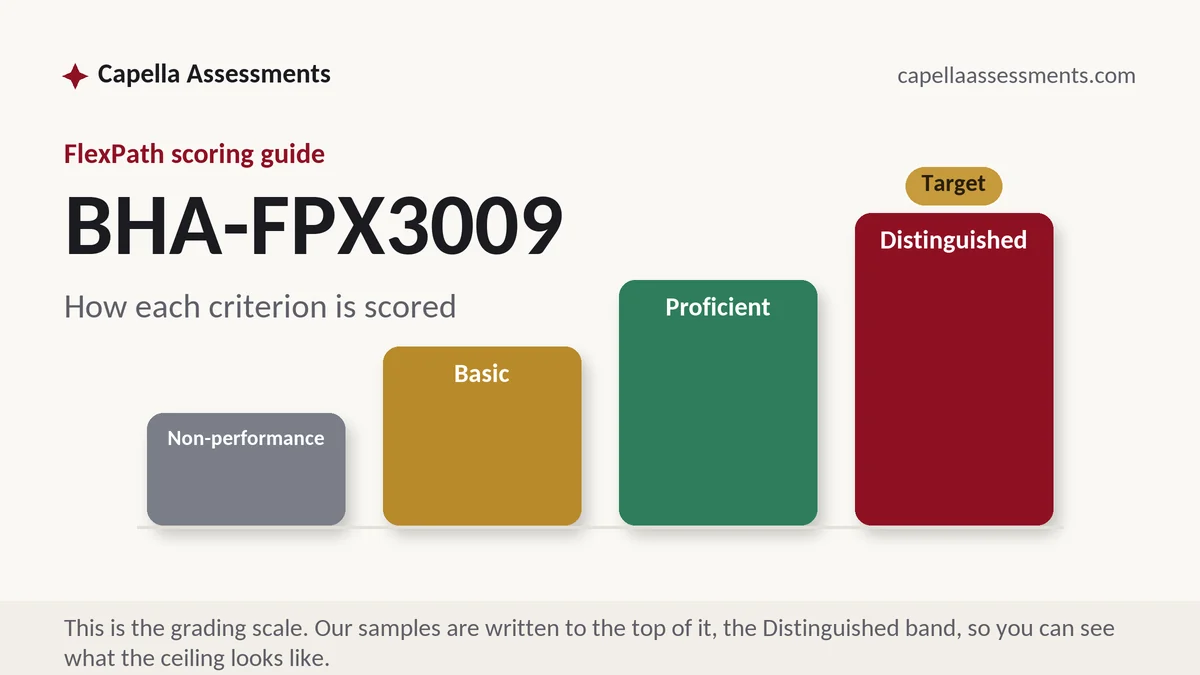
Samples here follow one discipline: the scoring guide is the outline, every criterion gets its section, the Distinguished description decides the depth, and the APA layer ships exact. Because Capella updates courses over time, your free custom sample is drafted against the scoring guide you send, not against an archive.
BHA-FPX3009 questions, answered
How current do the payment rules need to be?
Current, because they move annually. A paper describing a program under rules that have since changed reads as unreliable even where the analysis is sound. Use the most recent authoritative source you can reach and state the year the rules apply to. Where a rule changed recently, saying what it replaced shows command of the area rather than merely currency.
Do I need to cover several payment models?
Only where the instructions ask. Where they do, apply the same dimensions to each so the comparison holds together: how payment is set, who bears risk, what behaviour it rewards. Separate descriptions placed side by side rarely satisfy a comparison criterion. A single model analysed to depth usually beats three compared shallowly unless the instructions require breadth.
How do I show effect on the organization?
Name a decision that changes. Length of stay, care setting, documentation practice, staffing model, what gets measured. A consequence stated at the level of the industry is not markable; one stated as a choice somebody makes differently is. If the decision you name would be identical under a different payment model, the analysis has not landed yet.