Send the exact assignment or rubric from your classroom and a custom sample written to it lands in 24 to 48 hours, the first one free. BUS-FPX2061 is Capella’s Accounting Fundamentals course. It centers on recording business activity accurately and reading the resulting statements closely enough to say what an owner should do about them. Searches like "bus fpx 2061 assessment 3 assignment example", "BUSFPX2061 sample paper", and "BUS-FPX2061 assessment samples" land on this page.
What BUS-FPX2061 is really about
Accounting is a closed system before it is a subject, and BUS-FPX2061 is scored accordingly. Every transaction lands in two places, the trial balance either agrees or it does not, and a balance sheet that fails to balance announces an error before anybody reads a word of the analysis. That is unusual in this program, where most work is judged on the strength of an argument, and it changes how the assessment should be approached: the numbers get built and checked first, and the prose is written afterwards about figures that already hold. Students who write the discussion first and fit numbers to it produce papers where the narrative and the statements quietly disagree, which a scorer reading the totals finds quickly.
The interpretation half rests on one distinction this course exists to install: profit is not cash. A business can record its best month and still be unable to pay for anything, because revenue is recognized when it is earned and money arrives when a customer decides to send it. Papers treating net income as money in the account misread every statement that follows. Classification is the other recurring test, since whether something is an expense or an asset, a liability or equity, decides where it appears and what any ratio built on it means. Because this course sits early, the criteria also read presentation: headings on statements, the period covered, consistent units, and citations that resolve to the reference list.
What BUS-FPX2061’s assessments ask for
Assessments generally supply transactions or a set of figures and ask you to work them through the accounting cycle. That means recording accurately, carrying the balances forward, and producing the statements the instructions name, in the format they name. Interpretation is then required rather than optional: what the statements show about liquidity, profitability and how the business is financed, said in terms an owner with no accounting background would follow. Where ratios are in scope, the criteria usually want the calculation displayed and the result compared against something, a prior period or a competitor, since a ratio standing alone means very little. Several versions add an internal control element tied to how the records are kept.
Where students lose points in BUS-FPX2061
The expensive losses here are mechanical and unambiguous: a statement that does not balance, an entry posted to the wrong side, an item classified as an asset when it was consumed in the period, a figure that appears in income and never reaches retained earnings. After those, marks go for interpretation that restates the numbers in words, telling a reader that revenue rose without saying what that means for the business. Points also go for ratios computed against nothing, for statements presented without proper headings or periods, and for treating net income as available cash, which is the single misreading this course is built to prevent and the one that most often survives it.
The BUS-FPX2061 drawers
BUS-FPX2061 Assessment 1 transaction and journal work example
Assessment 1 typically records a set of transactions and proves the balances agree. On request, free, 24-48h.
BUS-FPX2061 Assessment 2 financial statement preparation example
Assessment 2 often builds the statements and shows how each one feeds the next. On request, free, 24-48h.
BUS-FPX2061 Assessment 3 statement interpretation memo example
Assessment 3 usually explains what the figures mean to somebody running the business. On request, free, 24-48h.
Your classroom shows something else?
Capella University revises courses; assessment counts and deliverables shift between terms. Send what your classroom shows and the desk matches it exactly.
Using a BUS-FPX2061 sample the right way
Use a sample as a worked example rather than as a reading. Follow one transaction from the entry through to the statement it lands in, checking that the totals agree at each stop, because tracing an item end to end teaches how the statements connect faster than any explanation of it. Then read the interpretation and notice how each sentence points at a figure and says what an owner should do about it. Your own numbers still have to be computed, since the calculation is precisely what a scorer can verify and the part no example completes for you.
How these samples are written
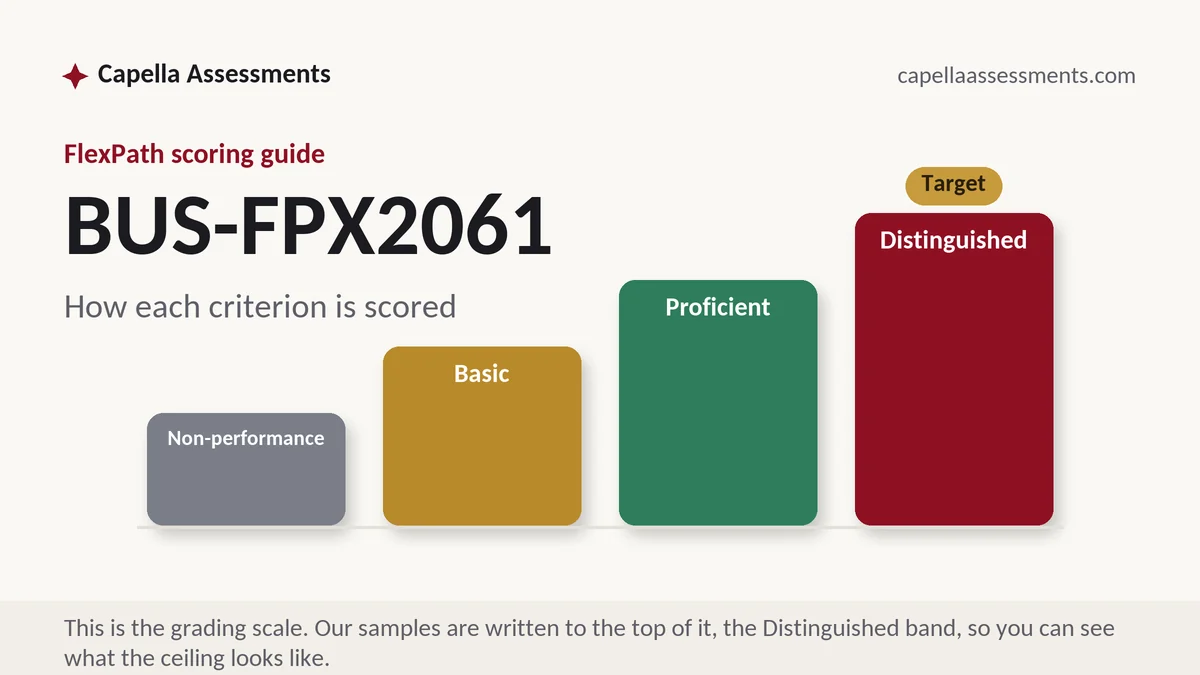
Every sample in this drawer is written the same way our custom ones are: the scoring guide decoded criterion by criterion, a subject-matched writer drafting to the Distinguished column, APA checked line by line, and the reasoning annotated so the paper teaches while it shows. Capella revises scoring guides, so a custom request is always written to the guide in YOUR courseroom, never from a stale template.
BUS-FPX2061 questions, answered
What if my balance sheet does not balance?
Find the error before writing anything else, because analysis built on unbalanced figures cannot be rescued by good prose. The difference itself is usually a clue: an amount equal to twice a transaction points at a posting on the wrong side, and one matching a single item points at something omitted. Check the entries against the source list before rebuilding the statement.
How much interpretation do the assessments want?
More than most students provide. Correct statements satisfy the accuracy criteria and leave the analysis ones open, so plan on a section saying what the figures reveal about paying bills, earning a margin and funding growth. Each sentence should name a figure and draw a consequence from it that whoever owns the business could act on this month.
Can I read a BUS-FPX2061 example before I attempt the calculations?
Yes, and reading one first is a reasonable way to see the expected format. With your instructions and scoring guide in hand the desk writes the first custom sample free, normally within 24-48h. Work through its figures rather than skimming them, then run your own data, since the numbers you were issued will differ from the ones in any example.