Send the exact assignment or rubric from your classroom and a custom sample written to it lands in 24 to 48 hours, the first one free. BUS-FPX3050 is Capella’s Fundamentals of Organizational Communication course. It centers on producing an actual workplace message and defending its channel, its ordering and what it does to the person receiving it. Searches like "bus fpx 3050 assessment 3 assignment example", "BUSFPX3050 sample paper", and "BUS-FPX3050 assessment samples" land on this page.
What BUS-FPX3050 is really about
The reliable way to lose marks in BUS-FPX3050 is to write about communication. A paper can define the sender, the channel, the noise and the feedback loop accurately, describe a breakdown at a fictional company, and never contain a single sentence anybody would actually send. The criteria in this course want the artifact. Where the assessment involves an announcement, the announcement gets drafted. Where it involves a complaint, a refusal or a correction, the words that would go on the screen belong on the page. That is uncomfortable, because a drafted message can be judged while a described intention cannot, and the discomfort is exactly the reason the criterion exists in the first place.
Once the message is written, the analysis has something to work on, and the sharpest analysis here is about order and channel. Bad news delivered with the decision in the first line reads differently from the same decision reached at the end of a paragraph of context, and the criteria expect that choice to be argued rather than made from habit. Channel is the same decision in another form: what is said in a meeting cannot be forwarded, and what goes in email will be. Direction matters too, since a message travelling up the organization needs its summary first, while one going down usually needs the reason before the instruction.
What BUS-FPX3050’s assessments ask for
Assessments generally give you an organizational situation and ask you to communicate in it and analyze what you did. That means identifying the audience by what they already know and what they stand to lose, choosing a channel and defending it, drafting the message, then explaining the choices a reader might question. Where conflict or difficult news is the subject, the criteria usually want the harder sentence written rather than summarized. Analytical sections often ask about barriers, answered by naming the specific one operating here instead of listing categories. Where teams or meetings are in scope, expect a question about how information moves between levels, answered with what gets lost at each pass.
Where students lose points in BUS-FPX3050
The dominant loss is the essay about communication where a message was requested. Second is the audience described by job title alone, with nothing about what they believe, fear or have already been told, which leaves every later choice unjustifiable. Third is a draft written in the writer's own vocabulary rather than the reader's, full of terms the recipient would have to decode. Marks also go for a channel chosen by convention, for barriers listed from a textbook rather than located in this situation, for tone claimed as professional and courteous rather than demonstrated in the draft, and for mechanical errors inside the message itself, which cost twice because the artifact is the evidence.
The BUS-FPX3050 drawers
BUS-FPX3050 Assessment 1 audience and message analysis example
Assessment 1 typically drafts one workplace message and defends the channel behind it. On request, free, 24-48h.
BUS-FPX3050 Assessment 2 difficult message memo example
Assessment 2 often writes the sentence a reader will not enjoy receiving. On request, free, 24-48h.
BUS-FPX3050 Assessment 3 communication evaluation example
Assessment 3 usually judges how information moved through a structure and where it thinned. On request, free, 24-48h.
Your classroom shows something else?
Capella University revises courses; assessment counts and deliverables shift between terms. Send what your classroom shows and the desk matches it exactly.
Using a BUS-FPX3050 sample the right way
Read a sample twice, once as a scorer and once as the person receiving the message. The second reading is the useful one: it shows where the draft would provoke a reply the writer did not want, which is precisely what the analysis section is supposed to anticipate. Then look at the opening sentence of the message and ask what it commits to, since the ordering decision is usually made right there. Build yours from a situation with an unwelcome element in it, because a message everybody wants to receive cannot demonstrate the judgment being assessed.
How these samples are written
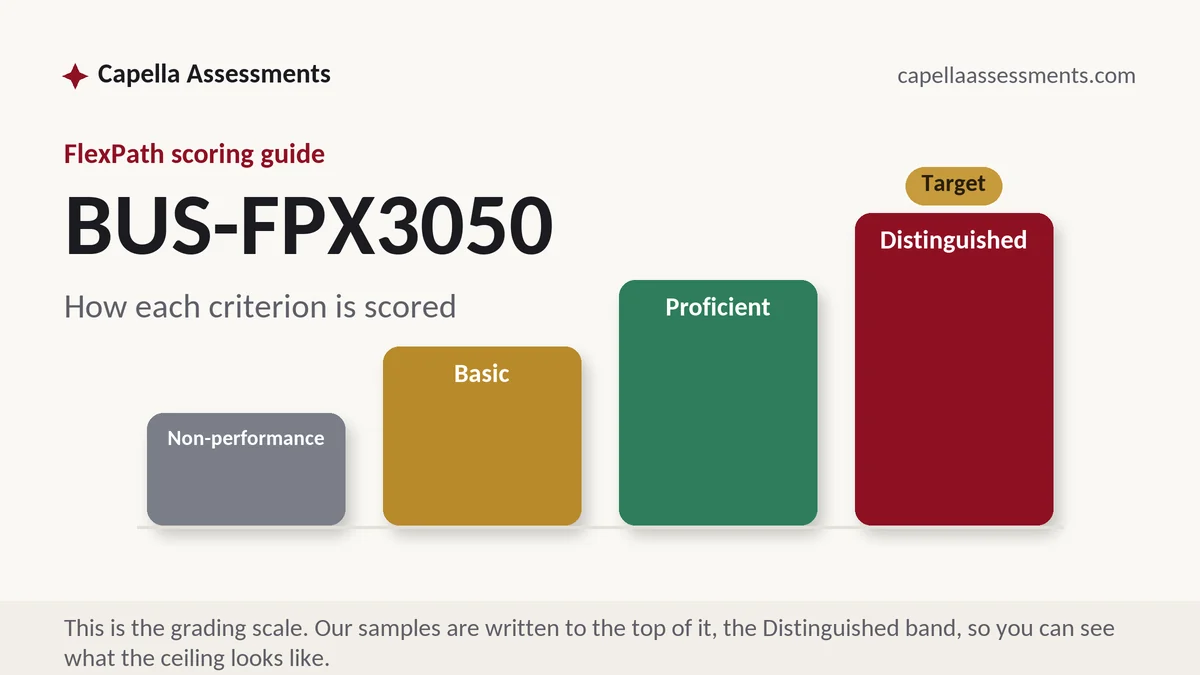
Samples here follow one discipline: the scoring guide is the outline, every criterion gets its section, the Distinguished description decides the depth, and the APA layer ships exact. Because Capella updates courses over time, your free custom sample is drafted against the scoring guide you send, not against an archive.
BUS-FPX3050 questions, answered
Do I really have to write out the whole message?
Where the assessment asks for one, yes, and it is the fastest path to the marks. A drafted memo or email can be assessed for audience fit, ordering, tone and clarity all at once. A paragraph explaining what you would say leaves each of those criteria with nothing to examine. Even a short draft of a few paragraphs gives your analysis something concrete to defend.
Can I invent the workplace situation?
If your instructions permit an invented scenario, yes, though it needs the awkwardness of a real one. A situation in which everybody agrees and nothing is at stake produces a message requiring no judgment and an analysis with nothing to explain. Include somebody who will be unhappy with the outcome, and the audience and channel sections start writing themselves almost immediately.
Can I use a BUS-FPX3050 sample as my submission?
No. Study it the way you would study a worked example: notice how the audience is analyzed, how the message is ordered and how the choices get defended, then write your own message for your own situation. What you hand in has to be yours. One built on your own scenario is free the first time, normally inside 24-48h.