Send the exact assignment or rubric from your classroom and a custom sample written to it lands in 24 to 48 hours, the first one free. BUS-FPX4011 is Capella’s Virtual Team Collaboration course. It centers on designing how a team that never meets in person will decide, hand off work and settle disagreements across time zones. Searches like "bus fpx 4011 assessment 3 assignment example", "BUSFPX4011 sample paper", and "BUS-FPX4011 assessment samples" land on this page.
What BUS-FPX4011 is really about
Distance changes what a team has to write down. In a shared office a decision can be reached in a corridor and nobody has to record it, because everyone who needed to hear it was standing there. BUS-FPX4011 removes the corridor, and the criteria are built around what has to replace it: an explicit agreement about where decisions live, how quickly a message is answered, and which channel carries which kind of traffic. Papers that treat a virtual team as an ordinary team with video attached miss this entirely. The interesting problems in the course are not technological. They are the ones created when eleven hours separate two people who need the same answer.
Trust is the other half, and the course treats it as something built by behavior rather than by introductions. A colleague seen once a quarter is judged almost entirely on whether work arrives when it was promised, so reliability carries a weight it would never carry down the hall. Assessments reward writers who follow that through to consequences: what happens the first time a deadline slips silently, who notices, and what the agreement said would happen. Culture belongs here too, since a direct refusal reads as efficient in one country and as an insult in another, and a team spanning both needs a convention rather than an assumption. Name the convention and the criteria have something to award.
What BUS-FPX4011’s assessments ask for
Assessments generally put you inside a distributed team and ask you to make it function. That means describing the team by what actually separates its members, hours, language, employer or function, then producing the agreement that answers those separations: response times, meeting rotation, where a decision is recorded and who is allowed to make it alone. Where technology is the focus, each tool has to be matched to a specific kind of exchange, with a reason a cheaper option was rejected. Conflict sections ask for a disagreement that distance made worse and for the step that would have caught it earlier. Where performance appears, expect to be asked how contribution is judged when nobody can see anybody working.
Where students lose points in BUS-FPX4011
The heaviest loss is the paper where the team could be sitting together. Nothing in it depends on distance, so the analysis would survive unchanged if everyone shared a floor. Second is the agreement written as values, a document promising respect and open communication that tells nobody when a message must be answered. Third is the tool list, four platforms named with their features and no exchange assigned to any of them. Marks also go for time zones mentioned once and never allowed to cost anything, for conflict resolved by scheduling a call, which is the answer to every question and therefore the answer to none, and for the assumption that silence means agreement.
The BUS-FPX4011 drawers
BUS-FPX4011 Assessment 1 virtual team charter example
Assessment 1 typically produces the working agreement, with response times and a decision owner named. On request, free, 24-48h.
BUS-FPX4011 Assessment 2 collaboration technology evaluation example
Assessment 2 often matches tools to exchanges and defends the one that costs more. On request, free, 24-48h.
BUS-FPX4011 Assessment 3 distributed conflict analysis example
Assessment 3 usually takes a disagreement distance made worse and finds the earlier catch. On request, free, 24-48h.
Your classroom shows something else?
Capella University revises courses; assessment counts and deliverables shift between terms. Send what your classroom shows and the desk matches it exactly.
Using a BUS-FPX4011 sample the right way
Read a sample for the parts that only exist because of distance. Find the response window, the decision record and the escalation step, since those three are what a team sharing a floor never has to write and what the criteria are looking for. Then check whether the conflict section names a person who lost something, because a disagreement with no loser was invented to be resolved. Build yours from a team you have actually been on, even a course group with one member in another country, since a real handoff supplies the friction that a hypothetical team will not.
How these samples are written
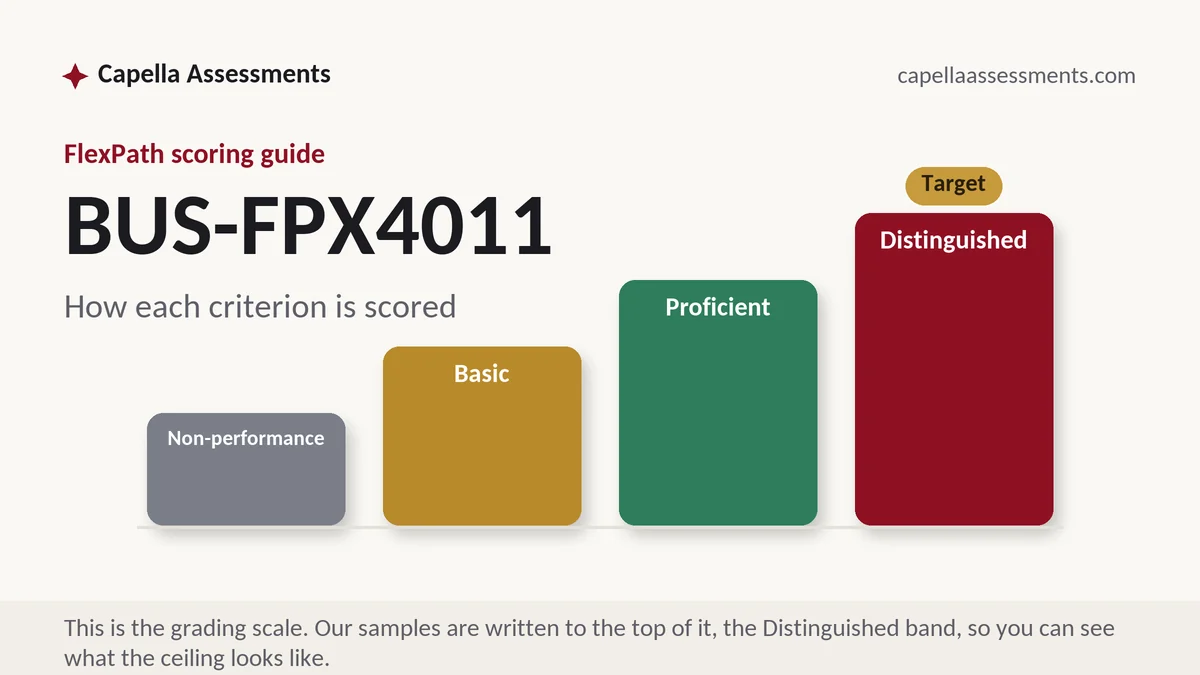
Every sample in this drawer is written the same way our custom ones are: the scoring guide decoded criterion by criterion, a subject-matched writer drafting to the Distinguished column, APA checked line by line, and the reasoning annotated so the paper teaches while it shows. Capella revises scoring guides, so a custom request is always written to the guide in YOUR courseroom, never from a stale template.
BUS-FPX4011 questions, answered
Can I write about a team from a class instead of a workplace?
Usually yes, and a course group spread across time zones is a legitimate subject if your instructions do not require an employer. What matters is that the separation is real and that you can describe a specific handoff that went wrong or nearly did. A team of three people in one city will not give the criteria anything to work with.
Do I need to name specific collaboration platforms?
Name them where you are recommending one, since a recommendation with no product in it cannot be evaluated. The scoring is not on the brand, though. It is on the match between what the tool does and the exchange you assigned it, so a plain shared document defended properly scores better than an expensive platform named without a reason.
Is there a BUS-FPX4011 Assessment 2 example I can look at?
Yes. Send the instructions and the scoring guide from your courseroom and the first custom sample costs nothing, with 24-48h the usual turnaround. Because sections frame the team differently, one built to your own version shows where your criteria put the weight, and which sections carry it, before you commit to a structure.