Send the exact assignment or rubric from your classroom and a custom sample written to it lands in 24 to 48 hours, the first one free. BUS-FPX4013 is Capella’s Organizational Structure, Learning, and Performance course. It centers on reading an organization's structure as the explanation for what it decides quickly, what it keeps relearning, and where performance stalls. Searches like "bus fpx 4013 assessment 3 assignment example", "BUSFPX4013 sample paper", and "BUS-FPX4013 assessment samples" land on this page.
What BUS-FPX4013 is really about
Most students arrive in BUS-FPX4013 able to name functional, divisional and matrix structures and unable to say what any of them does to a Tuesday. The criteria are built on that second thing. A functional structure makes deep expertise cheap and cross functional decisions expensive, so a product needing four departments to agree takes two months. A matrix gives two managers a claim on the same person, which resolves quickly when they agree and stops everything when they do not. The course asks for that level of specificity: name the structure, then follow one decision through it until you can say how long it took and who could have halted it.
Learning is the part most papers underdevelop, because it sounds like training and is not. An organization learns when something it discovered once changes what it does afterwards, which requires the discovery to reach a person with the authority to act and to survive that person leaving. Most firms fail at one of those two, and the failure is usually structural rather than personal: the information stops at a boundary, or it lives entirely in one head. Performance measurement closes the loop. A metric attached to a unit that cannot influence it produces effort in the wrong place, and the criteria reward writers who spot that mismatch before recommending a new dashboard.
What BUS-FPX4013’s assessments ask for
Each assessment hands you an organization to diagnose and a structural or systems change to propose. That means describing the current arrangement in terms of who reports to whom and what that makes slow, identifying a specific symptom, and tracing it back to an arrangement rather than to an individual. Where learning is the focus, the criteria want the mechanism named: how a lesson gets from the person who learned it to the person who needs it. Performance sections ask what is measured now, what behavior that produces, and what would change if the measure moved. Design recommendations are scored on the second order effect, meaning what the new arrangement makes harder as well as easier.
Where students lose points in BUS-FPX4013
The first loss is the textbook tour, three structures defined in sequence with the organization mentioned only as an example of one. Second is the symptom blamed on people, a paper concluding that departments should communicate better when the reporting lines are what stops them. Third is the learning section written as a training proposal, which answers a different question. Marks also go for structural charts reproduced with no analysis attached, for recommending a matrix without acknowledging that it creates two bosses, for metrics proposed with no owner, and for a redesign that solves the stated problem while quietly creating a coordination cost somewhere else, which the paper never mentions and a reader in that department would notice immediately.
The BUS-FPX4013 drawers
BUS-FPX4013 Assessment 1 structure diagnosis example
Assessment 1 typically traces one slow decision back to the arrangement that slowed it. On request, free, 24-48h.
BUS-FPX4013 Assessment 2 organizational learning analysis example
Assessment 2 often names the route a lesson has to travel and where it stops. On request, free, 24-48h.
BUS-FPX4013 Assessment 3 performance systems proposal example
Assessment 3 usually pairs a new measure with the unit that can actually move it. On request, free, 24-48h.
Your classroom shows something else?
Capella University revises courses; assessment counts and deliverables shift between terms. Send what your classroom shows and the desk matches it exactly.
Using a BUS-FPX4013 sample the right way
Read a sample by asking what each arrangement makes expensive. A good one will let you predict the symptom before the paper states it, which is the sign the diagnosis came from the structure rather than from the conclusion working backwards. Look at how the learning section names a route between two specific roles. Check that the recommendation admits a cost. Then build yours on an organization where you can actually establish who signs off on what, because that single fact carries more of the analysis in this course than any amount of published material about the industry.
How these samples are written
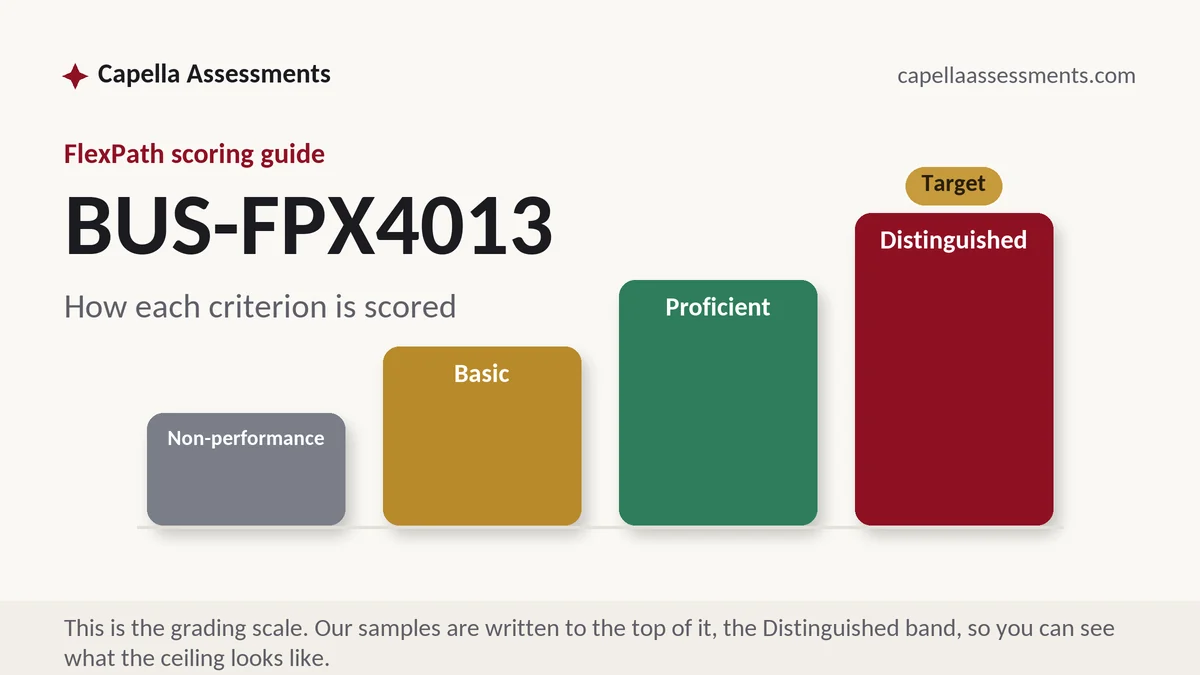
The method behind every paper on this shelf: criteria first, structure from the criteria, evidence current, APA exact, and annotations that show which paragraph answers which criterion. Send your courseroom's scoring guide with a request and the custom sample matches it exactly, revisions included.
BUS-FPX4013 questions, answered
What if my organization has no formal chart?
Then describe the arrangement as it works, which is often more useful. Who approves spending, who assigns work, who has to be told before something ships. Informal structure is still structure, and the criteria are reading whether you can identify where a decision genuinely stops, not whether you can reproduce a published diagram.
How is this different from writing about company culture?
Culture explains what people choose to do; structure explains what they are able to do. This course is mostly reading the second. Where culture belongs in your paper it works best as evidence of a structural fact, for example a habit of routing everything through one manager that tells you where authority has actually settled.
Can I get a BUS-FPX4013 sample written to my own assessment?
Yes, and that is the version worth having. Send the instructions plus the scoring guide your section uses, and the first one is free and usually ready in 24-48h. A diagnosis built on another organization is readable but it cannot show you how your criteria weight the recommendation against the analysis.