Send the exact assignment or rubric from your classroom and a custom sample written to it lands in 24 to 48 hours, the first one free. BUS-FPX4015 is Capella’s Strategic Planning and Implementation course. It centers on carrying a strategic plan through the scan and the objectives into an implementation somebody could be held to by name and date. Searches like "bus fpx 4015 assessment 3 assignment example", "BUSFPX4015 sample paper", and "BUS-FPX4015 assessment samples" land on this page.
What BUS-FPX4015 is really about
Strategic planning is the easiest business subject to write at length and the hardest to write usefully, because every term in it can be filled with air. BUS-FPX4015 pushes against that with criteria that keep asking who and when. A mission statement can be analyzed forever; an objective has to name a number and a date or it cannot be scored. The environmental scan is where most papers do their real work, and it is worth doing properly: a competitor with a name, a regulation with a date, a customer shift with evidence behind it. What the criteria will not accept is a scan assembled from adjectives about a fast changing industry.
Implementation is in the course title for a reason, and it is the half that decides most grades. A strategy that stops at recommendation has skipped the questions the criteria care about: which department does this, what does it displace, where does the money come from, and what happens in the first quarter that would tell anybody it is working. Resistance belongs here too, named as a group with something to lose rather than as a general human tendency. So do the awkward facts, since a plan that requires hiring during a freeze or capacity the operation does not have is a plan the reader can already see failing. Saying so is not weakness; it is the analysis.
What BUS-FPX4015’s assessments ask for
Each assessment moves the plan one stage further, so the work accumulates rather than repeating. Early ones establish the organization and its position, which means a scan built from named sources and an internal picture drawn from what the firm can actually do rather than from what it says about itself. Middle ones convert that into objectives, scored on whether each carries a measure, a target and a deadline. Later ones handle execution: sequencing, ownership, budget and the checkpoint that would catch a failure early. Where a framework such as a balanced scorecard is specified, the criteria want it populated with this organization's figures rather than explained. Recommendations that cannot be traced back to something the scan established are treated as unsupported.
Where students lose points in BUS-FPX4015
The largest loss is the SWOT with no consequence, four boxes filled and an analysis that proceeds as if they were empty. Second is the objective written as an intention, improve customer satisfaction and increase market share, with nothing measurable attached. Third is the implementation section that assigns work to the organization rather than to a role, so no reader can say who failed if it does not happen. Marks also go for a scan sourced entirely from the company's own materials, for financial claims with no figure behind them, for resistance acknowledged in one sentence and never addressed, and for a plan whose timeline is a list of stages with no dates on any of them.
The BUS-FPX4015 drawers
BUS-FPX4015 Assessment 1 external and internal scan example
Assessment 1 typically builds the position from named competitors, regulations and internal capacity. On request, free, 24-48h.
BUS-FPX4015 Assessment 2 strategic objectives set example
Assessment 2 often converts the scan into objectives that each carry a measure and a date. On request, free, 24-48h.
BUS-FPX4015 Assessment 3 implementation and control plan example
Assessment 3 usually assigns owners, money and the checkpoint that would catch a failure early. On request, free, 24-48h.
Your classroom shows something else?
Capella University revises courses; assessment counts and deliverables shift between terms. Send what your classroom shows and the desk matches it exactly.
Using a BUS-FPX4015 sample the right way
Read a sample backwards, from the implementation table to the scan. If you can trace each action to a specific finding, the paper is doing what this course rewards; if the actions would fit any firm in the industry, the scan was decorative and you are looking at a weak model. Watch how objectives are phrased, since that sentence pattern is worth borrowing when the content is not. Then build yours on an organization that publishes enough to be scanned, a listed company, a local employer you know from inside, because a plan for a firm you cannot investigate turns into fiction by the second section.
How these samples are written
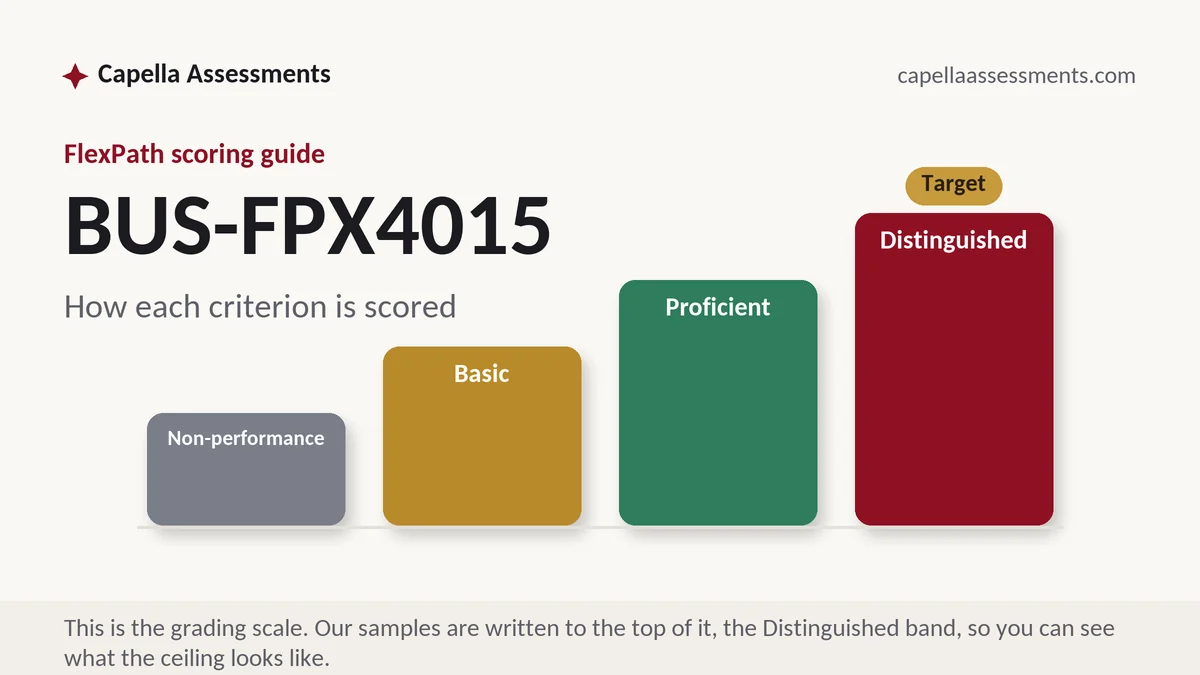
Samples here follow one discipline: the scoring guide is the outline, every criterion gets its section, the Distinguished description decides the depth, and the APA layer ships exact. Because Capella updates courses over time, your free custom sample is drafted against the scoring guide you send, not against an archive.
BUS-FPX4015 questions, answered
Do the assessments have to be about the same organization?
Usually yes, and it works in your favor. The plan is cumulative, so a scan done carefully in the first assessment keeps paying in the later ones, while a change of organization halfway through means rebuilding the foundation with less time. Check your instructions, then choose an organization you can still find material about in the final assessment.
How specific do the financial figures need to be?
Specific enough to be checked. A cost range with a stated basis satisfies the criteria; a claim that the initiative will pay for itself does not. Where you cannot obtain real numbers, published filings, industry reports and comparable projects give you a defensible order of magnitude, and saying which one you used is part of the work.
Can I see a BUS-FPX4015 sample built on my own assessment?
Yes. Send the instructions and your scoring guide and the first one is written free, normally inside 24-48h. Because this course builds across assessments, mention which stage you are at and which organization you have committed to, so the sample lands at the right point in the sequence instead of restarting the plan.