Send the exact assignment or rubric from your classroom and a custom sample written to it lands in 24 to 48 hours, the first one free. BUS-FPX4043 is Capella’s Compensation and Benefits Management course. It centers on assembling a total pay and benefits package for a real job, then justifying its cost to the employer and its value to the employee. Searches like "bus fpx 4043 assessment 3 assignment example", "BUSFPX4043 sample paper", and "BUS-FPX4043 assessment samples" land on this page.
What BUS-FPX4043 is really about
Compensation is one of the few business subjects where the reader is also the subject, and BUS-FPX4043 uses that. The criteria keep asking what an employee would understand from what you wrote. A benefits plan that makes sense to a finance department and confuses the person enrolling in it has failed a criterion, not a style preference. The course also insists on the distinction most people arrive without: legally required benefits such as social security contributions, unemployment insurance and workers compensation are not perks, and treating them as employer generosity is a factual error the scoring guide will find. Everything above that line is a choice somebody made and can be asked to defend.
The second half of the course is arithmetic with consequences. Total compensation is the wage plus everything the employer pays around it, and once that figure exists most arguments in the subject change shape: a raise looks different beside the payroll taxes attached to it, and a benefit looks cheaper when its cost per employee is set against the turnover it prevents. Assessments reward writers who carry that figure through rather than mentioning it once. Pay for performance belongs here as well, and it is the place where papers most often stop being careful, because a bonus scheme that pays for something the employee cannot control is a common design and a poor one.
What BUS-FPX4043’s assessments ask for
Most versions hand you a job or an organization and ask you to build or evaluate what it pays. That means establishing the market rate from a source you name and date, assembling the package including the employer contributions employees rarely see, and explaining the result in language the employee would follow. Where benefits are the focus, the criteria want each one costed and matched to a workforce, since a childcare subsidy and a retirement match do not appeal to the same people. Incentive sections ask what behavior the scheme actually buys. Legal compliance appears throughout rather than in one place, because pay decisions carry obligations that cannot be separated from the design.
Where students lose points in BUS-FPX4043
The most common loss is the benefits list, every offering named and none of them costed, which leaves the criteria nothing to weigh. Second is the market rate asserted, a salary recommended with no source, no date and no geography, so the number could be anything. Third is the package designed for an employee who does not exist, generous in the areas the writer values and silent about the ones this workforce would actually use. Marks also go for legally required contributions presented as benefits, for an incentive scheme with no ceiling and no measure, for cost figures that never reach a total, and for an explanation written in payroll vocabulary that no employee would decode.
The BUS-FPX4043 drawers
BUS-FPX4043 Assessment 1 total compensation analysis example
Assessment 1 typically prices the whole package, including the contributions employees never see. On request, free, 24-48h.
BUS-FPX4043 Assessment 2 benefits program evaluation example
Assessment 2 often costs each benefit and matches it to the workforce actually using it. On request, free, 24-48h.
BUS-FPX4043 Assessment 3 pay structure recommendation example
Assessment 3 usually sets pay against dated market data and defends the incentive attached. On request, free, 24-48h.
Your classroom shows something else?
Capella University revises courses; assessment counts and deliverables shift between terms. Send what your classroom shows and the desk matches it exactly.
Using a BUS-FPX4043 sample the right way
Read a sample for its totals. Find the point where the individual costs are added up, because that single figure is what turns a list into a compensation argument and it is the thing weak papers omit. Then read the employee facing section aloud; if you stumble, the criteria would too. Check that the market data carries a source and a year. Build yours around a job you can price, one you have held or one posted publicly with a range attached, since a real posting gives you a defensible starting number and removes the largest guess in the paper.
How these samples are written
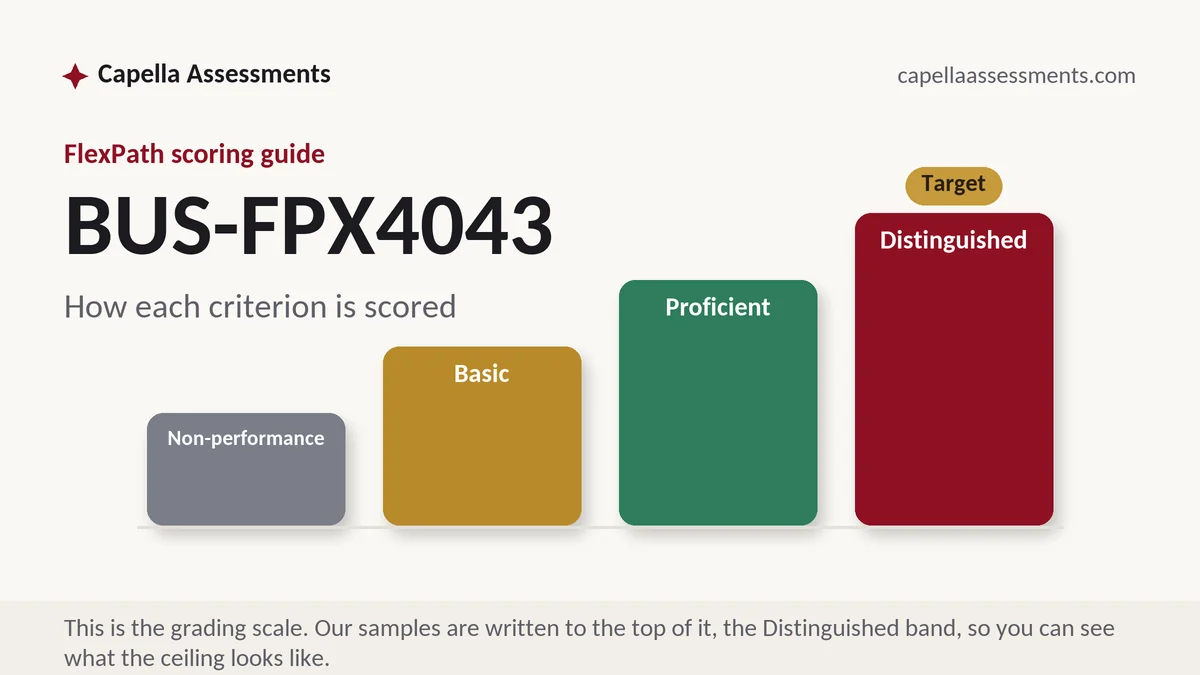
Every sample in this drawer is written the same way our custom ones are: the scoring guide decoded criterion by criterion, a subject-matched writer drafting to the Distinguished column, APA checked line by line, and the reasoning annotated so the paper teaches while it shows. Capella revises scoring guides, so a custom request is always written to the guide in YOUR courseroom, never from a stale template.
BUS-FPX4043 questions, answered
Where do I find salary data I can cite?
Government labor statistics, professional association surveys and public job postings with ranges are all defensible, and each should be named with the year and the geography attached. What weakens a paper is a single anonymous aggregator figure carrying the whole argument. Two sources that disagree are more useful than one that cannot be checked, because the gap itself is worth a paragraph.
Can I use my own employer's pay information?
Only what is public or what you are permitted to share. Actual salaries and individual records are not yours to publish in an assessment, and the criteria never require them. Describe the structure in general terms, use published market data for the numbers, and the paper works exactly as well without exposing anything confidential.
Is a BUS-FPX4043 Assessment 2 example available?
Yes, and the first one is free. Turnaround is normally 24-48h from the point your instructions and scoring guide land. Send the job or the organization your version specifies as well, since a compensation package is mostly numbers, and a package built for a different role would show you the format while leaving every figure wrong.