Send the exact assignment or rubric from your classroom and a custom sample written to it lands in 24 to 48 hours, the first one free. BUS-FPX4044 is Capella’s Legal Issues in Human Resource Management course. It centers on working out what an ordinary supervisory decision is legally allowed to be, and what has to be written down when it is made. Searches like "bus fpx 4044 assessment 3 assignment example", "BUSFPX4044 sample paper", and "BUS-FPX4044 assessment samples" land on this page.
What BUS-FPX4044 is really about
The legal HR course at this level is not preparing you to argue a case. It is preparing you to recognize the moment a routine decision acquires a legal dimension, which is where most employers actually get into trouble. A manager asking a friendly question about somebody's family in an interview, a supervisor writing a discipline note that mentions an injury, a schedule changed the day after somebody requested leave: these are the situations BUS-FPX4044 works with, and the criteria reward writers who can say precisely what is wrong with them. Naming the statute is the beginning of that answer. The rest is what the manager should have done instead.
Documentation runs through the whole course and is worth taking seriously early. Most employment disputes are decided on what was written at the time, so a performance problem recorded in vague and generous language becomes evidence that the problem did not exist. The course also teaches a habit of separation. Retaliation is a distinct claim from the complaint that preceded it, accommodation is a process rather than a yes or a no, and an at will relationship still has exceptions that decide real cases. Papers that keep these apart read as competent; papers that fold them into one general argument about fairness tend to be marked down even when the instinct behind them is right.
What BUS-FPX4044’s assessments ask for
Each assessment puts a supervisor in a situation with legal exposure and asks what happens next. That means identifying which law reaches these facts, saying which part of it applies and why, and converting that into an instruction somebody could follow on a shift. Where a policy is requested, it is scored on whether a manager reading it alone would know what to do. Training and communication sections ask you to explain an obligation to people who did not choose to learn it, which is a writing problem as much as a legal one. Where documentation appears, expect a question about what the record would have to show, and when it should have been written.
Where students lose points in BUS-FPX4044
The dominant failure is the law explained and never applied, an accurate summary of a statute with the scenario appearing only as an illustration. Second is the manager advised to consult HR, which is true, useless as an answer, and avoids everything the assessment was testing. Third is the analysis that decides the case, since the criteria are asking what the employer should do rather than who would win. Marks also go for protected characteristics listed rather than matched to the facts, for accommodation treated as a decision instead of a conversation with steps, for retaliation folded into the original complaint, and for policy language a supervisor could read twice without learning what to do.
The BUS-FPX4044 drawers
BUS-FPX4044 Assessment 1 employment law scenario analysis example
Assessment 1 typically takes one workplace moment and names the obligation it triggered. On request, free, 24-48h.
BUS-FPX4044 Assessment 2 policy or handbook section example
Assessment 2 often writes the policy a supervisor could act on without calling anybody. On request, free, 24-48h.
BUS-FPX4044 Assessment 3 manager guidance and documentation example
Assessment 3 usually turns the obligation into instructions a line manager can follow. On request, free, 24-48h.
Your classroom shows something else?
Capella University revises courses; assessment counts and deliverables shift between terms. Send what your classroom shows and the desk matches it exactly.
Using a BUS-FPX4044 sample the right way
Read a sample for the sentence that tells somebody what to do. Everything before it is analysis and everything after it is support, but that instruction is the criterion most papers miss, so find it and see how narrowly it is written. Then check how the facts are used: a strong sample returns to them repeatedly rather than describing the law and gesturing at the scenario once. Build yours from a situation with an awkward detail in it, a good employee, a difficult timing, since a clean case with an obvious answer gives the analysis nothing to do.
How these samples are written
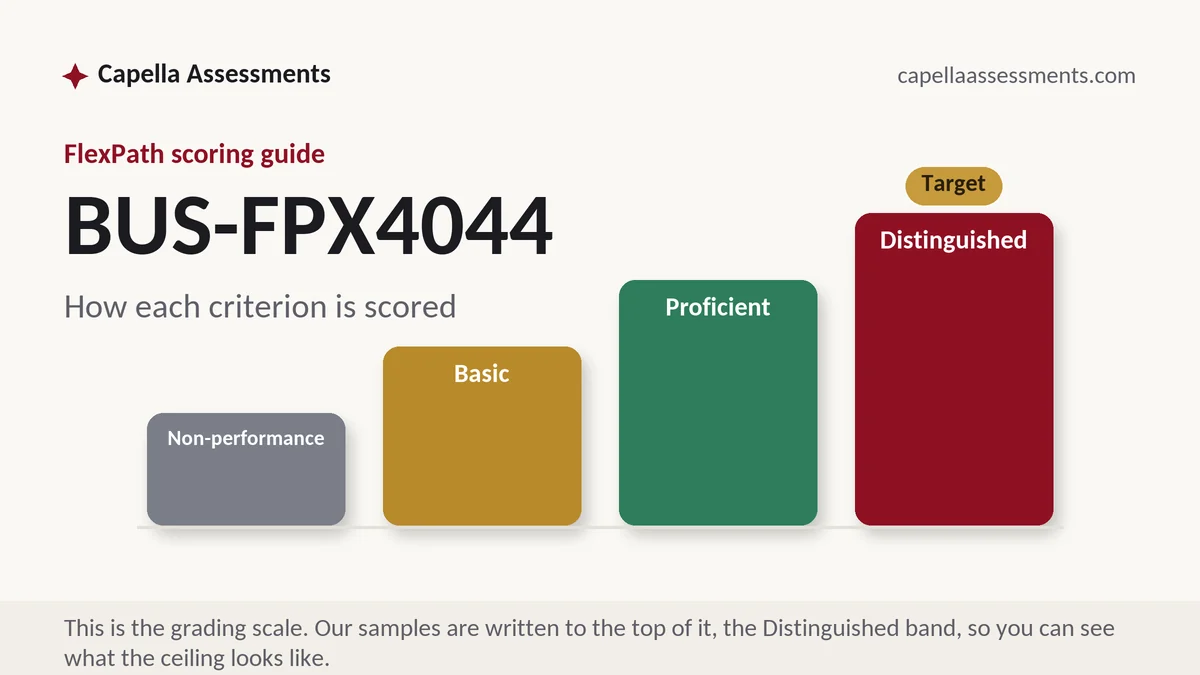
Samples here follow one discipline: the scoring guide is the outline, every criterion gets its section, the Distinguished description decides the depth, and the APA layer ships exact. Because Capella updates courses over time, your free custom sample is drafted against the scoring guide you send, not against an archive.
BUS-FPX4044 questions, answered
Do I need to cite actual court cases?
Only where your instructions ask for them. At this level the criteria are usually satisfied by the statute, the agency guidance and a clear application to the facts. Where a case does help, one decided example used properly beats a string of citations, and the value is in what the court required the employer to do rather than in the name.
Can I write about something that happened at my workplace?
Yes, with the identifying details removed and with care about anything still unresolved. Change names, blur the timing, describe the role rather than the person. What makes a real situation valuable is the awkward fact a hypothetical never has, and you can keep that while removing everything that would identify anybody involved.
How quickly can I get a BUS-FPX4044 sample?
The first custom sample is free, and it normally comes back inside 24-48h. Include the scenario your assessment supplies if there is one, because legal analysis is entirely facts driven, and a sample written against a different set of facts demonstrates the method while answering a question that is not yours.