Send the exact assignment or rubric from your classroom and a custom sample written to it lands in 24 to 48 hours, the first one free. BUS-FPX4047 is Capella’s Employee Training and Development course. It centers on designing training down to the objectives, the method and the facilitator's plan, then saying how anybody would know it worked. Searches like "bus fpx 4047 assessment 3 assignment example", "BUSFPX4047 sample paper", and "BUS-FPX4047 assessment samples" land on this page.
What BUS-FPX4047 is really about
Training proposals are easy to write and hard to write well, because the vocabulary of the subject sounds finished before any thinking has happened. BUS-FPX4047 pushes past that by asking for the level of detail a trainer would need. An objective such as understand customer service cannot be observed and therefore cannot be assessed; participants will resolve a complaint using the three step script without prompting can be. The criteria are built around that difference. Adult learning theory earns its place in the same way, not as a section reciting Knowles but as the reason a session for experienced staff starts with their own problems rather than with a definition slide.
The other half of the course is what happens after the room empties. Transfer is the honest name for the problem: people learn something on a Thursday and return to a job arranged so they cannot use it, and the training is then recorded as ineffective. Assessments reward writers who design against that, with a manager expected to ask about it, a task scheduled where the new skill is needed, or a follow up that is not another session. Evaluation belongs to the same argument. Reaction sheets measure whether people enjoyed the morning, which is worth knowing and is not evidence, and the criteria are reading whether you know the difference.
What BUS-FPX4047’s assessments ask for
The graded work moves from a need to a designed session to a way of judging it. Establishing the need means evidence, and error rates, complaints, observation notes or a supervisor's account all qualify where assumption does not. Design sections want objectives written to be observed, a method chosen against the objective rather than against fashion, and a running order with timings. Where materials are requested, the criteria expect the actual thing, a job aid, a scenario, a set of practice cases, rather than a description of what would be produced. Evaluation sections ask what you would measure, when, and what result would mean the training should be changed. Cost appears in some versions and is scored against the gap the training is meant to close.
Where students lose points in BUS-FPX4047
The failure that costs most is the program designed against a need nobody established, which is the same paper regardless of what the organization actually does. Second is the objective that cannot be observed, understand, appreciate, be aware of, which makes the evaluation section impossible before it starts. Third is the method chosen by default, a workshop proposed for something better handled by a job aid taped to a machine. Marks also go for adult learning theory named and then contradicted by the design itself, for evaluation stopping at a satisfaction survey, for timings missing so nobody can tell whether the session fits an afternoon, and for transfer left entirely to the participant.
The BUS-FPX4047 drawers
BUS-FPX4047 Assessment 1 training needs evidence example
Assessment 1 typically proves the gap is a learning problem before anything gets designed. On request, free, 24-48h.
BUS-FPX4047 Assessment 2 session design and materials example
Assessment 2 often delivers the objectives, the running order and the job aid itself. On request, free, 24-48h.
BUS-FPX4047 Assessment 3 evaluation and transfer plan example
Assessment 3 usually says what would be measured and how the skill survives the return to work. On request, free, 24-48h.
Your classroom shows something else?
Capella University revises courses; assessment counts and deliverables shift between terms. Send what your classroom shows and the desk matches it exactly.
Using a BUS-FPX4047 sample the right way
Read a sample for its objectives first, because everything else in a training paper is judged against them. If an objective names a behavior, a condition and a standard, the design and evaluation sections almost write themselves, and you will see that happening in a good sample. Then look at the running order and check that the time adds up. Build yours around something you have watched people do wrong, a process at work, a system nobody was shown properly, since a real gap gives you the evidence section for free and an invented one leaves you arguing from nothing.
How these samples are written
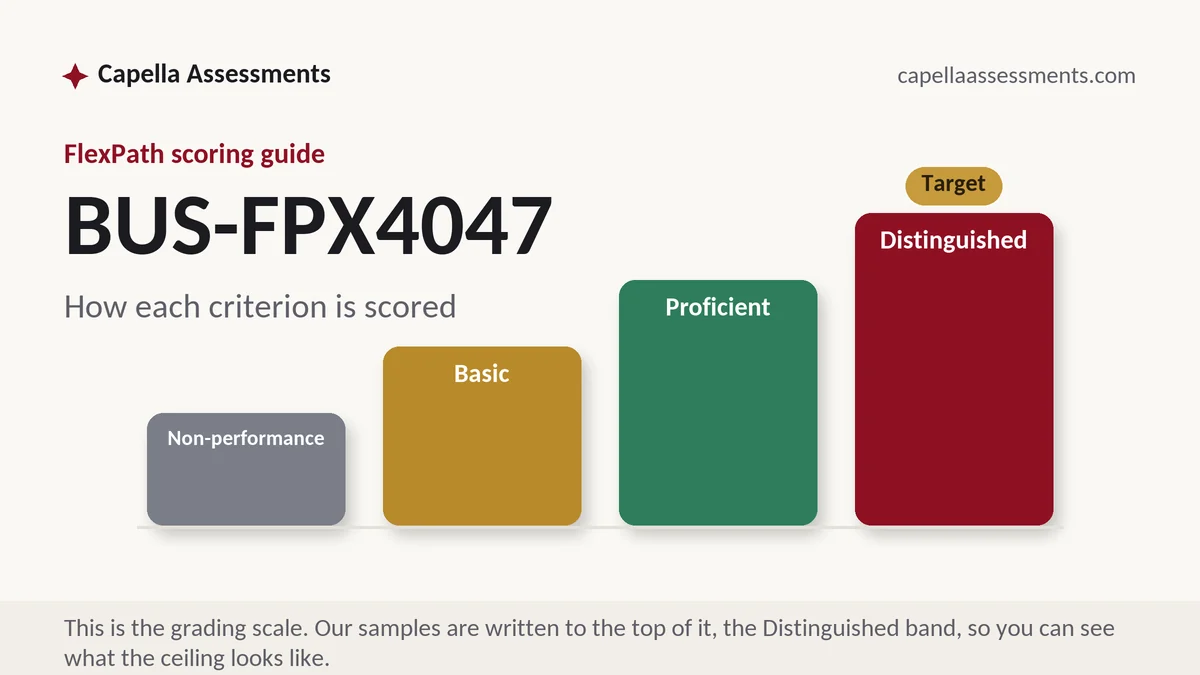
Samples here follow one discipline: the scoring guide is the outline, every criterion gets its section, the Distinguished description decides the depth, and the APA layer ships exact. Because Capella updates courses over time, your free custom sample is drafted against the scoring guide you send, not against an archive.
BUS-FPX4047 questions, answered
How detailed does the session plan have to be?
Detailed enough that somebody else could run it. That usually means timings for each segment, what the facilitator says or does, what participants produce, and the materials in hand. You do not need a script, but a plan that says discuss the material for thirty minutes has left the hardest part unwritten and the criteria will notice.
Do I have to cite adult learning theory?
Only where your instructions ask for it, and then make it do work. One principle applied visibly, experienced staff resisting content that ignores what they already know, is worth more than four theorists summarized in a paragraph. The criteria are reading whether the design reflects the theory, not whether the theory is described correctly.
Can I get a BUS-FPX4047 sample matched to my assessment?
Yes. Send your instructions and scoring guide and the first custom sample is written at no cost, generally ready in 24-48h. Mention the setting you have chosen, since a training design for a call center and one for a maintenance team differ in method, timing and materials even when the criteria behind them are identical.