Send the exact assignment or rubric from your classroom and a custom sample written to it lands in 24 to 48 hours, the first one free. BUS-FPX4060 is Capella’s Financial Accounting Principles course. It centers on reading a real company's published statements and notes the way a lender or an investor has to, with nothing internal available. Searches like "bus fpx 4060 assessment 3 assignment example", "BUSFPX4060 sample paper", and "BUS-FPX4060 assessment samples" land on this page.
What BUS-FPX4060 is really about
The distinction that organizes BUS-FPX4060 is who the statements are for. Financial accounting produces a document for people outside the business, which is why it is governed by rules rather than by usefulness: an outsider cannot ask a follow up question, so comparability has to be built into the reporting itself. That single fact explains most of what students find arbitrary about the subject. Accrual recognition, the classification rules, the disclosure requirements and the auditor's involvement all exist because the reader is a stranger. Papers that hold on to that idea tend to explain their own findings better, because they know what the reader was trying to establish and what the statement was designed to prevent.
The notes are where the marks are, and most submissions ignore them. A balance sheet reports one number for inventory; the note says which method produced it, and the method decides whether the figure is comparable to the competitor beside it. Contingent liabilities, revenue policies, lease commitments and subsequent events all live there, and any of them can change the conclusion a reader reaches from the face of the statements. Assessments in this course reward the writer who quotes a note and then uses it. The other repeated demand is arithmetic honesty: figures cited with the period attached, percentages that can be recalculated, and statements that agree with each other across the paper.
What BUS-FPX4060’s assessments ask for
Most assessments here start from a real company's published report and ask a question an outside user would ask. That means locating figures in the correct statement, computing the measures the criteria specify, and reaching a conclusion that a lender, an investor or a supplier could act on. Where accounting principles are the focus, the expectation is application: what accrual recognition did to these revenues, what a classification choice did to this ratio. Comparison sections want a competitor or a prior year, since a figure alone carries no verdict. Where the notes are in scope, the criteria are checking whether you read them, which is usually visible within a sentence. Sources are expected to be the filings themselves rather than a summary site quoting them.
Where students lose points in BUS-FPX4060
The costliest error is the figure taken from a summary site rather than from the filing, which is often wrong and always undated. Second is the analysis that stops at the calculation, a page of correct measures followed by no statement about what an outside reader should conclude. Third is the paper that never opens the notes, so a change of inventory method or a large contingency sits unmentioned underneath the whole argument. Marks also go for statements cited without a period, for percentages that do not reconcile with the figures shown, for comparisons against a company in a different business, and for conclusions phrased so cautiously that no decision could follow from them.
The BUS-FPX4060 drawers
BUS-FPX4060 Assessment 1 statement analysis from filings example
Assessment 1 typically pulls the figures from the filing itself and says where each came from. On request, free, 24-48h.
BUS-FPX4060 Assessment 2 accounting principles applied example
Assessment 2 often shows what a recognition or classification rule did to these numbers. On request, free, 24-48h.
BUS-FPX4060 Assessment 3 external user report example
Assessment 3 usually reaches a conclusion a lender or an investor could act on. On request, free, 24-48h.
Your classroom shows something else?
Capella University revises courses; assessment counts and deliverables shift between terms. Send what your classroom shows and the desk matches it exactly.
Using a BUS-FPX4060 sample the right way
Read a sample beside the filing it used. Open the same report, find the figures the writer cited, and check that they are where the paper says they are, because that habit catches the single most common error in this course before it reaches your own draft. Notice how the notes are brought in, usually as one quoted line doing a lot of work. Then choose a company for your own paper whose filings are easy to obtain and whose business you can describe in a sentence, since a conglomerate spreads the analysis across segments you have no time to untangle.
How these samples are written
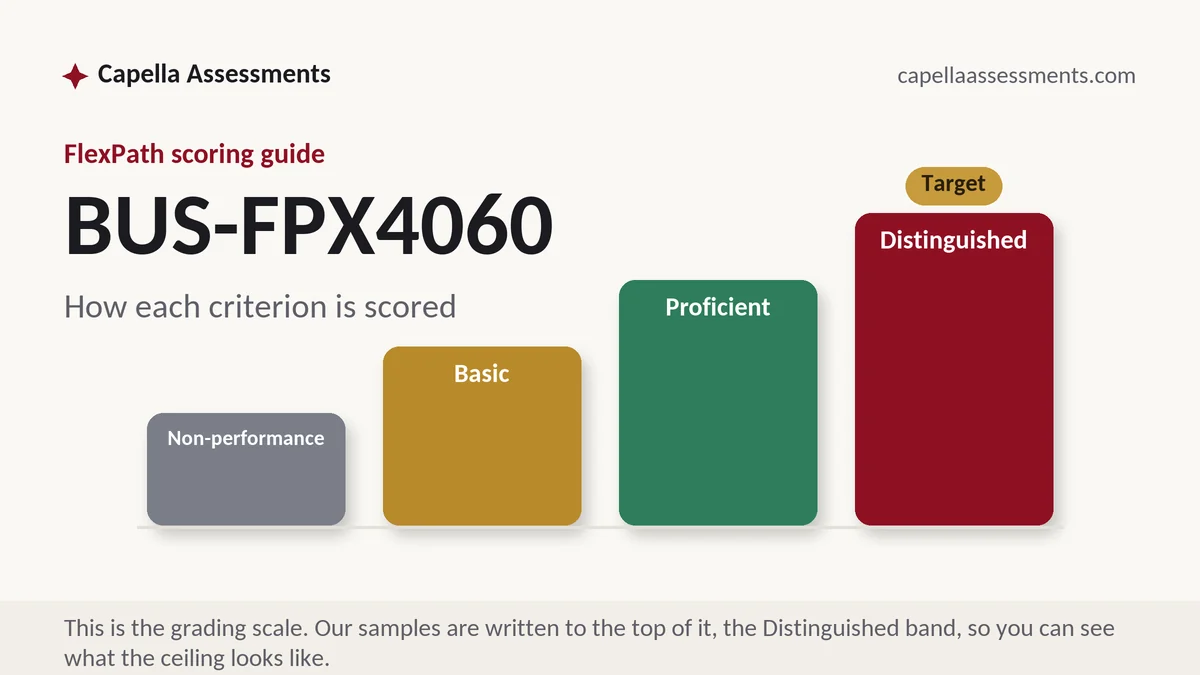
Every sample in this drawer is written the same way our custom ones are: the scoring guide decoded criterion by criterion, a subject-matched writer drafting to the Distinguished column, APA checked line by line, and the reasoning annotated so the paper teaches while it shows. Capella revises scoring guides, so a custom request is always written to the guide in YOUR courseroom, never from a stale template.
BUS-FPX4060 questions, answered
Which company should I choose?
One that files publicly, sells something you can describe simply, and has a competitor of similar size to compare against. Retailers, restaurant groups and single product manufacturers work well for that reason. Avoid financial institutions and diversified holding companies unless your instructions require them, because their statements follow conventions the course has not covered.
How much of the annual report do I actually need to read?
Less than you fear. The statements themselves, the accounting policies note, and any note bearing on the figures you are analyzing will cover most assessments. Skim the management discussion for the company's own account of a change, then verify it against the numbers, since the gap between the two is frequently the most interesting paragraph you can write.
Is there a BUS-FPX4060 Assessment 1 example I can see?
Yes. Send the instructions and the scoring guide and the first custom sample comes back free, normally within 24-48h. Tell the desk which company you have selected, because a statement analysis is inseparable from the figures it analyzes and a model built on another filing would show the method while proving nothing about yours.