Send the exact assignment or rubric from your classroom and a custom sample written to it lands in 24 to 48 hours, the first one free. BUS-FPX4064 is Capella’s Cost Accounting for Planning and Control course. It centers on costing a product or a job properly, exposing what the overhead allocation distorts, and investigating the variances that follow. Searches like "bus fpx 4064 assessment 3 assignment example", "BUSFPX4064 sample paper", and "BUS-FPX4064 assessment samples" land on this page.
What BUS-FPX4064 is really about
Direct materials and direct labor are easy to attach to a product because somebody can watch them being consumed. Everything else is the subject of BUS-FPX4064. Rent, supervision, maintenance, quality inspection and the electricity bill all have to reach a product somehow, and the route chosen decides what each product appears to cost. A plant that allocates on labor hours will report a low cost for the automated item and a high one for the handmade one, regardless of what is actually true. The criteria in this course reward writers who can see that distortion and demonstrate it, usually by recomputing the same product under a different base and showing what happened to the answer.
Control is the second word in the title and the one students leave thinnest. A standard cost is a prediction, and a variance is the difference between the prediction and what happened, which makes it the beginning of an investigation rather than the end of one. An unfavorable materials price variance can mean a buyer overpaid, or that a cheaper supplier was dropped for a reason, or that a rush order was placed because production fell behind. Assessments reward the writer who offers the plausible explanations and says which evidence would settle it. Papers that convert every variance directly into praise or blame are answering a simpler question than the one asked.
What BUS-FPX4064’s assessments ask for
A typical assessment supplies production data and asks what something cost and why. That means choosing a costing approach that suits the operation, applying it consistently, and showing the overhead route rather than presenting a total. Where activity based costing is in scope, the criteria want the drivers named and the recomputed product costs compared with the original, since the comparison is the argument. Variance sections ask for the calculation and then for the investigation: what could produce this figure, and which of those explanations the evidence supports. Where planning is the focus, budgets and standards are read for whether they could actually guide a decision next period. Consistency between the schedules and the narrative is checked closely here.
Where students lose points in BUS-FPX4064
The heaviest cost is the allocation performed without comment, a base applied because it was in the data and never defended against an alternative. Second is the variance calculated and then interpreted in one word, favorable or unfavorable, with no account of what could have produced it. Third is activity based costing described in general terms and never actually run, so the paper claims a distortion it does not demonstrate. Marks also go for job and process costing mixed within one answer, for overhead rates computed from actual figures where a predetermined rate belonged, for schedules with unlabeled columns, and for conclusions that recommend cutting a cost the analysis showed was not controllable.
The BUS-FPX4064 drawers
BUS-FPX4064 Assessment 1 product costing working example
Assessment 1 typically costs the item and shows the route every overhead dollar took. On request, free, 24-48h.
BUS-FPX4064 Assessment 2 allocation and activity analysis example
Assessment 2 often reruns the same product on a different base and compares. On request, free, 24-48h.
BUS-FPX4064 Assessment 3 variance investigation example
Assessment 3 usually treats the difference as a question and names the evidence that settles it. On request, free, 24-48h.
Your classroom shows something else?
Capella University revises courses; assessment counts and deliverables shift between terms. Send what your classroom shows and the desk matches it exactly.
Using a BUS-FPX4064 sample the right way
Read a sample for the allocation paragraph, which is short and decides everything after it. A strong one names the base, says why that base and not another, and admits what the choice distorts. Then look at how a variance is discussed: if the sample offers two or three possible causes and a way to tell them apart, it is modelling the reasoning the criteria want. Recompute one overhead rate to be sure you follow it. Build yours around an operation you can picture, since abstract cost pools produce abstract analysis and a real product gives every figure something to attach to.
How these samples are written
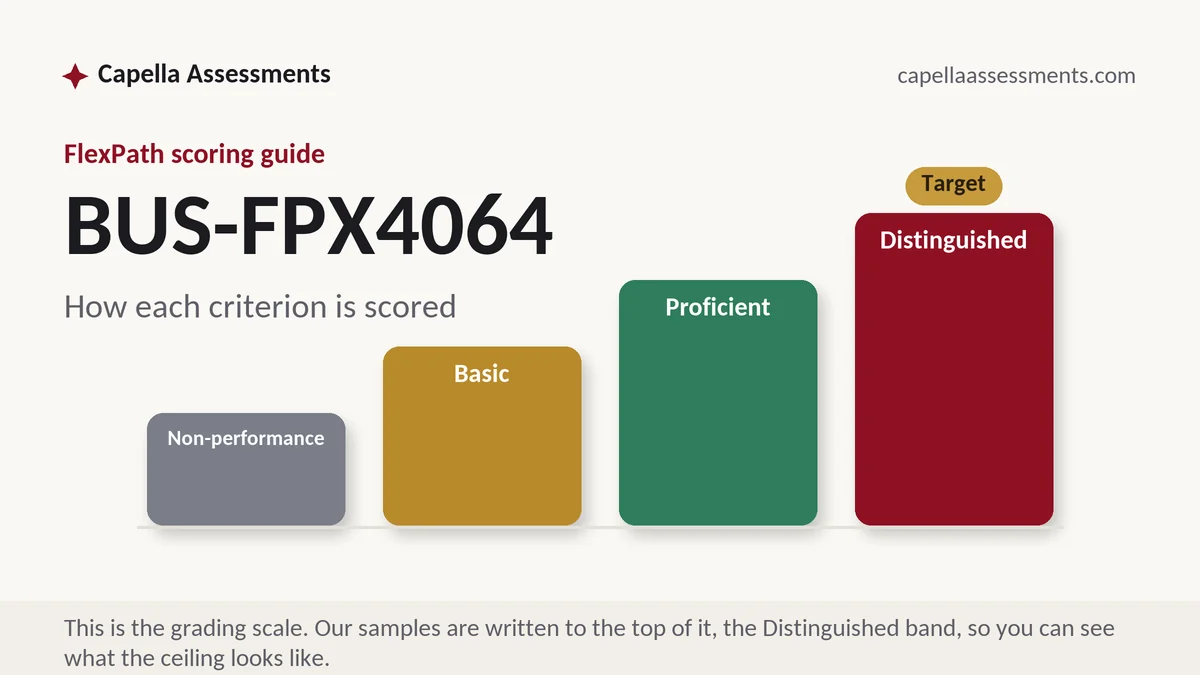
Samples here follow one discipline: the scoring guide is the outline, every criterion gets its section, the Distinguished description decides the depth, and the APA layer ships exact. Because Capella updates courses over time, your free custom sample is drafted against the scoring guide you send, not against an archive.
BUS-FPX4064 questions, answered
How do I choose between job costing and process costing?
Ask whether the units are distinguishable. A print shop producing different orders tracks costs to each job; a refinery producing identical output tracks them to a process and averages. Where an operation does both, say so and treat the parts separately rather than blending them, because a hybrid handled deliberately reads as competent while a hybrid handled accidentally reads as confusion.
Is an unfavorable variance always bad?
No, and saying so is often the strongest paragraph in the paper. Paying more for materials that cut rework or reduce scrap can be the right decision recorded as an unfavorable price variance. The criteria are reading whether you can separate the arithmetic sign from the management judgment, which is exactly the distinction the control half of the course exists to teach.
Can I see a BUS-FPX4064 example before I attempt mine?
Yes. The desk writes the first custom sample free and normally returns it inside 24-48h, working from the instructions and scoring guide you send. Include the production figures your assessment provides, because cost accounting answers are generated from the given data and a worked example on other figures teaches the layout while proving nothing about your own numbers.