Send the exact assignment or rubric from your classroom and a custom sample written to it lands in 24 to 48 hours, the first one free. CSC-FPX4030 is Capella’s Introduction to Machine Learning course. It centers on building and evaluating first machine learning models, where the grade follows the rigor of the evaluation more than the model's headline score. Searches like "csc fpx 4030 assessment 3 assignment example", "CSCFPX4030 sample paper", and "CSC-FPX4030 assessment samples" land on this page.
What CSC-FPX4030 is really about
CSC-FPX4030 introduces the machinery, regression, classification, training and testing, but the scoring guides spend most of their attention on the part beginners skip: evaluation done properly. A model that scores 95 percent means nothing until the paper says 95 percent of what, on which held-out data, against what baseline. Ninety-five on a dataset that is 95 percent one class is a coin with a sticker on it, and the criteria in current courserooms are written by people who have seen that exact submission many times. The strong paper describes its split before its results, names the metric that fits the problem, and reports the boring baseline first, because beating it is what makes the model a finding.
The other graded instinct is separating what the model found from what the world does. A classifier that predicts hospital readmission from zip code has found a correlation; the paper that says zip code causes readmission has failed a criterion that most versions state explicitly. Feature importance, leakage and overfitting all live in this gap, and the assessments are built so that a student who cannot tell learning from leaking will produce a suspiciously perfect number and then have to explain it. Sources here are the library documentation and the course texts rather than vendor marketing, and limitations sections are not politeness: naming what the dataset cannot support is often the difference between Proficient and Distinguished work.
What CSC-FPX4030’s assessments ask for
Assessments typically walk the standard pipeline: explore a dataset, prepare it, train a model or two, evaluate, and write up what happened. The write-up is where the criteria concentrate. Expect to justify the preprocessing, why these features, what was done with missing values, how the data was split, and to defend the choice of algorithm for this problem rather than in general. Evaluation sections want the metric matched to the task, accuracy where classes balance, something better where they do not, and a comparison against a baseline simple enough to embarrass an overfit model. Most versions close with interpretation and limitations, scored on whether the claims stay inside what the experiment showed, and several ask for an ethical note that works only when tied to this dataset's actual failure modes.
Where students lose points in CSC-FPX4030
The classic loss is the headline number with no context: high accuracy, no baseline, no class balance stated, no split described, which a grader reads as either leakage or luck. Second is causal language draped over correlation, the model shows that X causes Y, when the model ranked a feature. Third is preprocessing performed but never justified, rows dropped and columns scaled in silence, leaving the criterion about methodology unanswered. Marks also go for training metrics reported as results, for the algorithm chosen because a tutorial used it, for limitations sections that admit nothing specific, and for perfect scores submitted without suspicion, since in an introductory course a flawless model is almost always a leak, and noticing that is precisely the competency being assessed.
The CSC-FPX4030 drawers
CSC-FPX4030 Assessment 1 dataset exploration example
Assessment 1 typically explores and prepares a dataset with every cleaning decision justified. On request, free, 24-48h.
CSC-FPX4030 Assessment 2 model training report example
Assessment 2 often trains first models and documents the choices behind them. On request, free, 24-48h.
CSC-FPX4030 Assessment 3 evaluation writeup example
Assessment 3 usually evaluates against a baseline and keeps every claim inside the evidence. On request, free, 24-48h.
Your classroom shows something else?
Capella University revises courses; assessment counts and deliverables shift between terms. Send what your classroom shows and the desk matches it exactly.
Using a CSC-FPX4030 sample the right way
Read a sample in the order a grader does: split first, baseline second, results third. Notice how much of the paper happens before any model appears, and how the interpretation section refuses the causal sentence the results seem to invite. Then run the pipeline on a dataset of your own choosing, because the judgment calls, what to do with missing values, which metric fits, are the part that has to be practiced rather than read. Keep the sample's limitation habit: every claim carries its condition. That single habit moves more introductory machine learning grades than any amount of extra modeling.
How these samples are written
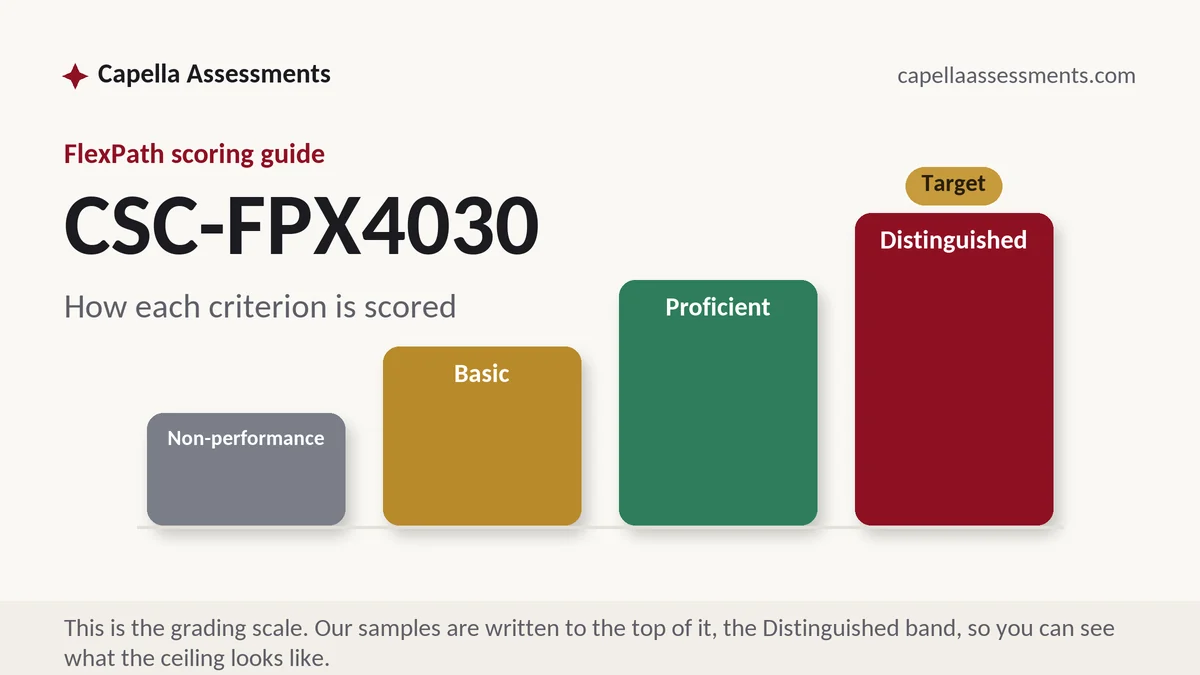
Every sample in this drawer is written the same way our custom ones are: the scoring guide decoded criterion by criterion, a subject-matched writer drafting to the Distinguished column, APA checked line by line, and the reasoning annotated so the paper teaches while it shows. Capella revises scoring guides, so a custom request is always written to the guide in YOUR courseroom, never from a stale template.
CSC-FPX4030 questions, answered
My model's accuracy is high. Why would a CSC-FPX4030 paper still lose marks?
Because accuracy is only meaningful in context. If the classes are imbalanced, a model predicting the majority class scores high while learning nothing, and the criteria expect you to catch that. State the class balance, report a metric that survives it, and compare against a trivial baseline. A modest score honestly evaluated outscores a high one that was never questioned.
How much math does this course's writing actually require?
Less than the field's reputation suggests, in most sections. The assessments want you to use the methods correctly and explain what the numbers mean, not to prove convergence. Where a formula matters, precision matters with it, but the graded core is judgment: right metric, clean split, claims that fit the evidence. Strong verbal reasoning about a correct experiment scores well.
Can I request a CSC-FPX4030 sample built on my assessment's dataset scenario?
Yes. Send your assessment instructions and scoring guide from the courseroom, including whatever dataset or scenario your section names, and a sample write-up is prepared to them, first one free, within 24-48 hours. Matching the scenario matters here because the preprocessing and metric choices that earn marks depend entirely on the data being discussed.