Send the exact assignment or rubric from your classroom and a custom sample written to it lands in 24 to 48 hours, the first one free. DB-FPX8405 is Capella’s Effective Organizational Leadership course. It centers on locating leadership in an organization's structures and systems, and defining the effectiveness any claim about it would have to demonstrate. Searches like "db fpx 8405 assessment 3 assignment example", "DBFPX8405 sample paper", and "DB-FPX8405 assessment samples" land on this page.
What DB-FPX8405 is really about
DB-FPX8405 asks about an organization, and most submissions answer about a leader. That distinction decides the marks. A paper that profiles an admired executive, however well written, has changed the unit of analysis and left the criteria unanswered, because organizational leadership lives in reporting lines, decision rights, incentive design and the habits a culture rewards. Those things outlast whoever holds the title. The assessments push toward that level deliberately, since a doctoral reader wants to know what the organization would still do if the leader left on Friday. Written at that level, a paper can explain why capable individuals produce poor collective outcomes, which is the question the course exists to raise.
Effectiveness is the second problem and it is harder than it looks. Almost every submission claims some arrangement is more effective, and very few say effective at what, measured how, over what period, and for whom. Published work in this area does not agree, and part of the assessment is showing that you know it does not: engagement, retention, financial return and stakeholder outcome pull in different directions and often against each other. Strong papers choose a definition, defend the choice against a competing one, and then stay inside it. Weak papers move between definitions as convenient, praising an organization for growth in one paragraph and for wellbeing in the next without noticing the trade.
What DB-FPX8405’s assessments ask for
Assessments generally ask you to diagnose an organization and argue what its leadership arrangements are producing. That means describing the arrangement concretely, who decides what, what gets rewarded, where information stops, and then reading published work onto it rather than around it. Where the criteria ask for a recommendation, they want it derived from the diagnosis and defended against what research says usually happens when organizations try that. Most versions expect the evidence base itself to be handled, so one paragraph that assembles several studies into a position outscores three that summarize them one at a time. Where culture is in scope, expect to be asked what observable behavior you are treating as evidence of it, since culture asserted is culture unmeasured.
Where students lose points in DB-FPX8405
The signature loss is the executive profile, a study of one leader's qualities where the criteria asked about an organization's capacity. Second is effectiveness left undefined, so the paper's central adjective carries no meaning a reader could test. Third is the literature stacked rather than combined, each study given its own paragraph and no position emerging from the pile. Marks also go for recommendations written in a consulting voice, confident, actionable and unsourced, and for culture claimed from what an organization says about itself in recruitment material. Papers also lose marks for reading a public company's results as proof of its leadership arrangements, when the same figures would be produced by a favorable market and no arrangement at all.
The DB-FPX8405 drawers
DB-FPX8405 Assessment 1 organizational diagnosis example
Assessment 1 typically describes an organization's leadership arrangements and what they are producing. On request, free, 24-48h.
DB-FPX8405 Assessment 2 leadership case analysis example
Assessment 2 often reads published work onto one organization rather than around it. On request, free, 24-48h.
DB-FPX8405 Assessment 3 effectiveness argument example
Assessment 3 usually defends a recommendation against what evidence says normally happens. On request, free, 24-48h.
Your classroom shows something else?
Capella University revises courses; assessment counts and deliverables shift between terms. Send what your classroom shows and the desk matches it exactly.
Using a DB-FPX8405 sample the right way
Use a sample to watch the unit of analysis hold. Track how often the paper names a person and how often it names a mechanism, and notice that the mechanism sentences are where the criteria are being satisfied. Then see how the definition of effectiveness is set early and never quietly swapped. Your own diagnosis should come from an organization you can see inside, kept unidentifiable, because the arrangement detail is what makes the analysis specific and it is the one part no sample can supply. The structure transfers; the organization has to be yours.
How these samples are written
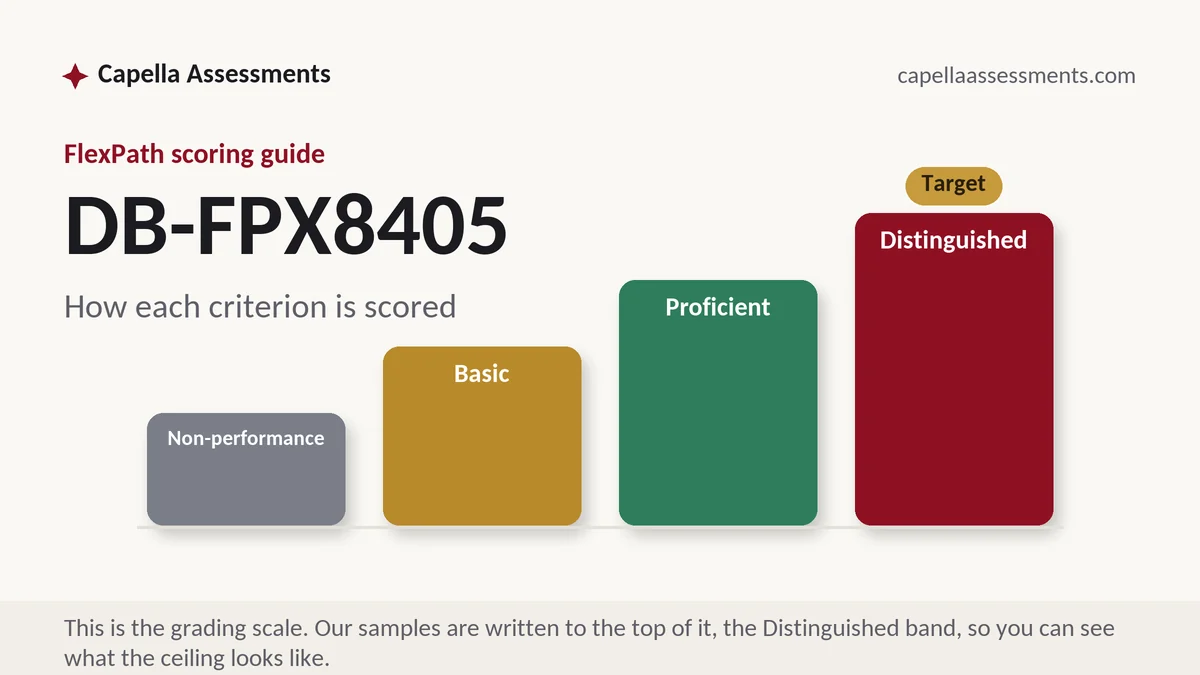
Samples here follow one discipline: the scoring guide is the outline, every criterion gets its section, the Distinguished description decides the depth, and the APA layer ships exact. Because Capella updates courses over time, your free custom sample is drafted against the scoring guide you send, not against an archive.
DB-FPX8405 questions, answered
How do I keep this from becoming a paper about my boss?
Ask what would still be true after a handover. Reporting lines, decision rights, incentive design and information flow survive a change of leader, and those are what the criteria treat as organizational leadership. Individuals can appear as evidence of how the arrangement behaves, but the claim being defended should attach to the arrangement rather than to whoever currently holds the post.
Is there a DB-FPX8405 Assessment 2 example available?
Yes. Attach the assessment instructions along with the scoring guide your courseroom issued, and the first sample is produced at no charge, normally in 24-48h and aimed at those criteria rather than at a generic outline. Use it to see how a diagnosis gets built and how published work is folded into it, then run the same method on the organization you have chosen.
How many sources does a doctoral paper like this need?
Follow your instructions where they set a number, and treat that number as a floor rather than a target. What separates submissions at this level is not the count but whether the sources speak to each other. Ten studies arranged into a position read as doctoral work. Twenty summarized in sequence read as a reading list with paragraph breaks.