Send the exact assignment or rubric from your classroom and a custom sample written to it lands in 24 to 48 hours, the first one free. DB-FPX8420 is Capella’s Teaching Business in Higher Education course. It centers on designing business instruction from published evidence about adult learning and defending a teaching position someone else could assess. Searches like "db fpx 8420 assessment 3 assignment example", "DBFPX8420 sample paper", and "DB-FPX8420 assessment samples" land on this page.
What DB-FPX8420 is really about
DB-FPX8420 exists because a doctorate is a license to teach, and most people who hold one teach the way they were taught. The course interrupts that by treating instruction as a researched activity with findings that often contradict what feels natural at the front of a room. Coverage does not produce learning. Confidence in the lecturer is a poor proxy for what students can do afterwards. Assessment shapes study behavior more powerfully than any syllabus statement about outcomes. Papers that engage those findings read as scholarship, and papers that describe an enjoyable classroom read as a personal essay with citations attached. The difference shows quickly, because a preference cannot be defended against evidence and a position can.
The second demand is alignment, which sounds procedural and turns out to be the hardest part. If an outcome says a student will evaluate a capital investment, the teaching has to give them practice evaluating one and the assessment has to require an evaluation rather than a definition. Business subjects make this concrete, since a case discussion, a spreadsheet exercise and a multiple choice quiz build very different capabilities and are frequently used interchangeably. Adult learners add a condition Knowles described decades ago and the evidence has kept refining: experienced students bring problems they want solved, and instruction that ignores what they walked in with loses them quietly rather than visibly.
What DB-FPX8420’s assessments ask for
Assessments generally ask you to design or critique instruction and justify it from published work. Expect measurable outcomes written at a level a reader could test, teaching activities that give practice in the thing an outcome names, and assessment requiring that same performance. Where the criteria ask for a teaching philosophy, they want claims with reasons and sources rather than values with adjectives. Several versions ask about the range of a class, answered concretely by saying what varies among the students you expect and what the design does about it. Where technology or online delivery is in scope, the useful question is what the mode changes about practice and feedback, since a tool adopted without that argument reads as fashion.
Where students lose points in DB-FPX8420
The dominant loss is the philosophy written as belief, a page of commitments to engagement and lifelong learning that no evidence supports and no colleague could dispute. Second is the misaligned design, where an outcome promises analysis and the assessment tests recall. Third is the source pattern of a business writer who has not read the teaching literature, citing management research about motivation where instructional research about learning was needed. Marks also go for activities described without the feedback that makes them work, for objectives written with verbs nobody could measure, and for classroom anecdotes carrying claims that need studies. Papers also lose marks for treating student satisfaction as proof of learning, which published work has repeatedly declined to support.
The DB-FPX8420 drawers
DB-FPX8420 Assessment 1 teaching philosophy statement example
Assessment 1 typically states a defended position on how business subjects should be taught. On request, free, 24-48h.
DB-FPX8420 Assessment 2 course design plan example
Assessment 2 often aligns outcomes, activities and assessment for one business subject. On request, free, 24-48h.
DB-FPX8420 Assessment 3 pedagogy literature synthesis example
Assessment 3 usually argues an instructional choice from published evidence about adult learners. On request, free, 24-48h.
Your classroom shows something else?
Capella University revises courses; assessment counts and deliverables shift between terms. Send what your classroom shows and the desk matches it exactly.
Using a DB-FPX8420 sample the right way
Read a sample by starting at its assessment and working backwards to the outcome that assessment claims to measure. If the two match, and the teaching in between gives practice at exactly that, you are looking at the alignment the criteria reward. Notice how the teaching philosophy makes claims that could be wrong, which is what separates it from a statement of values. Then build your own around a business subject you know well enough to teach, because content expertise is what lets a design get specific about where students struggle and what practice would fix it.
How these samples are written
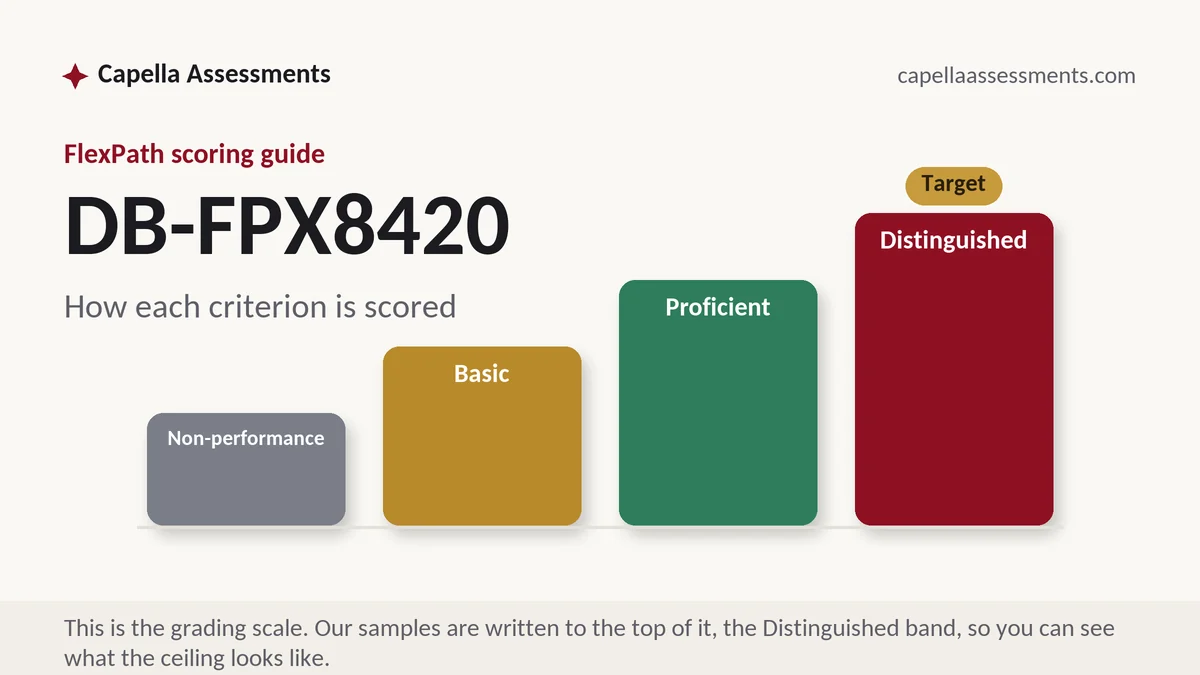
Samples here follow one discipline: the scoring guide is the outline, every criterion gets its section, the Distinguished description decides the depth, and the APA layer ships exact. Because Capella updates courses over time, your free custom sample is drafted against the scoring guide you send, not against an archive.
DB-FPX8420 questions, answered
Do I need teaching experience to write these papers?
No, and many students have none. What the criteria ask for is a design defended from published work, not a record of classroom hours. Experience helps you predict where students get stuck, and reading the instructional research substitutes for it well enough at this level. Where you draw on your own teaching, treat it as an example to be checked rather than as evidence.
Is a teaching philosophy supposed to be personal?
It is written in your voice and still has to argue. The difference between a strong one and a weak one is whether the claims could be disputed. Saying you believe in active learning commits to nothing. Saying which activities you use, for which outcomes, and what evidence supports the pairing gives a reader something to agree or disagree with.
Is there a DB-FPX8420 example of the course design assessment?
Yes, and it comes free the first time. Send your instructions and scoring guide, and the sample is built to those criteria and returned inside 24-48h, in whichever business subject your section requires. Use it to see how outcomes, activities and assessment are held in line with one another, then build the design for the subject you will actually teach.