Send the exact assignment or rubric from your classroom and a custom sample written to it lands in 24 to 48 hours, the first one free. DB-FPX8640 is Capella’s Seminar: Leadership Topic Development course. It centers on cutting a leadership concern down to a problem a study could answer, with the gap argued from published work rather than asserted. Searches like "db fpx 8640 assessment 3 assignment example", "DBFPX8640 sample paper", and "DB-FPX8640 assessment samples" land on this page.
What DB-FPX8640 is really about
Most students read the word topic and think of a subject: succession, remote supervision, executive burnout. The seminar is scored on something narrower, which is whether a concern has been cut until a study could answer it. A subject has no boundary and no verdict attached. A researchable problem names who is being studied, which construct is in question, and what would count as an answer, and it can be wrong. That difference is why capable students stall here. They arrive with a subject they care about deeply and discover that caring is not a criterion, while specifying is. The seminar spends its length on the cut, because everything downstream in the program inherits whatever survives it.
Leadership adds its own difficulty, because the field names the same behavior in several vocabularies and a topic that does not choose one inherits all of them. Writing about supportive supervision commits you to a literature; writing about servant leadership commits you to a different one with its own instruments and its own arguments, and a topic that slides between them cannot be reviewed. The second difficulty is that a leadership problem in an organization is usually a practice problem, felt as turnover or a failed rollout. The seminar keeps asking what question sits under it that published work has left open, since an employer's problem and a field's problem are related but never the same thing.
What DB-FPX8640’s assessments ask for
Assessments here typically ask for the parts of a topic in writing, one at a time, and then ask whether they agree with each other. Expect a statement of the practice problem in a real setting, a research problem that a study could take on, and a gap supported by what published work has and has not established. Where the criteria mention a population, they want the people who would actually be studied, named at a level a recruiter could work with rather than as an industry. Most sections also ask what makes the problem worth a doctorate, answered by what a field would gain rather than by what an organization would save. Feasibility usually appears somewhere, and access to senior participants is the honest place to raise it.
Where students lose points in DB-FPX8640
The first loss is the topic submitted at subject size, where leadership development in healthcare is offered as though it were a question. Second is the gap asserted, a sentence saying little research exists, written by someone who searched twice and found the search hard. Third is the construct left open, so the same paragraph borrows evidence from three named models that measure different things. Marks also go for a research problem that only an employer has, for populations described as leaders without a level, a sector or a way to reach them, and for significance claimed in the language of return on investment. Papers also lose marks when the problem, the purpose and the question drift apart, since a reader checks those three sentences against each other before reading anything else.
The DB-FPX8640 drawers
DB-FPX8640 Assessment 1 research topic brief example
Assessment 1 typically states a practice problem and the setting it was observed in. On request, free, 24-48h.
DB-FPX8640 Assessment 2 problem statement paper example
Assessment 2 often turns that situation into a question published work has left open. On request, free, 24-48h.
DB-FPX8640 Assessment 3 gap justification example
Assessment 3 usually defends the gap and names who would be studied. On request, free, 24-48h.
Your classroom shows something else?
Capella University revises courses; assessment counts and deliverables shift between terms. Send what your classroom shows and the desk matches it exactly.
Using a DB-FPX8640 sample the right way
Read a sample here backwards. Start at the research question, then check that the purpose statement above it promises exactly that and that the problem statement above both describes a situation in which the question matters. When those three sentences hold, you are looking at what the criteria reward, and the review of literature under them is doing its job rather than decorating. Then notice how small the final question is compared with the concern the paper opened with. The question you defend has to come from your own setting and reading, and any data, participants and ethics approval behind it later remain yours alone. What a sample teaches is the cut.
How these samples are written
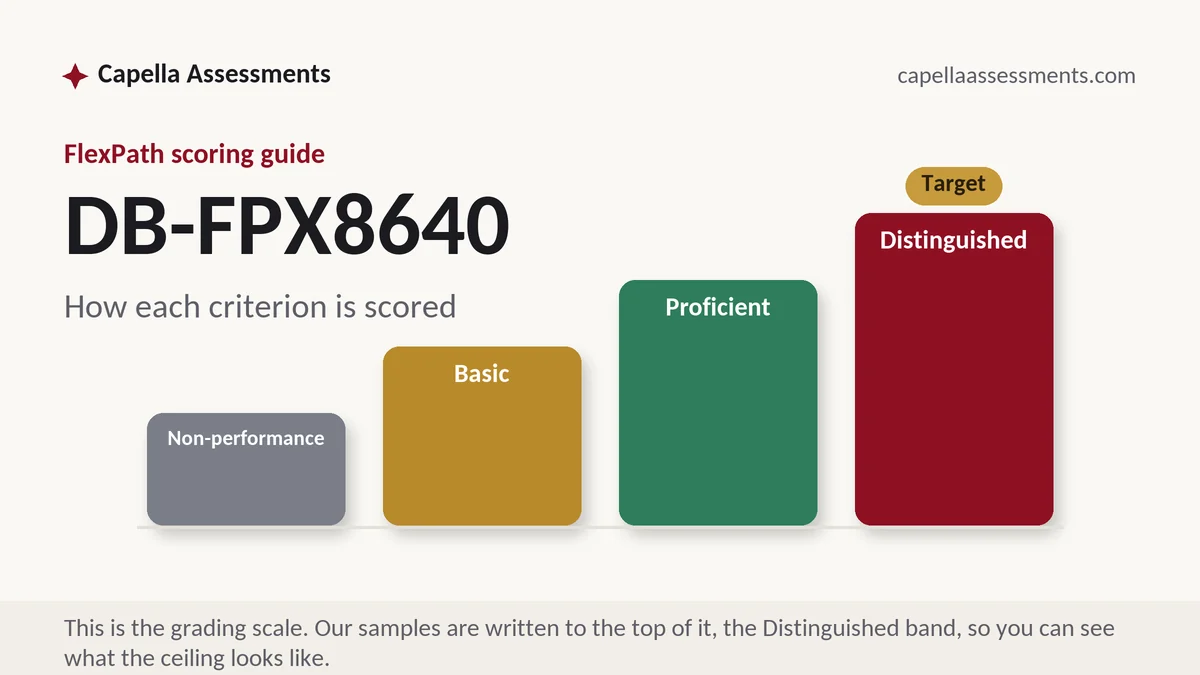
Every sample in this drawer is written the same way our custom ones are: the scoring guide decoded criterion by criterion, a subject-matched writer drafting to the Distinguished column, APA checked line by line, and the reasoning annotated so the paper teaches while it shows. Capella revises scoring guides, so a custom request is always written to the guide in YOUR courseroom, never from a stale template.
DB-FPX8640 questions, answered
Is there a DB-FPX8640 Assessment 1 example I can read?
Yes. Upload the instructions plus the scoring guide your section issued, and the first custom sample comes back built to those criteria within 24-48h, free. Read it for how a wide concern gets narrowed and how the gap is argued from sources rather than announced. The topic you defend still has to be one you can live with for the rest of the program.
How do I know my topic is narrow enough?
Try to write the study in one sentence: who would be studied, what would be measured or asked, and what answer would settle the question. If any part of that sentence cannot be filled in, the topic is still a subject. A second test is whether a reasonable reader could disagree with your gap claim, since a gap nobody could dispute is usually a gap nobody argued.
My topic comes from a problem at work. Is that a disadvantage?
It is an advantage as long as you translate it. A workplace problem gives you access, detail and a reason to persist, none of which the seminar can supply. What it does not give you is a research problem, and that translation is the work: state what the field has left unresolved underneath the situation you are watching, then keep the organization unidentifiable while you write about it.