Send the exact assignment or rubric from your classroom and a custom sample written to it lands in 24 to 48 hours, the first one free. DB-FPX8650 is Capella’s Seminar: Leadership Literature Review course. It centers on organizing a body of leadership research by the arguments inside it until the review itself reaches a defended position. Searches like "db fpx 8650 assessment 3 assignment example", "DBFPX8650 sample paper", and "DB-FPX8650 assessment samples" land on this page.
What DB-FPX8650 is really about
The tell in a weak review is its table of contents. Author by author, study by study, each with a paragraph, the whole thing arranged by the order in which the writer happened to read. Nothing in that arrangement is an argument, which is why it can be thorough and still score at Basic. A doctoral review is organized by what the studies are arguing about: a construct defined two ways, an effect that holds in one setting and not another, a method that keeps producing a result nobody has replicated. The reader should be able to see the shape of the field from your headings alone, and your headings should be claims rather than names.
The second demand is that the review arrives somewhere. Synthesis is not neutrality, and a paper that reports what everyone found and then stops has described a field without joining it. Somewhere near the end a doctoral review says what the weight of evidence supports, what remains contested, and which unresolved question the writer intends to work on. Leadership makes both demands harder than they sound. The volume is enormous, much of it built on self-report gathered at one point in time, and what reaches publication skews toward findings that worked. Deciding what to leave out is therefore part of the argument, and the criteria expect the decision rule to be visible.
What DB-FPX8650’s assessments ask for
Assessments in this seminar generally ask for the review in stages. Expect a documented search first, with terms, databases, date limits and the reasons for each, so a reader could repeat it and find roughly what you found. Expect a body of sources appraised rather than listed, with the weak ones named as weak and kept or dropped for a stated reason. Then expect the synthesis itself, marked on whether the sections are organized around questions rather than around researchers and on whether the evidence inside each section is combined rather than queued. Where the criteria mention a theoretical framework, they want the theory that will structure the eventual study identified and defended, not merely mentioned in the introduction and abandoned.
Where students lose points in DB-FPX8650
The classic loss is the annotated bibliography with transitions, study after study in a row, each summarized accurately and none of them speaking to any other. Second is the review that never lands, closing on a call for further research that could have been written before the reading started. Third is the search that cannot be repeated, described as extensive with no terms, no databases and no limits a reader could apply. Credit also goes missing for headings named after theories when the sections underneath argue about outcomes, for sources dated well outside the window the writer claimed to use, and for a synthesis that quietly ignores the studies which found nothing. Reviews also lose marks for leaning on other people's reviews, since a secondary summary hides the sample and the instrument that decide how much a finding is worth.
The DB-FPX8650 drawers
DB-FPX8650 Assessment 1 annotated bibliography example
Assessment 1 typically documents a search and appraises what it returned, source by source. On request, free, 24-48h.
DB-FPX8650 Assessment 2 thematic synthesis example
Assessment 2 often groups the evidence by argument and combines studies inside each theme. On request, free, 24-48h.
DB-FPX8650 Assessment 3 literature review paper example
Assessment 3 usually assembles the whole review and states where the evidence leaves the question. On request, free, 24-48h.
Your classroom shows something else?
Capella University revises courses; assessment counts and deliverables shift between terms. Send what your classroom shows and the desk matches it exactly.
Using a DB-FPX8650 sample the right way
Read a sample by its headings first. Write them out on their own and ask whether they name arguments or authors, then check whether the paragraphs under each one combine sources or take turns with them. The sentence to look for is the one where the writer says what the evidence supports on balance, because that sentence is the difference between a review and a reading list. After that, follow one study through the paper and see how few words it gets. Your review has to be built from sources you have read yourself, since the position at the end is what you will be asked to defend.
How these samples are written
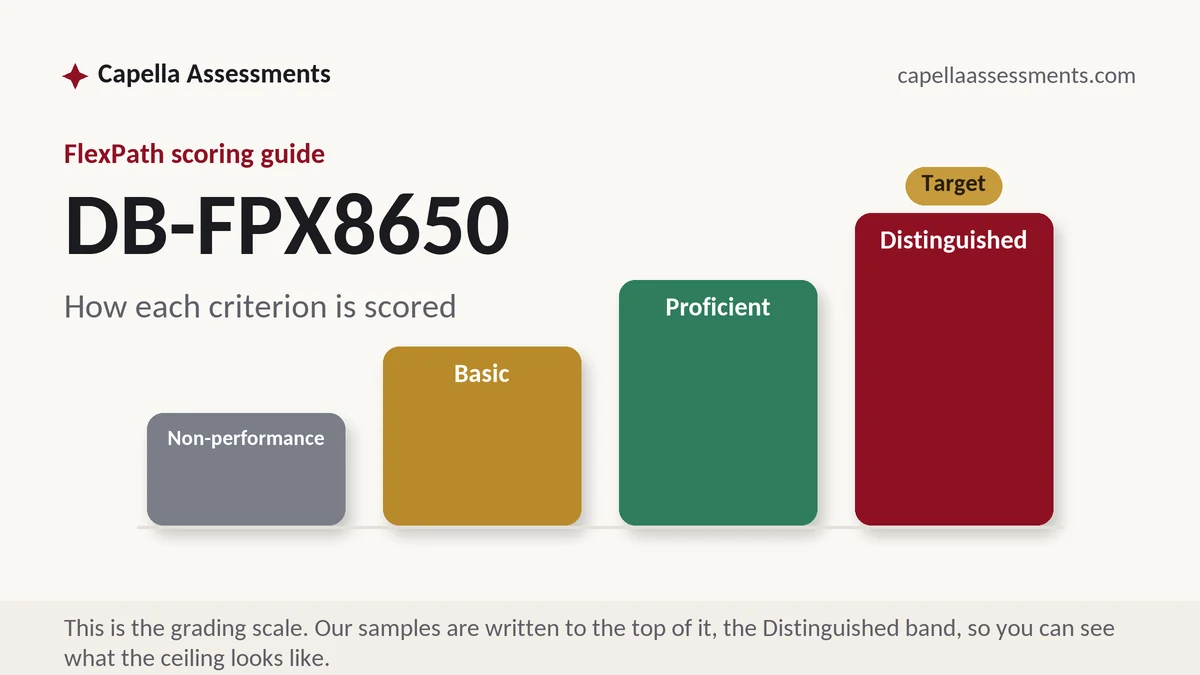
Samples here follow one discipline: the scoring guide is the outline, every criterion gets its section, the Distinguished description decides the depth, and the APA layer ships exact. Because Capella updates courses over time, your free custom sample is drafted against the scoring guide you send, not against an archive.
DB-FPX8650 questions, answered
Can I organize the review by theory instead of by theme?
You can, when the theories are what the field is arguing about, and that is the test. If your sections would still make sense with the theory names removed, because each one is really about an outcome or a population, then theme is the honest structure. Organizing by theory becomes a problem when it turns into one paragraph per model with no comparison inside any of them.
Is there a DB-FPX8650 Assessment 2 example available?
Yes. Attach the instructions and the scoring guide issued in your own courseroom, and the first custom sample costs nothing, usually returned inside 24-48h and written to those criteria. Use it to see how a search gets documented and how a section combines four or five studies into one claim. The body you review has to be the one behind your own question.
What do I do with studies that contradict each other?
Put them in the same paragraph and explain the disagreement. Differences in sample, instrument, setting or time frame usually account for part of it, and saying which part is exactly the analysis the criteria are looking for. A review that reports only the agreeing studies is easier to write and reads as incomplete to anyone who knows the field.