Send the exact assignment or rubric from your classroom and a custom sample written to it lands in 24 to 48 hours, the first one free. DB-FPX8730 is Capella’s Managing Innovation, Design, and Creativity course. It centers on managing the conditions, selection gates and design methods that decide which novel work survives contact with an operating business. Searches like "db fpx 8730 assessment 3 assignment example", "DBFPX8730 sample paper", and "DB-FPX8730 assessment samples" land on this page.
What DB-FPX8730 is really about
Students usually arrive assuming the problem is idea supply, and design a paper around workshops, suggestion schemes and ways to make people more creative. Very few organizations are short of ideas. What they are short of is a defensible way to choose between them, the patience to fund something whose payoff is uncertain, and any mechanism for stopping work that is not going to succeed. Research on creativity supports the reframing: idea generation responds to conditions that are reasonably well understood, while the difficult behavior is selection under uncertainty, where the same measures used to run the existing business will reject almost anything genuinely new. That is the management problem the assessments are built around.
Design gets the same treatment. The methods in circulation, prototyping, user research, iteration on cheap versions, carry claims about how uncertainty is reduced, and a doctoral paper is expected to state the claim and check it rather than to adopt the vocabulary. Some of it holds up well and some of it is a workshop format with a following. Creativity is the third strand and the most misread, since students tend to treat it as a personal trait and hire for it, while the published work points more consistently at conditions: what a problem is framed as, how much autonomy the work carries, whether an unsuccessful attempt costs the person anything, and whether there is time that is not already spoken for. Those are management variables.
What DB-FPX8730’s assessments ask for
Assessments generally ask you to examine how an organization handles new work and to propose something better, argued from research rather than from practice folklore. Expect the portfolio to matter: what mix of work is running, how projects are selected, what evidence is required at each gate, and what happens to a project that fails to clear one. Where the criteria ask about design, they want a method applied to a real problem with its assumptions stated, not described in the abstract. Where creativity is in scope, expect questions about the conditions around a team rather than the qualities of its members. Most sections also want measurement addressed, and spending on research is an input that says nothing about output.
Where students lose points in DB-FPX8730
The signature loss is the ideation plan, a program of workshops and challenges proposed for an organization whose actual bottleneck is the approval it takes to spend anything. Second is design vocabulary worn rather than used, where sprints and personas appear as labels over a process nobody changed. Third is creativity attributed to people, so the recommendation becomes a hiring profile and the conditions the research points at go unexamined. Credit is also lost where a stage gate is proposed with the same evidence thresholds a mature product would face, where failure is celebrated in a sentence and punished everywhere else in the design, and where innovation is measured by how much was spent on it. Weak papers also treat one famous firm's practice as a rule that transfers.
The DB-FPX8730 drawers
DB-FPX8730 Assessment 1 innovation portfolio review example
Assessment 1 typically examines what new work an organization is running and how it got approved. On request, free, 24-48h.
DB-FPX8730 Assessment 2 design process case study example
Assessment 2 often applies a design method to one problem and reports what it produced. On request, free, 24-48h.
DB-FPX8730 Assessment 3 creativity intervention proposal example
Assessment 3 usually proposes conditions the research supports and says how they would be observed. On request, free, 24-48h.
Your classroom shows something else?
Capella University revises courses; assessment counts and deliverables shift between terms. Send what your classroom shows and the desk matches it exactly.
Using a DB-FPX8730 sample the right way
Take a sample apart at the point of selection. Find the paragraph where a project is chosen or stopped and see what evidence the writer says should decide, because that is the part practitioner writing almost always leaves out. Then check how the design method is handled: whether the paper says what the method claims and what would show the claim failing. Build yours around new work you have watched go through an approval, successful or killed, kept unidentifiable, since the reasons a project actually died are rarely the reasons written on the form.
How these samples are written
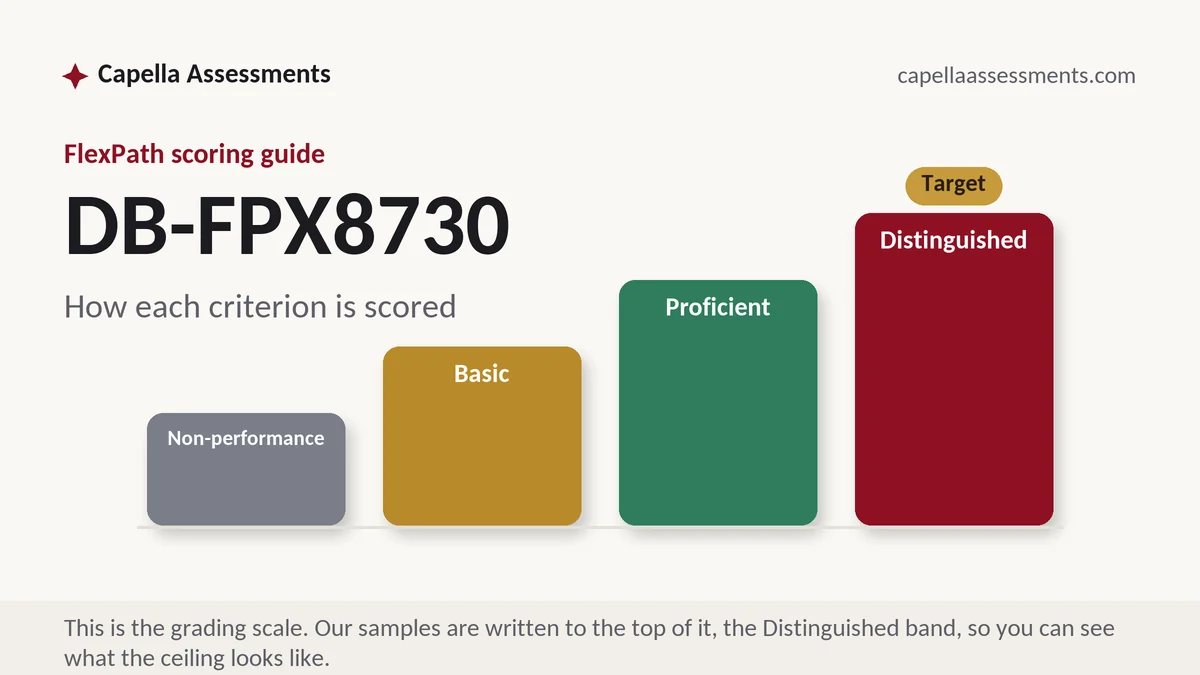
Samples here follow one discipline: the scoring guide is the outline, every criterion gets its section, the Distinguished description decides the depth, and the APA layer ships exact. Because Capella updates courses over time, your free custom sample is drafted against the scoring guide you send, not against an archive.
DB-FPX8730 questions, answered
Is design thinking an acceptable framework at doctoral level?
Yes, treated as a set of claims rather than as a belief. Say what the method asserts about reducing uncertainty, what evidence supports that, and where studies have found it doing less than promised. A paper that applies the method to a real problem and reports honestly what it produced will read as scholarship. A paper that adopts the vocabulary will not.
Can I request a DB-FPX8730 example for the assessment I am on now?
Yes, and the first one is written at no cost. Send the instructions and the scoring guide from your section and a custom sample is written to those criteria, normally inside 24-48h. Study how the argument moves from conditions to selection to measurement, then write your own version around an organization whose approval process you can describe.
My organization does not do formal innovation management. Can I still write this?
Yes, and the absence is itself a finding. Describe what happens instead: who decides that something new gets tried, what it costs them to propose it, and where the money comes from. An informal arrangement can be analyzed against the research just as a stage gate can, and papers built on one are often more specific because the writer can see the whole process.