Send the exact assignment or rubric from your classroom and a custom sample written to it lands in 24 to 48 hours, the first one free. DB-FPX8850 is Capella’s Seminar: General Management Literature Review course. It centers on organizing published management research into an argument, so that a gap emerges from what the studies disagree about. Searches like "db fpx 8850 assessment 3 assignment example", "DBFPX8850 sample paper", and "DB-FPX8850 assessment samples" land on this page.
What DB-FPX8850 is really about
The word review misleads almost everyone who enters DB-FPX8850. Students expect an extended reading report, so they produce one: article, summary, next article, summary, held together by transitions. A doctoral review is an argument built out of other people's findings, and its author has a position before the first citation appears. That position is usually something like this much is settled, this much is contested, and this specific thing has not been examined in this setting. Everything cited exists to move a reader toward that sentence. Once students see the review as a case being made rather than a territory being covered, the organizing problem solves itself, because material that does not advance the case has no reason to be there.
Organization is where the marks actually sit. A review arranged by author gives a reader one voice at a time and no way to see where the field agrees. A review arranged by finding puts several studies inside a single paragraph, says what they found together, and then says where they part company. Management research parts company often, since a construct measured in one industry with one instrument rarely behaves the same way in another, and the seminar treats those splits as content rather than as noise to be smoothed. The gap at the end has to be produced by that arrangement. A gap announced without the review behind it reads as a preference, and a doctoral reader will ask which studies made it visible.
What DB-FPX8850’s assessments ask for
Assessments in this seminar typically ask for a search that can be described and a synthesis that can be followed. Expect to state where you searched, with which terms and limits, and what you did with the volume that came back, since a doctoral reader treats the search as method rather than as background. Expect the body to be grouped by theme or by finding, with each group ending in a statement of what that group establishes. Where the criteria mention critical analysis, they mean weighing: which studies carry more weight, what their designs allow them to claim, and where a widely cited result rests on a sample too narrow to support it. The closing section usually has to name the gap and say why it is worth a doctoral project rather than a memo.
Where students lose points in DB-FPX8850
Marks go first to the annotated bibliography in paragraph form, where every study gets its own block and nothing is ever compared. Second is the funnel opening that starts with global commerce and takes four pages to reach the actual subject. Third is the gap asserted at the end with no line back to any study in the body. Marks also go for citations of studies the writer plainly read only in abstract, visible when a paper is described by its topic and never by its method. Reviews lose marks for coverage that stops at the first page of results, for a search described as thorough with nothing said about terms, and for quotation used where synthesis was required, since a string of quoted sentences leaves the writer with no position of their own.
The DB-FPX8850 drawers
DB-FPX8850 Assessment 1 search strategy write-up example
Assessment 1 typically documents where you searched, with what terms, and what the search returned. On request, free, 24-48h.
DB-FPX8850 Assessment 2 thematic synthesis example
Assessment 2 often groups studies by finding and states what each group establishes together. On request, free, 24-48h.
DB-FPX8850 Assessment 3 gap statement example
Assessment 3 usually closes the review by naming what the field has left unexamined. On request, free, 24-48h.
Your classroom shows something else?
Capella University revises courses; assessment counts and deliverables shift between terms. Send what your classroom shows and the desk matches it exactly.
Using a DB-FPX8850 sample the right way
Read a sample here for its paragraph shape. Find a paragraph carrying three or four studies at once and watch how the writer states the shared finding first and the disagreement second, because that ordering is the synthesis the criteria reward. Then trace the closing gap backwards and confirm that every part of it was set up earlier. The studies in your own review have to be ones you located and read, since the search is part of what is being marked and the gap has to come out of your field rather than out of a sample. What a sample gives you is a way to arrange evidence you gathered yourself.
How these samples are written
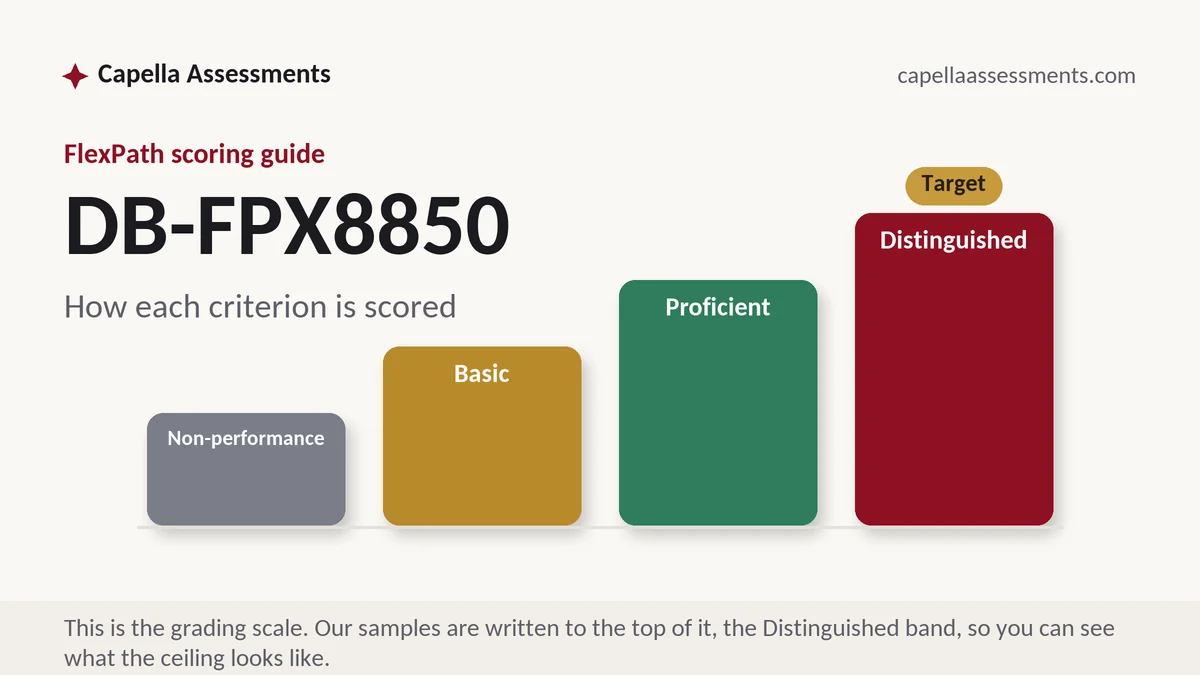
Samples here follow one discipline: the scoring guide is the outline, every criterion gets its section, the Distinguished description decides the depth, and the APA layer ships exact. Because Capella updates courses over time, your free custom sample is drafted against the scoring guide you send, not against an archive.
DB-FPX8850 questions, answered
My review keeps turning into a list of studies. What am I missing?
Usually a controlling idea. Try writing the one sentence your review has to prove before you sort anything, then group studies by what they contribute to that sentence rather than by when you found them. Studies that contribute nothing come out. The list disappears on its own once every paragraph has a job in the argument.
Is there a DB-FPX8850 example of the literature review assessment?
Yes. Send the instructions and the scoring guide your section issued, and a first custom sample is written to them at no charge, normally back within 24-48h. Read it for how sources are grouped and how the gap is set up across the whole document. Your own review has to be built from the studies you searched out and read.
Can I use a sample if my project topic is completely different?
That is the normal case, and it is fine. What a sample shows is arrangement: how studies are grouped, how a claim is supported across several of them, how a section closes. None of that depends on subject matter. The reading you do and the gap you argue belong to your project, and no sample can supply them.