Send the exact assignment or rubric from your classroom and a custom sample written to it lands in 24 to 48 hours, the first one free. EDD-FPX8030 is Capella’s Investigating Problems of Practice course. It centers on turning a felt concern in a school into an investigable problem of practice, with local evidence and published research holding the frame. Searches like "edd fpx 8030 assessment 3 assignment example", "EDDFPX8030 sample paper", and "EDD-FPX8030 assessment samples" land on this page.
What EDD-FPX8030 is really about
EDD-FPX8030 is where the phrase problem of practice stops being a label and starts being a test. Most drafts fail the test the same way: they present a worry, low reading growth, rising chronic absence, new teachers leaving, and treat the worry itself as the problem. The course asks for more. A problem of practice has documented existence, in enrollment tables, assessment results or discipline records a practitioner can actually see. It has a location, a population and a scale. And it has a frame from the literature that explains why this pattern deserves investigation rather than another program. Writing all of that down is harder than most students expect, and it is precisely what the criteria measure.
The second discipline is separating the problem from its favorite explanation. Practitioners usually arrive knowing what they intend to blame, the schedule, the curriculum, the phones, and a paper organized around a predetermined culprit is advocacy wearing a methods vocabulary. The assessments typically require the explanations held as rivals: what the local evidence can support, what published research says about similar patterns elsewhere, and what remains genuinely unknown at this site. That unknown is the point. A problem of practice worth a doctorate ends in a question someone could investigate, not in a solution someone already prefers. Sections vary in emphasis, but in current courserooms that arc, from concern to evidence to framed question, is remarkably stable.
What EDD-FPX8030’s assessments ask for
Expect the assessments to walk one concern through increasing rigor. Early work typically asks you to state a problem of practice from your own setting and show it exists in records rather than in impressions, with the site kept unidentifiable. Middle work often demands the literature: not sources that share your worry, but research that frames it, complicates it, or documents how similar institutions have understood it. Later work usually assembles a conceptual framework, the set of relationships you believe connects causes, conditions and the pattern you can see, drawn so a reader could disagree with it precisely. Throughout, the scoring guide tends to reward restraint. A writer who says what cannot yet be claimed about their own building usually outscores one with a confident answer.
Where students lose points in EDD-FPX8030
The classic loss is the solution smuggled in early, a problem statement written backwards from the program the writer wants to defend. Second is evidence by adjective, where a situation is called persistent, significant and widespread without a single local record cited to show it. Third is literature used as agreement, a row of sources that echo the writer's concern while none of them frame or test it. Marks also drain when the population keeps shifting, a problem stated about ninth graders and analyzed about the whole district, and when scope grows until no investigation could cover the claim. And conceptual frameworks lose points when they arrive as decoration, a diagram unconnected to the argument, relating boxes the paper never discusses again.
The EDD-FPX8030 drawers
EDD-FPX8030 Assessment 1 problem of practice analysis example
Assessment 1 typically documents that a local concern exists in records, not impressions. On request, free, 24-48h.
EDD-FPX8030 Assessment 2 evidence review example
Assessment 2 often tests rival explanations against site evidence and published research. On request, free, 24-48h.
EDD-FPX8030 Assessment 3 conceptual framework example
Assessment 3 usually draws the relationships a reader could dispute, then defends them from literature. On request, free, 24-48h.
Your classroom shows something else?
Capella University revises courses; assessment counts and deliverables shift between terms. Send what your classroom shows and the desk matches it exactly.
Using a EDD-FPX8030 sample the right way
Study a sample for its restraint. Notice how small the documented problem is compared to the worry that produced it, and how every sentence about the site points at a record a practitioner could pull. Watch the framework earn its place by shaping the questions, not decorating them. Then be clear about the boundary: the problem you eventually carry into your doctoral project, along with your research question, your data, your participants and your IRB submission, is yours alone and is never drafted here. A sample shows the genre of a well framed problem. The problem itself has to come from your building.
How these samples are written
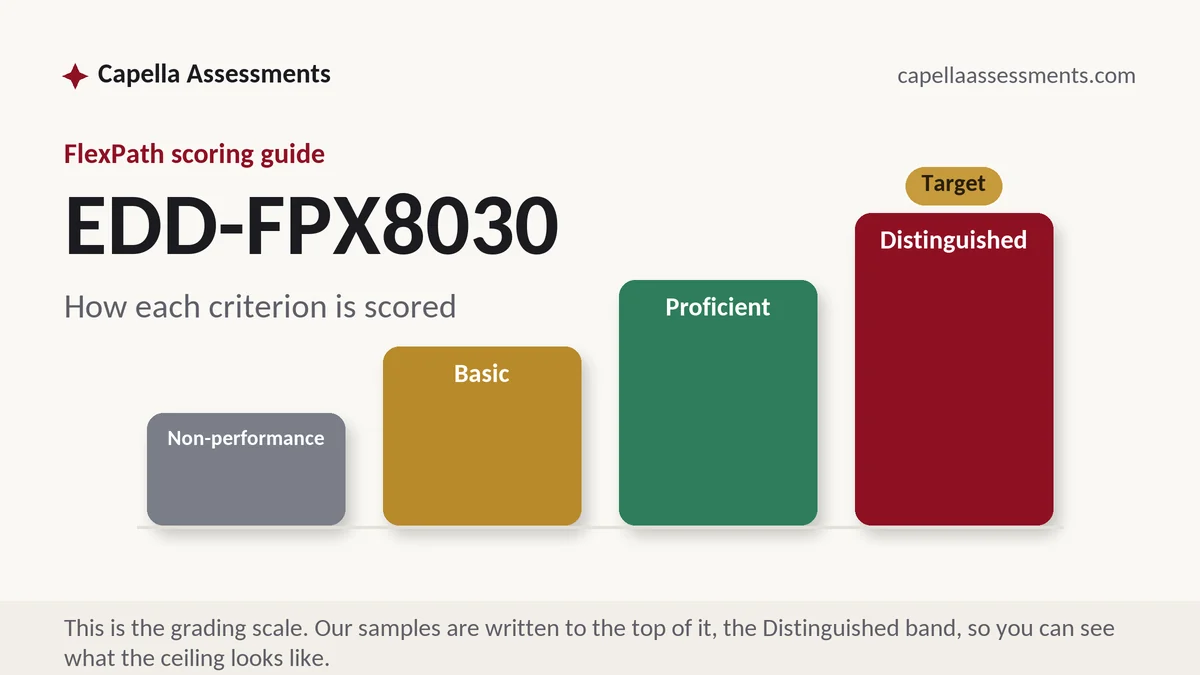
Samples here follow one discipline: the scoring guide is the outline, every criterion gets its section, the Distinguished description decides the depth, and the APA layer ships exact. Because Capella updates courses over time, your free custom sample is drafted against the scoring guide you send, not against an archive.
EDD-FPX8030 questions, answered
How is a problem of practice different from a research problem?
A research problem can live anywhere in the literature; a problem of practice lives in a specific institution and is felt by named roles, teachers, counselors, families. The doctoral move is connecting the two, showing your local pattern through frames the research provides. The assessments in EDD-FPX8030 grade exactly that connection, in both directions.
Can I get an EDD-FPX8030 sample for the conceptual framework assessment?
Yes. Forward the instructions and the scoring guide from your section and a custom sample is drafted to them, free the first time and normally delivered in 24-48h. It will model how a framework is argued and drawn around a documented problem. Yours then gets built around your own site's evidence, which no sample can supply.
What if my school's data seems to contradict my problem?
Then you have found something better than a confirmation. A pattern that resists your first reading forces the rival explanations the criteria reward, and writing that tension honestly usually scores higher than a tidy case. State what the records show, state what you expected, and let the gap become the question. That is investigation, which is the course's actual subject.