Send the exact assignment or rubric from your classroom and a custom sample written to it lands in 24 to 48 hours, the first one free. EDD-FPX8522 is Capella’s Leading a Culture of Learning course. It centers on the conditions under which teachers keep learning as professionals, and what observable behavior lets a leader claim a culture exists. Searches like "edd fpx 8522 assessment 3 assignment example", "EDDFPX8522 sample paper", and "EDD-FPX8522 assessment samples" land on this page.
What EDD-FPX8522 is really about
EDD-FPX8522 is about the adults. Schools describe themselves as learning communities while the learning in question belongs entirely to children, and this course closes that gap by asking what the teachers and staff are learning, from whom, and under what conditions. That reframing surprises students who expected a course on school climate. A culture of learning, as the criteria treat it, is a pattern of adult behavior: teachers opening their practice to colleagues, mistakes surfacing in meetings without punishment, evidence changing minds in public. Each of those behaviors has a research base, and each has conditions a leader either builds or withholds. The writing task is connecting the three layers without slogan.
The second half of the course's argument is that culture cannot be commanded, only cultivated, and that the difference shows up in evidence. A leader can mandate collaboration time and get compliance meetings; the culture is what happens when the leader is not in the room. Assessments typically press on that distinction by demanding observable indicators for every cultural claim, which forces writers off the mission statement and into the building. Knowles matters here, since the adults in question learn as adults do, from problems they own rather than programs they receive. So does the research on collective efficacy, which gives a writer something stronger than sentiment when arguing that adult learning moves outcomes for children.
What EDD-FPX8522’s assessments ask for
The assessments generally move from diagnosis to design. Diagnostic work typically asks you to assess the learning culture of a real institution, yours kept unidentifiable, using indicators you can defend: what adults actually do in meetings, how practice becomes public, what happens after a visible failure. Design work usually asks for the leadership moves that would shift those indicators, grounded in research on professional learning and adult development rather than in enthusiasm for community. Some sections add a reflective layer on your own habits as a lead learner, and it is graded as evidence handling, not confession. Across all of it, the scoring guide rewards the writer who names concrete behavior where a weaker paper would say culture, climate or buy in and move on.
Where students lose points in EDD-FPX8522
Papers on culture die by abstraction. The first loss is the claim with no referent, a school described as collaborative and growth minded while nothing any adult does appears on the page. Second is the poster fallacy, culture read off artifacts, vision statements, hallway displays, the language of the website, rather than off behavior. Third is the mandate confusion, where required PLC meetings are offered as proof of a learning culture when attendance was never the question. Marks also leave for professional development treated as culture rather than as one input to it, for collective efficacy cited and never operationalized, and for designs that change structures while leaving incentives untouched. And any paper that measures teacher learning by satisfaction surveys has volunteered for Basic on the evidence criterion.
The EDD-FPX8522 drawers
EDD-FPX8522 Assessment 1 learning culture analysis example
Assessment 1 typically diagnoses one institution's adult learning culture through defensible observable indicators. On request, free, 24-48h.
EDD-FPX8522 Assessment 2 professional learning design example
Assessment 2 often designs the conditions that would shift how faculty learn together. On request, free, 24-48h.
EDD-FPX8522 Assessment 3 reflective practice memo example
Assessment 3 usually examines the writer's own habits as the institution's lead learner. On request, free, 24-48h.
Your classroom shows something else?
Capella University revises courses; assessment counts and deliverables shift between terms. Send what your classroom shows and the desk matches it exactly.
Using a EDD-FPX8522 sample the right way
Use a sample from this course as a translation exercise. Every cultural claim in it should resolve to something seeable, and tracing how the writer performs that translation, culture to behavior to condition to leadership move, teaches the skill the criteria actually grade. Pay attention to the diagnostic section's honesty; a culture assessed as mixed, with specific strong and weak indicators, is the register doctoral readers trust. Then diagnose a building you know from the inside, because the telling details, what happens after a failed lesson goes public, live below the reach of any outsider. The translation method is the takeaway. The observations must be yours.
How these samples are written
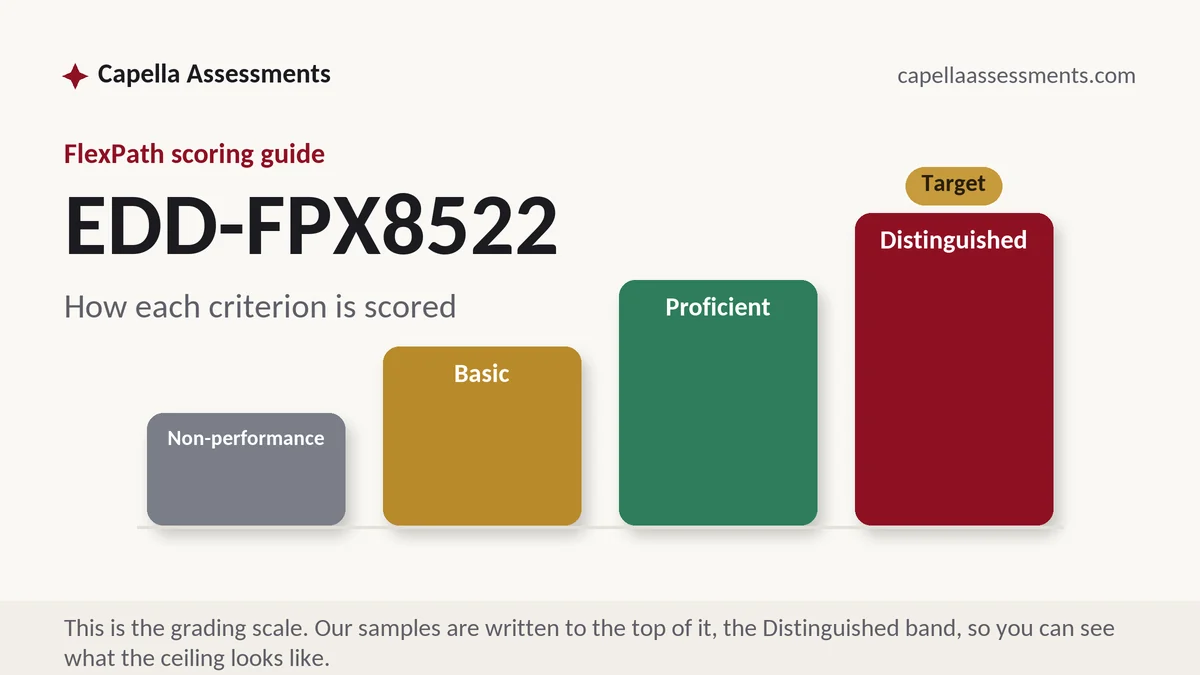
The method behind every paper on this shelf: criteria first, structure from the criteria, evidence current, APA exact, and annotations that show which paragraph answers which criterion. Send your courseroom's scoring guide with a request and the custom sample matches it exactly, revisions included.
EDD-FPX8522 questions, answered
How do I write about my school's culture without trashing colleagues?
Describe conditions and patterns, never individuals, and keep the site unidentifiable. A weak learning culture is almost always a rational response to incentives, time structures and history, which means you can analyze it without indicting anyone. That framing is also what the criteria want, since leadership work locates causes in conditions a leader can change.
How quickly can I get an EDD-FPX8522 sample?
Typically inside 24-48h once your assessment instructions and courseroom scoring guide arrive, and the first custom sample carries no charge. The writing is done fresh to your criteria rather than pulled from a shelf, which is what the window pays for. Send both documents together and the turnaround stays at the short end.
Is collective efficacy just another buzzword to cite?
It becomes one the moment it is cited without measurement. The construct earns its place when you say which adult beliefs and behaviors would indicate it, how they form, and what leadership conditions the research links to their growth. Used that way it anchors a strong paper. Dropped in as a magic phrase, it reads as decoration and grades that way.