Send the exact assignment or rubric from your classroom and a custom sample written to it lands in 24 to 48 hours, the first one free. ENG-FPX1000 is Capella’s English Composition course. It centers on the craft of the essay itself, from a thesis that commits through paragraphs built to carry it. Searches like "eng fpx 1000 assessment 3 assignment example", "ENGFPX1000 sample paper", and "ENG-FPX1000 assessment samples" land on this page.
What ENG-FPX1000 is really about
In every other course, writing carries the content; in ENG-FPX1000 the writing is the content, and that inversion catches students who have coasted on decent prose. The criteria name the machinery directly: a thesis that makes an arguable claim, topic sentences that advance it, evidence integrated rather than dropped in, transitions that do logical work. A pleasant essay that wanders scores below an awkward one that argues, which surprises people reliably until they read the scoring guide closely. The claim is the load-bearing element. Once a thesis commits to something a reasonable reader could dispute, every paragraph has a job, and the criteria for organization and development mostly grade whether each paragraph does it.
Revision is the other place this course differs from what high school taught. In current courserooms the assessments often ask for evidence of it, a revised draft, a reflection on what changed, and the criteria distinguish revision from correction: moving a paragraph, cutting a favorite sentence, sharpening the thesis after the draft revealed what you actually meant. Papers that fix commas and call it revision answer a different question than the one asked. Mechanics still count, and as the program's foundational writing course the APA expectations here set the habit for everything after, but they sit beside the thinking rather than in place of it. A reflection that names one real structural change outscores a page of general growth.
What ENG-FPX1000’s assessments ask for
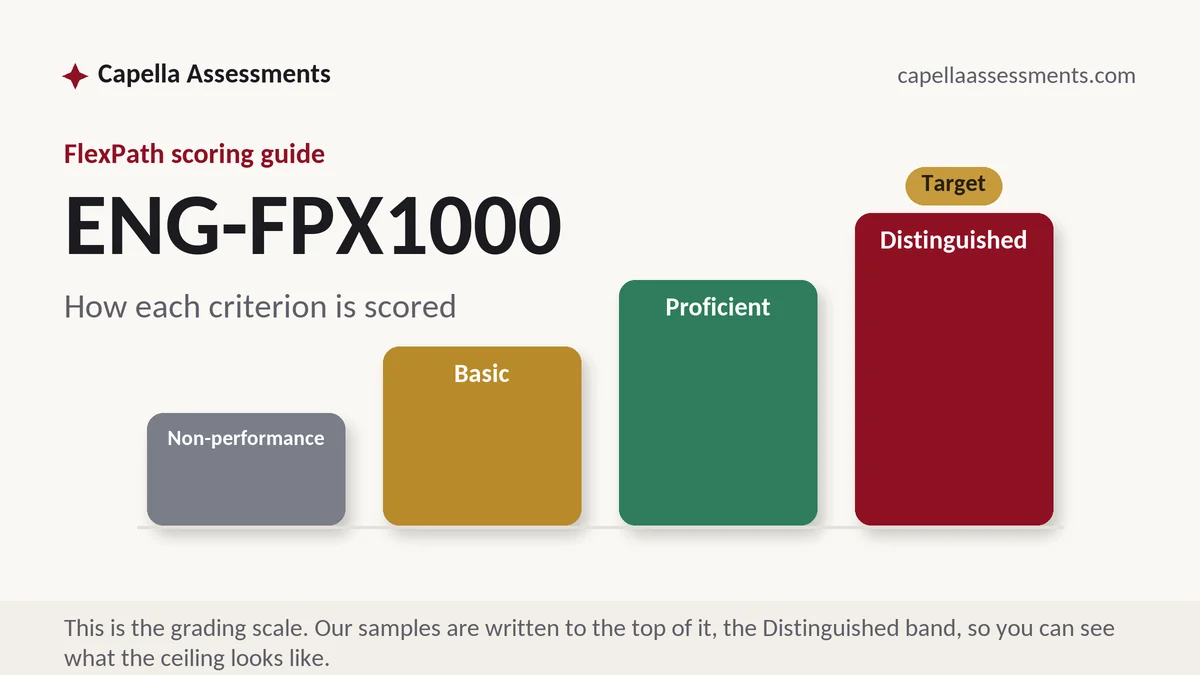
The sequence typically builds from personal ground toward argument. Early assessments often ask for narrative or reflective writing, scored on focus and concrete detail rather than on drama, and they exist to establish voice before the stakes rise. Middle assessments usually bring sources in, testing whether a quotation is introduced, used and cited rather than left to speak for itself. The later work is generally persuasive: a thesis on a debatable question, support organized to build, and a counterposition treated as something to answer rather than to mock. Along the way expect drafts, feedback responses or reflections, because the course is scoring the process on purpose. Whatever the sequence in your section, the scoring guide attached to each assessment is the contract to write against.
Where students lose points in ENG-FPX1000
The thesis that promises nothing loses the most: a topic announced, no position taken, so the essay can only describe. Second is the paragraph as container, several loosely related sentences sharing a space with no controlling idea, which the organization criterion is written to catch. Third is the quotation left to argue by itself, dropped in without setup or follow-through. Marks drain too through introductions that stall, conclusions that merely restate, revision presented as proofreading, and counterarguments built weak so they fall over easily. And in a course this attentive to mechanics, patterned errors, the same comma splice ten times, cost more than their size suggests, because the criteria read them as an unlearned rule rather than a slip.
The ENG-FPX1000 drawers
ENG-FPX1000 Assessment 1 reflective essay example
Assessment 1 often asks for focused personal writing scored on detail and control. On request, free, 24-48h.
ENG-FPX1000 Assessment 2 source-based essay example
Assessment 2 typically tests whether quotations are introduced, used and cited properly. On request, free, 24-48h.
ENG-FPX1000 Assessment 3 argument essay example
Assessment 3 usually wants a debatable thesis defended with an answered counterposition. On request, free, 24-48h.
Your classroom shows something else?
Capella University revises courses; assessment counts and deliverables shift between terms. Send what your classroom shows and the desk matches it exactly.
Using a ENG-FPX1000 sample the right way
Read a sample twice, once for what it says and once for how it moves. On the second pass, underline the thesis, then check each topic sentence against it and watch the essay hold together, because that skeleton is the thing to copy, never the sentences. Compare a draft and revision pair where one is included and list what actually changed. Then write on a question you have a stake in, since commitment is the quality graders can feel and cannot be faked. The free first sample is written to your prompt and scoring guide, so the structure you study matches the essay you owe.
How these samples are written
Samples here follow one discipline: the scoring guide is the outline, every criterion gets its section, the Distinguished description decides the depth, and the APA layer ships exact. Because Capella updates courses over time, your free custom sample is drafted against the scoring guide you send, not against an archive.
ENG-FPX1000 questions, answered
Is there an ENG-FPX1000 argument essay example written to Capella's criteria?
Yes. Send the assessment instructions and scoring guide from your courseroom and a sample is written against them, free the first time, in 24-48h. Prompts vary between sections, so a sample keyed to your actual question shows the thesis move your criteria want, which a generic essay on a different topic cannot.
Can I write in first person for these essays?
Often yes, especially in the narrative and reflective assessments, where first person is the point. For the argumentative work, read your instructions; many sections permit it and some restrict it. What the criteria consistently punish is not the pronoun but the drift it invites, opinion stated where evidence was required. Anchor claims in support either way.
What should I do with a sample essay besides read it?
Reverse-outline it. Write one line per paragraph stating its job, and the essay's architecture appears on a single page. Do the same to your own draft and the weak paragraphs identify themselves. That exercise turns a sample into instruction instead of temptation, and it is the fastest known cure for the wandering essay.