Send the exact assignment or rubric from your classroom and a custom sample written to it lands in 24 to 48 hours, the first one free. HIM-FPX1610 is Capella’s Introduction to Medical Terminology course. It centers on building and decoding clinical terms from their parts so a written record says one thing to every reader who opens it. Searches like "him fpx 1610 assessment 3 assignment example", "HIMFPX1610 sample paper", and "HIM-FPX1610 assessment samples" land on this page.
What HIM-FPX1610 is really about
Students arrive at HIM-FPX1610 expecting flashcards and are graded on something closer to reading comprehension. Memorising a term gives you that term; taking it apart gives you every term built from the same pieces, because prefixes, roots and suffixes recombine and an unfamiliar word yields to the same procedure every time. The written assessments are built on that difference. They put a document in front of you and ask what it says, which no memorised list survives, since operative notes and discharge summaries use terms in combinations no glossary anticipates. The assessments that ask you to construct terms are testing the same skill from the other direction, and the ones that ask for a definition still expect the parts to be visible in the answer.
The second thing the course teaches quietly is that a term in a record is not a word on a page. It is what a coder will read, what a payer will see, and what will still be sitting there when the chart is requested years later, so a single letter changed between ilium and ileum moves the anatomy and everything downstream of it. That is why the scoring guides treat spelling as accuracy rather than presentation, and why an abbreviation with two possible expansions is a documentation problem rather than a style choice. The plain-language work is the same discipline aimed at a different reader: saying what a term means without reaching for another term the reader also does not have.
What HIM-FPX1610’s assessments ask for
Assessments in current courserooms tend to move between three kinds of work. One is construction and analysis: split a term into its elements, say what each element contributes, and build a term from a definition without reaching for a list. Another is document work, where an excerpt from a clinical note is supplied and you report what happened to the patient in ordered sequence, naming body system, procedure, laterality and finding in the words the record actually uses. The third is translation, writing for a patient or a non-clinical colleague, scored on whether the reader could act on the result rather than on how gentle it sounds. Where abbreviations appear, expect to be asked which ones carry forward safely and which have to be spelled out.
Where students lose points in HIM-FPX1610
Points go first to spelling, which is less forgiving here than anywhere else in the program, because the near miss is usually a real term for a different structure. Second is the definition assembled from a search result rather than from the elements, which shows up when the root is glossed correctly and the suffix is ignored. Third is plain language that is still clinical, where a term is swapped for a slightly less technical term and nothing has been explained. Beyond those, marks go for reading a document out of order, for treating laterality and negation as decoration, for expanding an ambiguous abbreviation to whichever meaning suits the sentence, and for answers describing a body system in general when the assessment asked what this note records.
The HIM-FPX1610 drawers
HIM-FPX1610 Assessment 1 terminology breakdown example
Assessment 1 typically builds and dismantles terms across body systems from their elements. On request, free, 24-48h.
HIM-FPX1610 Assessment 2 clinical report interpretation example
Assessment 2 often supplies a clinical note and asks what it actually records. On request, free, 24-48h.
HIM-FPX1610 Assessment 3 plain-language translation example
Assessment 3 usually rewrites clinical content for a reader without clinical training. On request, free, 24-48h.
Your classroom shows something else?
Capella University revises courses; assessment counts and deliverables shift between terms. Send what your classroom shows and the desk matches it exactly.
Using a HIM-FPX1610 sample the right way
Read a sample for procedure rather than content. Watch the writer break a term at its joins before defining it, and notice that the definition names each element instead of paraphrasing the whole. In the document sections, follow the order the sample reads in, since a clinical note is not written in the order things happened and front-to-back reading produces a confused summary. Then work your own terms, because the recall is genuinely yours to build and a sample only shows what a correct answer looks like from the outside. What transfers is the habit of stopping at an unfamiliar word and dismantling it instead of guessing from context.
How these samples are written
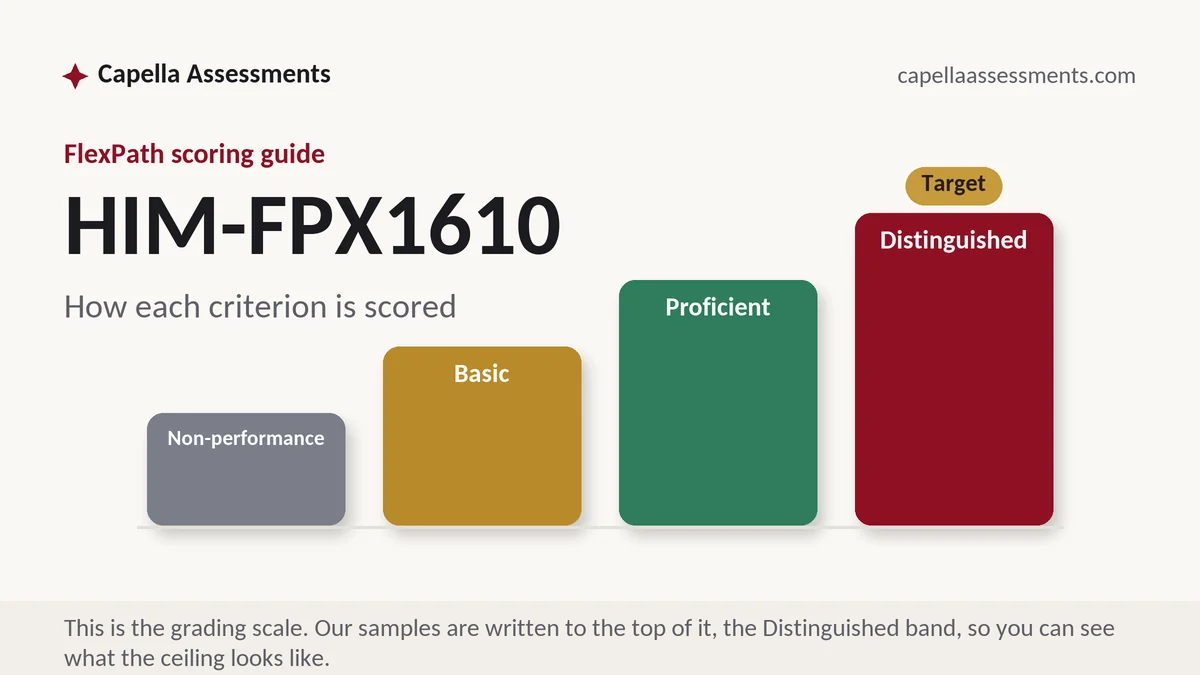
Samples here follow one discipline: the scoring guide is the outline, every criterion gets its section, the Distinguished description decides the depth, and the APA layer ships exact. Because Capella updates courses over time, your free custom sample is drafted against the scoring guide you send, not against an archive.
HIM-FPX1610 questions, answered
Do I have to memorise every term to pass this course?
Memorise the parts and you will not have to. The assessments put documents in front of you that no list anticipated, so recall of individual words runs out quickly while root, prefix and suffix keep working. Learn the combining forms for each body system, then practise on notes you have never seen until decoding is automatic rather than effortful.
Is there a HIM-FPX1610 Assessment 2 example I can read?
Yes. Send the instructions and the scoring guide from your courseroom and the first custom sample is free, back in 24-48h, written against those criteria rather than a generic version. Terminology assessments vary in which body systems and which document types they use, so the version written for your section will sit closer to what you are graded on.
Can I look terms up while writing the assessment?
Usually yes, and checking a term is sensible. What a lookup will not give you is the part of the answer being scored, which is the construction: what each element contributes and why the term means what it does. Copy a dictionary line into an answer and the definition criterion is met thinly. Show the parts and it is met properly.