Send the exact assignment or rubric from your classroom and a custom sample written to it lands in 24 to 48 hours, the first one free. HIM-FPX2670 is Capella’s Strategic Management of Health Information Systems course. It centers on choosing and planning an information system from the problem it has to solve rather than from what the product offers. Searches like "him fpx 2670 assessment 3 assignment example", "HIMFPX2670 sample paper", and "HIM-FPX2670 assessment samples" land on this page.
What HIM-FPX2670 is really about
HIM-FPX2670 is a planning course wearing a technology name, and submissions starting from the technology score badly. The order the criteria reward runs problem, requirement, option, decision. What is going wrong in the organization now, what would have to be true for it to stop, what could deliver that, and which of those is worth what it costs. A paper opening with a description of a product and then finding reasons to want it has inverted the sequence, and every later section inherits the inversion, because requirements written after a preference has formed will describe the preferred option. The strategic word in the title means alignment: the system has to serve something the organization has already said it is trying to do.
Cost is where these papers separate. A system has a price, and then it has everything the price excludes: interfaces built, records converted, staff pulled off the floor for training, productivity lost for a period after go-live, support renewed annually. Submissions comparing licence figures and stopping have compared the smallest number in the decision. The second separator is what happens after the signature. Governance is a criterion in most versions and it wants names attached to roles: who approves a change once the system is live, who arbitrates when two departments want opposite configurations, and how the benefits claimed in the proposal will be checked against what the organization actually received.
What HIM-FPX2670’s assessments ask for
Assessments generally ask for a case rather than a description. Expect to establish the current state and the gap it produces, derive requirements from that gap, evaluate alternatives against weighted criteria you state before scoring anything, and recommend one with the reasoning visible. Where the criteria address feasibility, they want cost, timeline, staffing and disruption treated as constraints rather than listed as risks. Most versions ask for an implementation approach, scored on sequencing and ownership rather than on enthusiasm, and several ask what the organization would monitor to know the investment paid off. Where stakeholders appear, the ones who matter are those whose work changes on the first day the system is live.
Where students lose points in HIM-FPX2670
The largest loss is the brochure paper, which describes capability after capability with nothing the organization was trying to fix. Second is the option comparison whose criteria were invented to match the winner, visible when the dimensions differ between the options. Third is a cost section limited to purchase price, leaving conversion, interfaces and lost productivity outside an argument about value. Marks also go for benefits stated as improved efficiency with nothing that could be measured, for implementation approaches with no sequence and no owner, and for risk sections naming resistance without saying which group loses what. Papers also lose marks for recommending a system whose own requirements the organization could not meet.
The HIM-FPX2670 drawers
HIM-FPX2670 Assessment 1 needs assessment example
Assessment 1 typically establishes the gap a new system would have to close. On request, free, 24-48h.
HIM-FPX2670 Assessment 2 system selection analysis example
Assessment 2 often scores alternatives against criteria the paper set in advance. On request, free, 24-48h.
HIM-FPX2670 Assessment 3 implementation and governance plan example
Assessment 3 usually sequences a rollout and names who owns it afterwards. On request, free, 24-48h.
Your classroom shows something else?
Capella University revises courses; assessment counts and deliverables shift between terms. Send what your classroom shows and the desk matches it exactly.
Using a HIM-FPX2670 sample the right way
Read a sample backwards. Start at the recommendation, then check whether the criteria producing it were stated before the options were examined, because that ordering is the whole test in this course and it is easy to see once you look for it. Watch how the cost section is built and what it counts beyond the licence. Then rebuild it around a gap your own organization or a documented case genuinely has, since a decision only reads as a decision when something was at stake. What transfers is the sequence, and the discipline of writing requirements you would still accept if your preferred option failed them.
How these samples are written
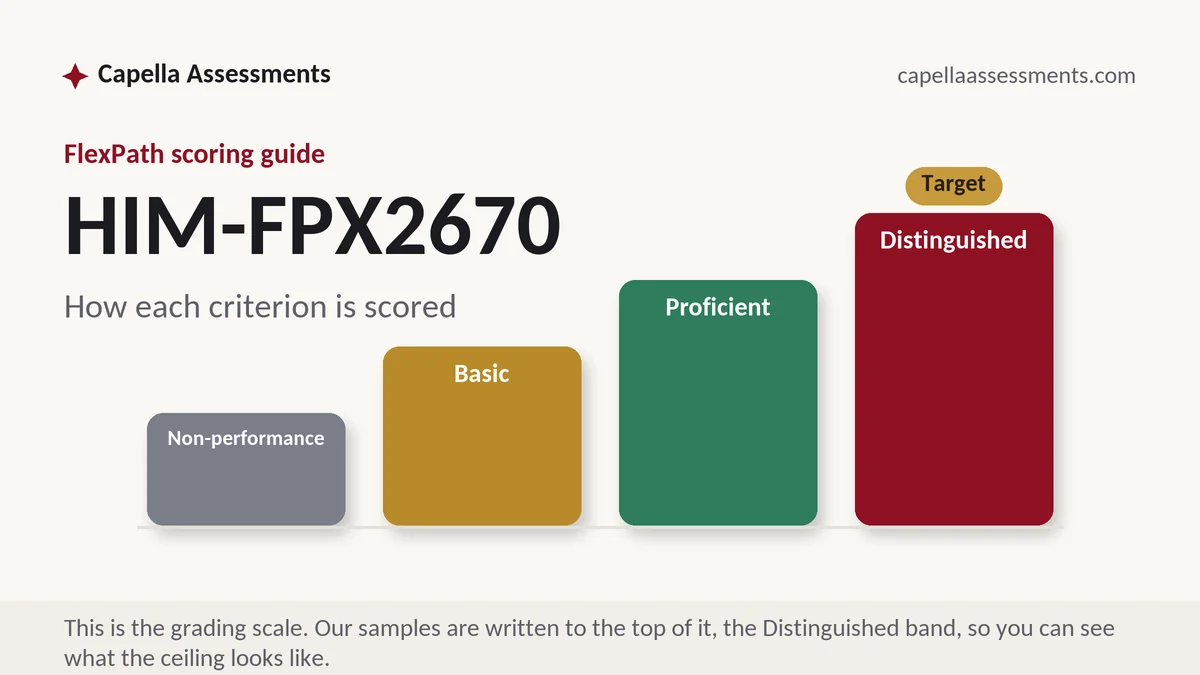
Every sample in this drawer is written the same way our custom ones are: the scoring guide decoded criterion by criterion, a subject-matched writer drafting to the Distinguished column, APA checked line by line, and the reasoning annotated so the paper teaches while it shows. Capella revises scoring guides, so a custom request is always written to the guide in YOUR courseroom, never from a stale template.
HIM-FPX2670 questions, answered
How do I pick criteria for comparing systems?
Derive them from the gap you documented, weight them before you look at any option, and keep them measurable enough that two readers would score an option the same way. Criteria written after a favourite has emerged will quietly describe that favourite. If a criterion cannot separate the options from each other, it is decoration and should be cut.
Do I need real vendor pricing for the cost section?
Rarely available, and generally not required. What is required is the shape of the cost: purchase, interfaces, data conversion, training time off the floor, support renewals, and the productivity dip after go-live. A labelled estimate with its basis stated satisfies the criterion. An unsourced figure presented as fact does not, and it is easy for a scorer to spot.
How is HIM-FPX2670 different from the courses about running the record?
This one sits before and above the system rather than inside it. The writing is about the decision: what problem justifies the spend, which option meets requirements set in advance, who governs configuration afterwards, and how a claimed benefit gets verified later. Documentation practice, corrections and daily record quality belong to the operational courses further along the program.