Send the exact assignment or rubric from your classroom and a custom sample written to it lands in 24 to 48 hours, the first one free. HIM-FPX3620 is Capella’s Foundations of Health Information Management course. It centers on the life of a health record from creation to destruction and who is accountable for it at each stage. Searches like "him fpx 3620 assessment 3 assignment example", "HIMFPX3620 sample paper", and "HIM-FPX3620 assessment samples" land on this page.
What HIM-FPX3620 is really about
The first thing HIM-FPX3620 asks you to settle is what the record even is, and most submissions skip it. A patient chart is not one object. It is entries made by different roles at different moments, some belonging to the legal record, some working notes, some living in systems the department does not control. Until a paper says which of those is in scope, its statements about access, retention and release cannot be checked, because each of those obligations attaches to a defined set rather than to everything carrying the patient name. The assessments reward that definition being made explicitly and made early, and they punish the paper that assumes a reader will supply it.
After the definition comes the sequence, and the course treats it as a lifecycle with obligations at every point: created at the encounter, completed inside a deadline, analysed for deficiency, coded, stored, released under authority, retained for a stated period, destroyed in a documented way. Each stage has an owner and a failure mode. Submissions describing the department as a set of job titles miss what the criteria are after, which is the function each role performs on the record as it moves. Standards belong here too. A required data set or an accreditation documentation requirement means something once it is attached to the stage it governs.
What HIM-FPX3620’s assessments ask for
Assessments generally ask you to explain a piece of the record lifecycle and defend how it is handled. That means stating what sits inside the record set you are discussing, naming the requirement that governs the stage, and describing the process concretely enough that a reader could tell who does what and by when. Where retention or destruction is the focus, expect the schedule to be tied to a stated basis rather than asserted. Where the criteria address department functions, the answer names the work rather than the title. Several versions ask you to compare paper and electronic handling of the same obligation, which is scored on what changes about custody rather than on what is more convenient.
Where students lose points in HIM-FPX3620
Points go first to papers discussing the record without defining it, which leaves every later claim unverifiable. Second is retention stated as a number with no basis, since the period depends on the record type and on who is imposing it. Third is the department drawn as an organisation chart, roles listed and no function performed on anything. Marks also go for treating release of information as a single process when the authority differs by requester, for a retention schedule cited once and then ignored by the lifecycle analysis, and for accounts of destruction that stop at deletion without the certificate, the log or the vendor accountability that makes it defensible in a later dispute.
The HIM-FPX3620 drawers
HIM-FPX3620 Assessment 1 records lifecycle analysis example
Assessment 1 typically defines the record set and follows it through custody. On request, free, 24-48h.
HIM-FPX3620 Assessment 2 retention and release policy example
Assessment 2 often sets out who may obtain what, and how long records are kept. On request, free, 24-48h.
HIM-FPX3620 Assessment 3 department functions report example
Assessment 3 usually maps the work each records function performs on the chart. On request, free, 24-48h.
Your classroom shows something else?
Capella University revises courses; assessment counts and deliverables shift between terms. Send what your classroom shows and the desk matches it exactly.
Using a HIM-FPX3620 sample the right way
The part of a sample worth studying is its opening definition. Find the sentence fixing the record set in scope, notice how much later work that one sentence makes possible, then follow how the paper moves stage by stage rather than theme by theme. That order is what keeps the obligations attached to something. Build your own around a record type you can describe accurately, because the specifics of who completes what and when are examined most closely. Notice how the sample cites at the requirement instead of at the end of the section, which is exactly where a reader checking your retention claim will look first.
How these samples are written
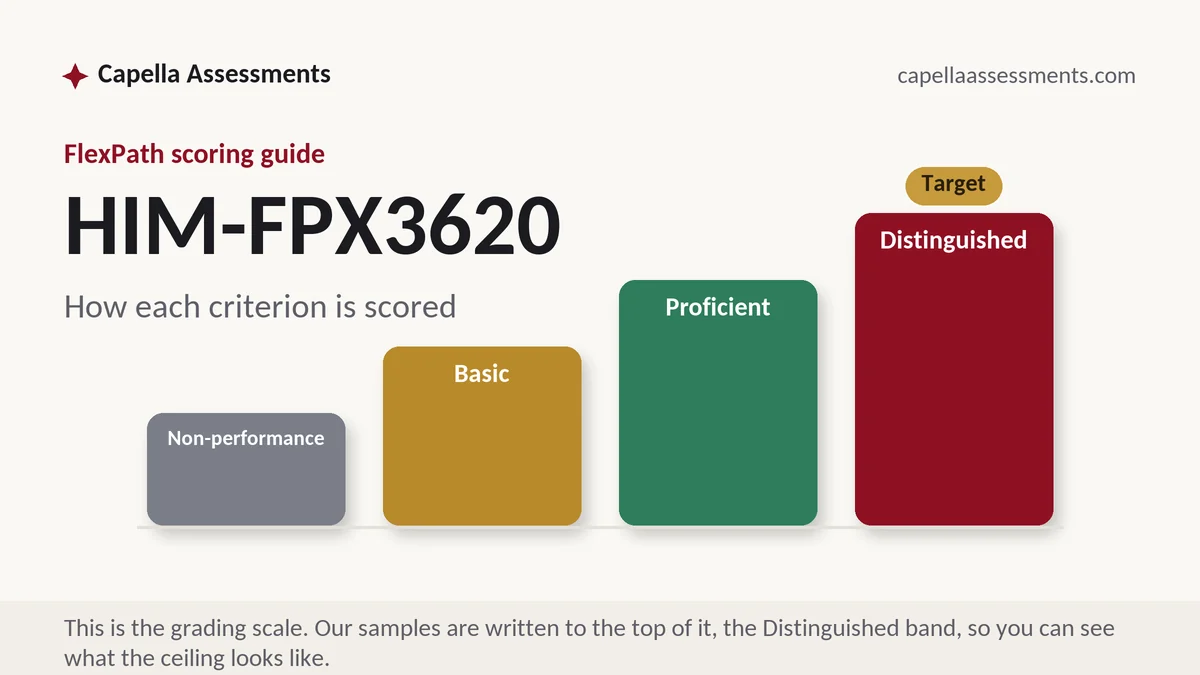
Samples here follow one discipline: the scoring guide is the outline, every criterion gets its section, the Distinguished description decides the depth, and the APA layer ships exact. Because Capella updates courses over time, your free custom sample is drafted against the scoring guide you send, not against an archive.
HIM-FPX3620 questions, answered
What actually counts as the legal health record?
It is defined by your organization inside what regulators and accreditors require, so the honest move in a paper is to state the definition you are working from and cite its basis. Generally it is the documentation the organization would produce in response to a legal request, which is narrower than everything stored about a patient and wider than the chart alone.
How do I justify a retention period?
Tie it to a source rather than to a habit. Periods differ by record type, by state requirement, by the age of the patient at the time of service, and by whichever obligation runs longest. A paper naming the governing requirement and applying the longer period is doing the work. A number offered on its own cannot be checked by anyone.
Can I request a HIM-FPX3620 sample written to my own assessment?
Yes, and that is what the desk is for. Send the instructions and the scoring guide from your courseroom and the first custom sample comes back free within 24-48h, written against your criteria. Read it as a model of structure and sourcing, then write your own submission, since the sample exists to show the shape of a strong answer.