Send the exact assignment or rubric from your classroom and a custom sample written to it lands in 24 to 48 hours, the first one free. HRM-FPX5055 is Capella’s Comprehensive Reward Systems course. It centers on building a defensible pay structure from job evaluation and market data, then justifying every number in it. Searches like "hrm fpx 5055 assessment 3 assignment example", "HRMFPX5055 sample paper", and "HRM-FPX5055 assessment samples" land on this page.
What HRM-FPX5055 is really about
Compensation is the HR subject that will not let a good sentence rescue a bad table. The work produces numbers, and numbers either reconcile or they do not: a range that does not sit around its own midpoint, a grade whose spread contradicts the one above it, a market figure applied without saying which survey, which year or which geography it came from. Scoring guides here read the structure before they read the prose, which is why HRM-FPX5055 catches out students who write fluently about motivation and total rewards philosophy. The criterion is asking whether this plan could be handed to a payroll office and implemented, not whether the thinking behind it is admirable.
Two pressures decide the shape of any structure, and the course is built on the tension between them. Internal equity asks whether jobs are ranked sensibly against each other, which is what job evaluation produces. External competitiveness asks what the market pays for the same work, which is what survey data produces, and the two rarely agree. A paper that resolves the conflict, saying which jobs are led, which are lagged and why the organization can afford that choice, is doing what the criteria measure. Law sits underneath both: a pay difference between employees performing substantially equal work needs a factor other than sex behind it, and a role misclassified as exempt turns a design question into unpaid overtime liability.
What HRM-FPX5055’s assessments ask for
Most assessments in this course ask you to analyze or design part of a reward system for a described organization. That means establishing what the jobs are worth internally, pricing benchmark jobs against market data you name and date, and building grades and ranges that follow from both. Where variable pay is in scope, the criteria expect the trigger, the measure and the funding source rather than a statement that incentives motivate performance. Benefits sections want cost to the employer and value to the employee treated separately, since they are rarely the same. Many versions also ask you to justify the philosophy behind the structure, and that justification is scored on whether it explains the numbers you produced rather than sitting above them as preamble.
Where students lose points in HRM-FPX5055
Compensation papers most often fail at the seam between the argument and the table. A rationale insists the structure leads the market while the ranges it produced sit below every benchmark quoted two pages earlier, and the criterion reading internal consistency finds the contradiction at once. Market data quoted with no survey, no date and no geography costs the next set of marks, because everything built on top of it becomes unverifiable. Points also go for motivation theory expanded to fill the space where a structure belongs, for incentive plans with no funding source, for benefits named rather than costed, and for pay decisions defended by fairness alone where the criterion asked for a business rationale. Classification does quiet damage too, since an exempt label on a role that fails the duties test undoes the design underneath it.
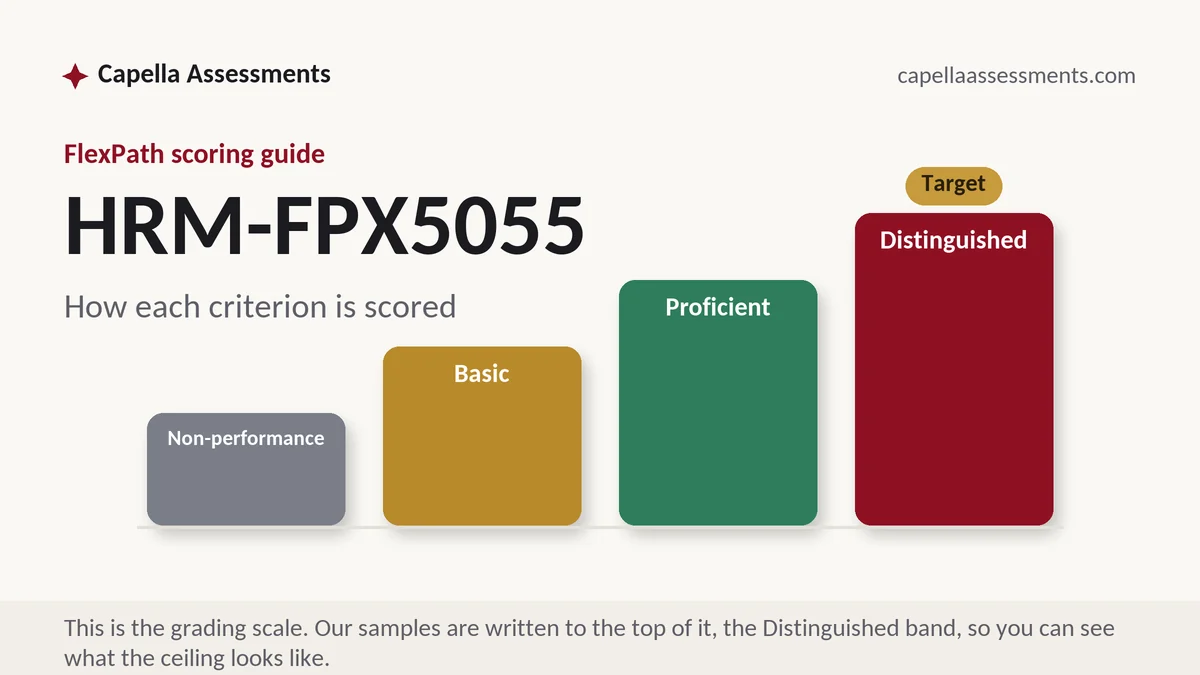
The HRM-FPX5055 drawers
HRM-FPX5055 Assessment 1 job evaluation analysis example
Assessment 1 typically ranks the jobs internally before any market figure enters the plan. On request, free, 24-48h.
HRM-FPX5055 Assessment 2 compensation plan example
Assessment 2 commonly prices benchmark jobs and turns the results into grades and ranges. On request, free, 24-48h.
HRM-FPX5055 Assessment 3 total rewards proposal example
Assessment 3 in many sections adds benefits and variable pay to the base structure. On request, free, 24-48h.
Your classroom shows something else?
Capella University revises courses; assessment counts and deliverables shift between terms. Send what your classroom shows and the desk matches it exactly.
Using a HRM-FPX5055 sample the right way
Treat a sample as a worked example before you treat it as writing. Follow one benchmark job from its evaluation points through its market match to the grade it lands in, and satisfy yourself that you could reproduce every step. That traceability is what the analytical criteria are looking for. Then read the rationale and notice how it explains particular numbers instead of describing a compensation philosophy in general. Build your own around an organization whose jobs you can genuinely describe, since job content is what evaluation runs on, and rerun the arithmetic yourself rather than trusting a table you inherited.
How these samples are written
Every sample in this drawer is written the same way our custom ones are: the scoring guide decoded criterion by criterion, a subject-matched writer drafting to the Distinguished column, APA checked line by line, and the reasoning annotated so the paper teaches while it shows. Capella revises scoring guides, so a custom request is always written to the guide in YOUR courseroom, never from a stale template.
HRM-FPX5055 questions, answered
Do I need real salary survey data for HRM-FPX5055?
Where the instructions allow published sources, use them and state the survey, the year and the geography. Where they do not, a clearly labelled assumption is acceptable and far safer than an unattributed figure. A market number with no attribution costs more than an approximate one that names its basis, because every grade and range built on top of it becomes unverifiable to the person scoring your work.
How much math is actually in this course?
Enough that it can be checked. You will rank jobs, price them, set midpoints and build ranges, and the criteria read whether those pieces agree with each other. The mathematics is not advanced, but it is unforgiving: one grade boundary set carelessly shows up in every table afterwards. Budget time for reconciling the numbers, not only for writing the rationale around them.
Can I get a HRM-FPX5055 Assessment 2 example with the tables in it?
Yes. Send the instructions and the scoring guide and the sample comes back with the structure built out, evaluation through to ranges, so you can see how the numbers are carried between sections. The first custom sample is free and normally lands inside 24-48h. It is written to your version of the assessment, since the data and the organization differ between sections.