Send the exact assignment or rubric from your classroom and a custom sample written to it lands in 24 to 48 hours, the first one free. HRM-FPX5075 is Capella’s Leading and Influencing for the Human Resource Practitioner course. It centers on moving a decision you do not control by building a case the manager who owns it can defend. Searches like "hrm fpx 5075 assessment 3 assignment example", "HRMFPX5075 sample paper", and "HRM-FPX5075 assessment samples" land on this page.
What HRM-FPX5075 is really about
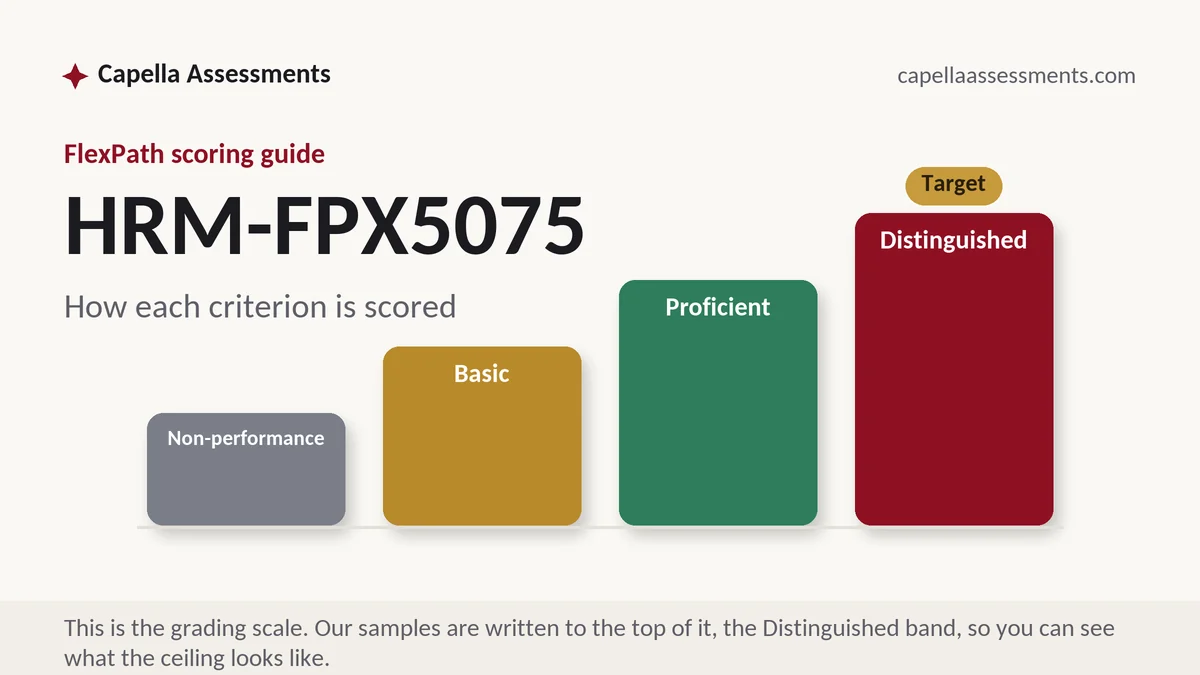
HR practitioners lead sideways. The recommendation goes to somebody who outranks them or controls a budget they cannot touch, and HRM-FPX5075 is scored on whether the writing accounts for that fact. A paper summarising transformational and transactional leadership accurately has not yet reached the course's question, which is how a person with no command over the outcome gets the outcome anyway. Strong submissions name the individual who has to be moved, state what that person is measured on, and shape the case so that agreeing costs them less than refusing. Theory enters where it changes the approach and stays out where it would only decorate it, and the scoring guide reads the difference.
Credibility carries this course where charisma would carry another one. HR is the function most often brought in after the decision and asked to make it survivable, so the influence problem starts before the conversation does, in whether this practitioner is read as judgment or as paperwork. Stakeholder analysis earns marks only when it says what each person stands to lose, and resistance is read the same way, as information about a real cost rather than an obstacle to be handled. One lever deserves particular care: legal exposure is genuine leverage, and a practitioner who reaches for it on every occasion spends it. Where the assessment turns to your own practice, name a relationship you have not built and the first conversation you would use to start it.
What HRM-FPX5075’s assessments ask for
Assessments put a change or a recommendation in front of you and ask how you would get it accepted. That means identifying the decision maker and the people whose cooperation the change needs, analyzing what each of them is accountable for, and choosing an approach that fits the specific resistance you expect rather than the general idea of resistance. Where the criteria ask for a business case, they want the cost of doing nothing stated in terms the manager already tracks: turnover, overtime, time to fill, grievances. Change models appear in many sections and are scored on application rather than description. Where the assessment involves a difficult message, writing the words you would use, including the concession you would have to make, is what makes it assessable.
Where students lose points in HRM-FPX5075
Marks concentrate where the paper forgets it is writing to somebody else. The stakeholder section is the usual place: roles listed with an interest rating and no statement of what any of them would have to surrender. Close behind is the case argued from principle, insisting the practice is best in class rather than showing what the present arrangement costs the manager who would have to change it. A theory section comparing influence styles and then recommending whatever the writer wanted anyway loses the application criteria outright. Points also go for tactics that quietly assume authority the practitioner does not hold, for change models named and then abandoned, and for reflections written as ambitions, which could have come from any practitioner in any organization.
The HRM-FPX5075 drawers
HRM-FPX5075 Assessment 1 stakeholder influence analysis example
Assessment 1 typically maps who decides, who resists, and what each stands to lose. On request, free, 24-48h.
HRM-FPX5075 Assessment 2 change leadership plan example
Assessment 2 commonly turns that reading into a sequence for getting the change accepted. On request, free, 24-48h.
HRM-FPX5075 Assessment 3 leadership development plan example
Assessment 3 usually asks what the practitioner would change about how they build credibility. On request, free, 24-48h.
Your classroom shows something else?
Capella University revises courses; assessment counts and deliverables shift between terms. Send what your classroom shows and the desk matches it exactly.
Using a HRM-FPX5075 sample the right way
Look in a sample for the sentence written from the other person's side, where the argument stops being what HR wants and becomes what the manager gets. That inversion is the skill the criteria measure and the hardest one to reverse-engineer from a scoring guide alone. Then check how the sample handles the strongest objection, whether it is answered or quietly avoided. Build your own around a change you have genuinely tried to get accepted, since the texture of real resistance is difficult to invent and immediately recognisable to anyone who has met it.
How these samples are written
Samples here follow one discipline: the scoring guide is the outline, every criterion gets its section, the Distinguished description decides the depth, and the APA layer ships exact. Because Capella updates courses over time, your free custom sample is drafted against the scoring guide you send, not against an archive.
HRM-FPX5075 questions, answered
Which leadership or change model should I use in HRM-FPX5075?
Whichever one you can carry through the whole paper. The criteria read application, so a model whose steps show up in your plan beats a better known one named once and dropped. Say why it suits this situation and what you would have lost by choosing another. A model that produces the same recommendation you would have written without it is not doing any work.
How do I write about influence when I have no formal authority?
That is the assignment. Authority would make the paper trivial, so the criteria look at what you use instead: evidence the manager trusts, a relationship built before it was needed, timing, and framing the request against something they are already accountable for. Name those levers explicitly rather than describing yourself as collaborative, which offers a temperament where the criterion wants a tactic.
Can the desk write a HRM-FPX5075 sample for my scenario?
Yes. Send the instructions, the scoring guide and the scenario if your section supplies one, and the first custom sample comes back free, normally inside 24-48h. Influence assessments vary in whether the stakeholder analysis or the change plan carries the weight, so a sample built from your own criteria shows you where the effort belongs in your version.