Send the exact assignment or rubric from your classroom and a custom sample written to it lands in 24 to 48 hours, the first one free. HRM-FPX5118 is Capella’s Human Resource Legal Challenges and Solutions course. It centers on converting an employment law problem into the duty an employer owes, the process that discharges it, and the record that proves it. Searches like "hrm fpx 5118 assessment 3 assignment example", "HRMFPX5118 sample paper", and "HRM-FPX5118 assessment samples" land on this page.
What HRM-FPX5118 is really about
Compliance is a posture, and HRM-FPX5118 is scored on the opposite. Writing that an employer must follow Title VII, or that discrimination is prohibited, satisfies nothing, because the criteria ask which duty attached, when it attached, and what the employer owed once it did. Employment law works through triggers: a request for adjustment starts an interactive obligation, a serious health condition and enough hours worked start a leave entitlement, a complaint starts a duty to investigate and a separate prohibition on retaliation. A paper that identifies the trigger can then say what should have happened next. A paper that stays at the level of the statute name can only tell the employer to act lawfully, which answers nothing anyone asked.
The second word in the course title is doing real work. These assessments are written for a reader who has to act, usually a line manager with a decision in front of them, so the analysis has to convert into an instruction: hold the meeting, request the certification, write the reason down while it is fresh, apply the policy the same way to the next person. Two distinctions carry marks. One separates conduct that is unlawful from conduct that is merely unwise, since an employer can sit inside the law and still hand a plaintiff a case. The other separates the rule from the record, because most employment disputes turn on whether the employer can show what it did and why, long after anyone remembers.
What HRM-FPX5118’s assessments ask for
Assessments generally hand you a workplace scenario and ask what the employer is exposed to. That means separating the issues instead of merging them, identifying the specific statute or doctrine that reaches each one, checking the coverage conditions that decide whether it applies to this employer at all, and applying it to the facts you were given rather than to the subject in general. Where the criteria ask for authority, agency guidance and decided cases carry more weight than a summary article. The solutions half usually wants two outputs: what the employer should do about this situation now, and what should change in policy, training or documentation so the next one does not arise. Several versions also ask you to weigh the risk carried by each option rather than presenting one.
Where students lose points in HRM-FPX5118
The first marks go to the statute named and the duty left unstated, which produces an accurate paragraph about a law and no analysis of what this employer owed. Next is the recommendation to consult legal counsel, offered as the answer rather than as the step it actually is. Third is the missed retaliation issue, where the underlying complaint is examined carefully and what happened to the complainant afterwards is never assessed at all. Marks also go for coverage conditions skipped, so a duty gets applied to an employer the rule may not reach; for jurisdiction left unnamed where state law differs; for policy recommendations with no training or documentation behind them; and for analysis treating unfair as a synonym for unlawful, which surrenders the distinction the course exists to teach.
The HRM-FPX5118 drawers
HRM-FPX5118 Assessment 1 legal risk analysis example
Assessment 1 typically separates a scenario into issues and names the duty attached to each. On request, free, 24-48h.
HRM-FPX5118 Assessment 2 grievance case analysis example
Assessment 2 often works a complaint through investigation, decision and the record supporting it. On request, free, 24-48h.
HRM-FPX5118 Assessment 3 policy revision memo example
Assessment 3 usually turns the analysis into policy, manager guidance and what gets documented. On request, free, 24-48h.
Your classroom shows something else?
Capella University revises courses; assessment counts and deliverables shift between terms. Send what your classroom shows and the desk matches it exactly.
Using a HRM-FPX5118 sample the right way
Read a sample at the joints. Watch where it separates one scenario into distinct issues, and watch the sentence that turns a legal conclusion into an instruction someone could carry out on Monday. Those two moves are what the criteria measure, and neither is easy to infer from a scoring guide alone. Skim the statutory background, which any source will supply. Then rework the analysis with your own facts, since the scenario in your section will differ in exactly the details that decide the answer. Notice as well what the sample tells the employer to record and when, because documentation is where a defensible decision becomes a provable one.
How these samples are written
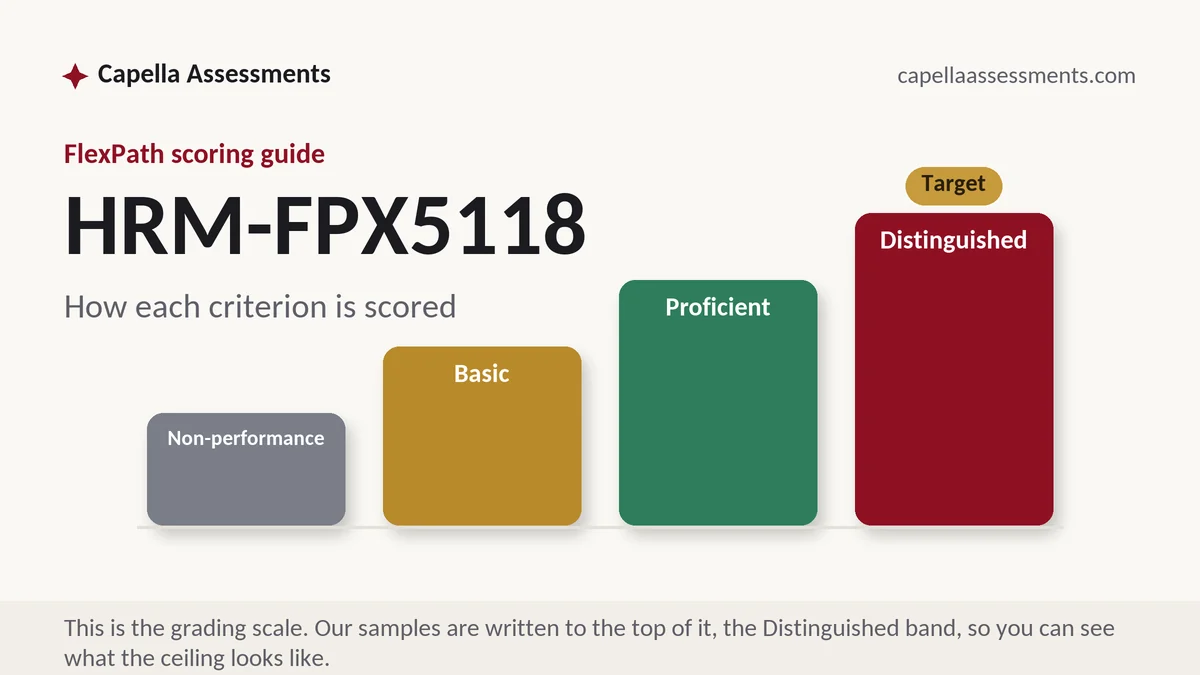
Samples here follow one discipline: the scoring guide is the outline, every criterion gets its section, the Distinguished description decides the depth, and the APA layer ships exact. Because Capella updates courses over time, your free custom sample is drafted against the scoring guide you send, not against an archive.
HRM-FPX5118 questions, answered
Do I have to cite actual cases in HRM-FPX5118?
Follow the instructions, but authority helps. Agency guidance and decided cases give an employment law argument something to stand on, and both are publicly available. A general article summarizing a statute is weaker than the guidance it summarizes. Where you cite a case, use it for the rule it settled rather than for the story, and say whether it binds the jurisdiction you chose.
The scenario could go different ways depending on the state. What then?
Name the jurisdiction and say why you picked it. Employment law varies at state level on leave, pay, non-competes and protected classes, and an answer written for nowhere in particular cannot be assessed against anything. Choose a state, apply its rule alongside the federal floor, and note in one line where a different state would produce a different result.
How fast can I get a HRM-FPX5118 sample?
Within 24-48h of sending what your section actually requires: the assessment instructions, the scoring guide from your courseroom, and the scenario if one was provided. The first custom sample is free. Where a case study comes with the assessment, the sample is written to that fact pattern rather than to a substitute, since in this course the facts decide the answer.