Send the exact assignment or rubric from your classroom and a custom sample written to it lands in 24 to 48 hours, the first one free. IT-FPX1170 is Capella’s Goals and Ethics for the IT Professional course. It centers on what an IT professional owes the people whose data and systems they touch, and how a career gets planned deliberately. Searches like "it fpx 1170 assessment 3 assignment example", "ITFPX1170 sample paper", and "IT-FPX1170 assessment samples" land on this page.
What IT-FPX1170 is really about
What makes IT ethics its own subject is access. A help desk technician can read what a vice president cannot, and IT-FPX1170 is built on that asymmetry. The scoring guides reward papers that put a genuine dilemma on the page, a colleague browsing records they have rights to but no reason for, a manager asking for a shortcut the policy forbids, and then reason through it with a named professional code doing visible work. The common failure is the sermon: a paper announcing that honesty and integrity matter, which no criterion can score because nothing was ever at stake. An ethical position only becomes assessable when the writer shows what following it would cost.
The goals half of the course is scored with the same insistence on the checkable. A goal criterion is not satisfied by wanting to grow in the field; it wants a target role, the distance between present skills and that role, and dated milestones a reader could verify happened. Strong submissions treat the plan like a small project: current state, gap, actions, evidence of completion. The two halves also meet, because in many sections the criteria ask how ethical commitments shape the career being planned, and the papers that answer well pick a commitment with teeth, a line the writer would not cross for a promotion, rather than a value stated in the abstract.
What IT-FPX1170’s assessments ask for
Assessments typically ask for three kinds of writing. The ethics analysis wants a scenario examined through a professional code, with the relevant provisions named and applied rather than the code cited whole, and a decision defended including what it costs. The goal-setting work wants a professional development plan with a target role, a skills inventory honest enough to show gaps, and milestones with dates. Reflective components ask where your own line sits, and score on specificity: the situation that would test you, named, beats a paragraph of good intentions. Where the criteria mention stakeholders, they mean the people affected by an IT decision, users, data subjects, employers, and the marks go to papers that notice when those interests pull in different directions rather than assuming they align.
Where students lose points in IT-FPX1170
The sermon costs the most: values affirmed, nothing decided, no criterion touched. Second is the ethics case with no tension, chosen because the answer is obvious, which leaves the analysis nothing to weigh; a dilemma both of whose sides are defensible is what the assessment actually wants. Third is the aspirational plan, goals with no dates, no gap analysis and no way a reader could later tell whether any of it happened. Marks also go for citing a code without applying a specific provision, for treating the employer's interest as the only interest in play, and for reflections written to sound admirable rather than to be true, which experienced graders in current courserooms recognize on sight and score as evasion.
The IT-FPX1170 drawers
IT-FPX1170 Assessment 1 ethics case analysis example
Assessment 1 typically reasons through one IT workplace dilemma using a named professional code. On request, free, 24-48h.
IT-FPX1170 Assessment 2 professional development plan example
Assessment 2 often maps a target role, the skills gap, and dated milestones. On request, free, 24-48h.
IT-FPX1170 Assessment 3 reflective position paper example
Assessment 3 usually asks where your own ethical line sits and what would test it. On request, free, 24-48h.
Your classroom shows something else?
Capella University revises courses; assessment counts and deliverables shift between terms. Send what your classroom shows and the desk matches it exactly.
Using a IT-FPX1170 sample the right way
Read a sample at the point of cost, the sentence where doing the right thing visibly loses the writer something, because that is the moment the ethics criteria come alive. Notice too how the development plan names dates and artifacts, a certificate earned, a project shipped, so progress could be audited. Then build your own case from a pressure you have actually felt or could realistically face, since invented dilemmas tend to resolve too cleanly. A sample written to your own IT-FPX1170 scoring guide is free the first time and lands within 24-48 hours; study its reasoning shape, then argue a case that is yours.
How these samples are written
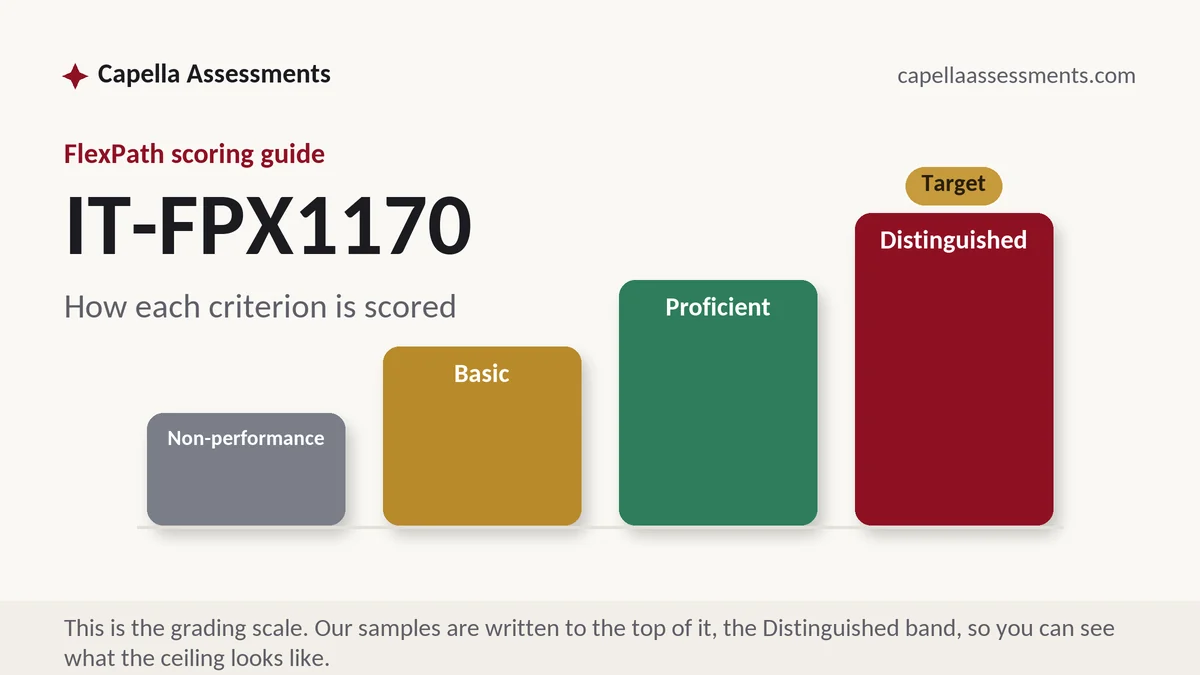
Samples here follow one discipline: the scoring guide is the outline, every criterion gets its section, the Distinguished description decides the depth, and the APA layer ships exact. Because Capella updates courses over time, your free custom sample is drafted against the scoring guide you send, not against an archive.
IT-FPX1170 questions, answered
Does my IT-FPX1170 ethics paper need a real professional code?
Working from a named code is what makes the analysis concrete, because then a specific provision can be set against a specific act. Cite the provision you apply, not just the organization that publishes it. Where two provisions pull against each other, saying so strengthens the paper; codes are written to require judgment, and showing the judgment is what the criteria reward.
What counts as a measurable goal in the development plan?
One a stranger could verify. A role named, a skill gap stated plainly, an action with a date, and an artifact that proves completion, a credential, a portfolio piece, a responsibility taken on. In current courserooms the criteria for this plan reward evidence over enthusiasm, so a modest goal with a verification path outscores an inspiring one that cannot be checked.
Is it okay to request a sample for a course about ethics?
The samples are study models, which is a use the course's own subject supports: you are examining how a strong argument is built, then writing your own. Read the sample for its reasoning structure and its handling of cost, not for sentences to reuse. The request is free the first time, and what you submit should be your own position, argued in your own voice.