Send the exact assignment or rubric from your classroom and a custom sample written to it lands in 24 to 48 hours, the first one free. IT-FPX4803 is Capella’s System Assurance Security course. It centers on assuring one system an organization relies on, matching each control to a named risk and proving it works. Searches like "it fpx 4803 assessment 3 assignment example", "ITFPX4803 sample paper", and "IT-FPX4803 assessment samples" land on this page.
What IT-FPX4803 is really about
Assurance is a stricter word than security, and IT-FPX4803 is graded on the difference. Security writing can list safeguards; assurance writing must show that each safeguard answers a named risk on a named system and that its working can be demonstrated to someone who doubts it. The strong papers therefore start with the system and what the organization loses when it fails, confidentiality, integrity, or availability, priced in business terms, and only then reach for controls. Each control arrives paired with its risk and with the evidence that would prove it holds: a log reviewed, a restore rehearsed, an access list reconciled. A control without a risk is decoration, and a risk without evidence planned is a promise.
The organizational half of the grade is proportion. A control that stops the threat and also stops the nursing shift from charting has solved the wrong problem, and this course marks it that way: the criteria expect the cost of a safeguard, in money, in friction, in hours, weighed against the exposure it closes. Continuity belongs to the same argument, since the system being assured must also survive bad days, which brings backup, recovery objectives, and the difference between an outage and a breach into the paper. In current courserooms the scoring guides also reward policy written as if people will read it: short obligations assigned to roles, not a recitation of frameworks with no one accountable inside them.
What IT-FPX4803’s assessments ask for
Assessments typically move from analysis to plan to proof. Early work usually assesses a described system for exposures, asking you to identify what is worth attacking, from where, and what the organization stands to lose, with the reasoning anchored to that system rather than to threats in general. The middle in many sections builds the safeguard layer: technical and administrative controls selected against the identified risks, each justified for cost and side effects, and the residual risk stated honestly rather than rounded to zero. Later work often asks for the assurance itself, the testing, monitoring, and audit activity that would demonstrate the controls function, plus the continuity arrangements for when one fails. Framework references earn only when tied to a decision this system needed.
Where students lose points in IT-FPX4803
The defining loss is the checklist paper: controls transcribed from a framework, none mapped to a risk this system actually carries, so the assessor cannot tell whether the writer understood anything or copied everything. Second is threat inflation, an analysis that treats every exposure as existential, which reads as an inability to prioritize and makes the cost argument impossible. Third is the assurance gap, safeguards proposed with no way to demonstrate they function, no log, no test, no review cycle, leaving the paper all plan and no proof. Marks also go for residual risk claimed as eliminated, for controls whose business friction is never priced, for continuity sections that set recovery objectives no backup design could meet, and for policies addressed to no role in particular.
The IT-FPX4803 drawers
IT-FPX4803 Assessment 1 risk assessment example
Assessment 1 typically prices what one system's failure costs and where attack pressure sits. On request, free, 24-48h.
IT-FPX4803 Assessment 2 controls justification example
Assessment 2 often selects safeguards against named risks, priced for cost and friction. On request, free, 24-48h.
IT-FPX4803 Assessment 3 assurance and continuity plan example
Assessment 3 usually plans the proof: tests, monitoring, audits, and recovery when a control fails. On request, free, 24-48h.
Your classroom shows something else?
Capella University revises courses; assessment counts and deliverables shift between terms. Send what your classroom shows and the desk matches it exactly.
Using a IT-FPX4803 sample the right way
Read an assurance sample down its mapping. Every control should be traceable left to a risk and right to the evidence that would prove it works; run your finger along a few rows and the paper's logic becomes visible. Notice how residual risk is admitted and sized, because that honesty is a criterion in most sections and a habit worth stealing. Then choose a system you genuinely understand, even a modest one, and build your own three-column logic around it. A small system assured completely outscores an enterprise sketched loosely, and the discipline scales to whatever you defend after graduation.
How these samples are written
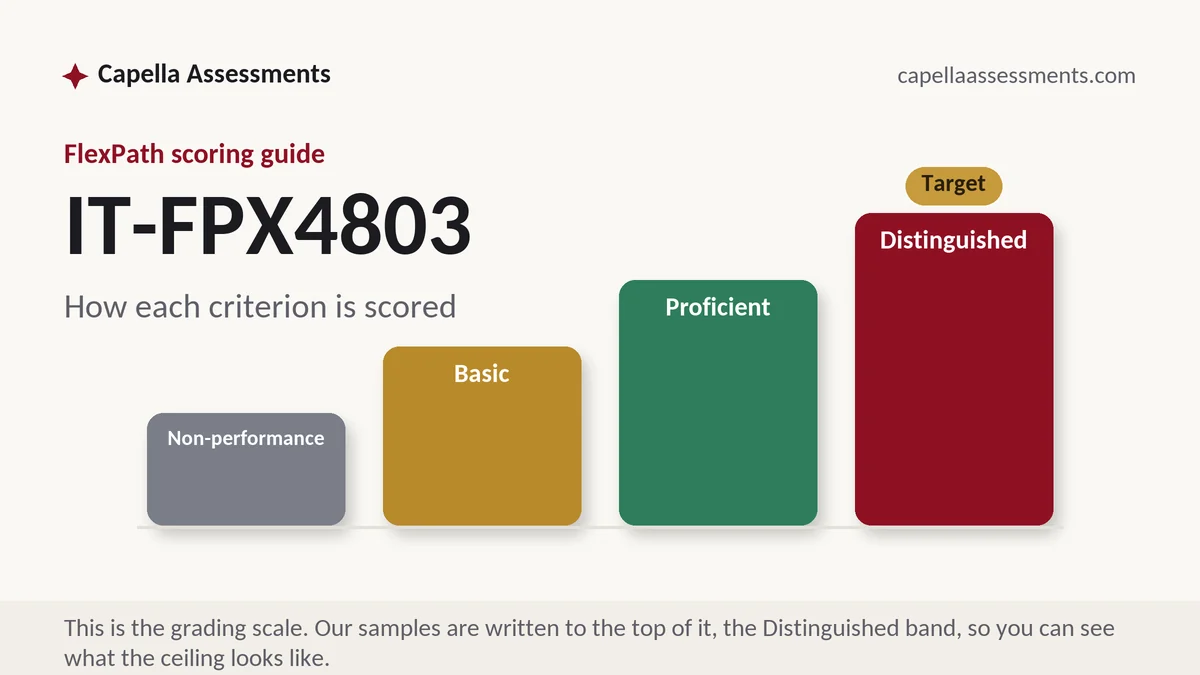
Samples here follow one discipline: the scoring guide is the outline, every criterion gets its section, the Distinguished description decides the depth, and the APA layer ships exact. Because Capella updates courses over time, your free custom sample is drafted against the scoring guide you send, not against an archive.
IT-FPX4803 questions, answered
How does IT-FPX4803 differ from the cybersecurity capstone?
Scope. This course assures one system deeply: its risks, its controls, its proof. IT-FPX4993 integrates the whole security program for an organization and is scored on how the pieces hand off to each other. Doing 4803 well is the best preparation, because a capstone is several of these arguments made to cohere.
Do I need a specific framework for the controls section?
Use whichever your instructions name, and where none is named, pick one and use it as a source of candidate controls rather than as an outline. The criteria pay for the mapping between control and risk, which no framework does for you. A paper organized by its own risks, borrowing controls where they fit, reads as understanding.
Can I request an IT-FPX4803 sample against my exact scoring guide?
That is the only way these get written. Forward the scoring guide and instructions from your courseroom and a sample is composed to those criteria within 24 to 48 hours, free on the first occasion. Sections weight the assurance evidence differently, so a generic security paper would serve you worse than one shaped to your own criteria list.