Send the exact assignment or rubric from your classroom and a custom sample written to it lands in 24 to 48 hours, the first one free. LEAD-FPX5210 is Capella’s Leading Globally course. It centers on what happens to a leader's habits when the team spans cultures, argued through a specific situation. Searches like "lead fpx 5210 assessment 3 assignment example", "LEADFPX5210 sample paper", and "LEAD-FPX5210 assessment samples" land on this page.
What LEAD-FPX5210 is really about
LEAD-FPX5210 is a graduate course, and the scoring guides read like it: description earns little, application earns some, and judgment under constraint earns the criterion. The material tempts writers toward two easy papers, a summary of cultural dimension research and a celebration of inclusive leadership, and neither is what gets scored. What the criteria want is a leader with a specific problem, a deadline missed across time zones, feedback that landed as insult, silence in a meeting that meant five different things, and an analysis of how cultural difference produced it. Dimension frameworks belong in that analysis as instruments, generating hypotheses about what the behavior means, and they turn poisonous the moment they become verdicts about what people from somewhere are like.
The strongest submissions treat adaptation as a cost-bearing decision rather than an attitude. Adjusting a communication style, restructuring a meeting so input arrives asynchronously, moving a negotiation off email, each has a price somewhere else, and graduate criteria reward the writer who names it. Self-assessment runs through most versions of this course, and it works the same way: the useful sentence identifies a default you carry, where it comes from, and the context in which it stops serving you. Sources are expected to be scholarly and current, with named frameworks attributed to their researchers rather than floated as common knowledge. What holds the whole paper together is the decision test: by the end, something the leader will do differently exists on the page, with a reason.
What LEAD-FPX5210’s assessments ask for
Assessments in current courserooms typically combine analysis of a global leadership situation with a plan and a self-assessment. The situation may be supplied as a case or drawn from your own work; either way the criteria want the cross-cultural mechanics traced, what each party expected, where the expectations came from, and what the collision cost. Plans are scored on operational content: how communication, decision rights and conflict handling change for this team, not on commitments to awareness. The self-assessment usually asks you to locate your own leadership profile against the demands of a global role and to name development moves with some way of telling they happened. Where a presentation is required, expect the same analysis compressed for an executive audience rather than restated.
Where students lose points in LEAD-FPX5210
The travel guide is the characteristic loss: a country profile recited, high context, hierarchical, relationship oriented, applied to nobody in particular. Second is the framework used as a stereotype dispenser, individuals explained entirely by their nationality, which graduate criteria increasingly penalize in so many words. Third is the frictionless plan, adaptation promised everywhere at no cost to speed, clarity or accountability, which reads as unserious to anyone who has run a distributed team. Marks also leave through cases described too thinly to analyze, self-assessments that discover only strengths, sources a decade old in a field that keeps moving, and conclusions where the leader has learned a great deal and will change nothing identifiable on the next call.
The LEAD-FPX5210 drawers
LEAD-FPX5210 Assessment 1 global leadership analysis example
Assessment 1 typically traces how cultural difference produced one team's specific problem. On request, free, 24-48h.
LEAD-FPX5210 Assessment 2 cross-cultural strategy paper example
Assessment 2 often plans how communication and decision rights change for a global team. On request, free, 24-48h.
LEAD-FPX5210 Assessment 3 leadership self-assessment example
Assessment 3 usually measures your own defaults against what a global role demands. On request, free, 24-48h.
Your classroom shows something else?
Capella University revises courses; assessment counts and deliverables shift between terms. Send what your classroom shows and the desk matches it exactly.
Using a LEAD-FPX5210 sample the right way
Read a sample for the moment culture stops being background and starts driving the decision. There is usually one paragraph where the analysis pivots, where the framework explains the silence or the missed deadline, and the plan follows from that explanation; find it, because that pivot is what your criteria are paying for. Notice also what the adaptation costs and where the paper says so. Then work from a team you have actually led or sat inside, since invented global scenarios flatten exactly the detail this analysis needs. The free first sample is built in 24-48h to your case, instructions and scoring guide.
How these samples are written
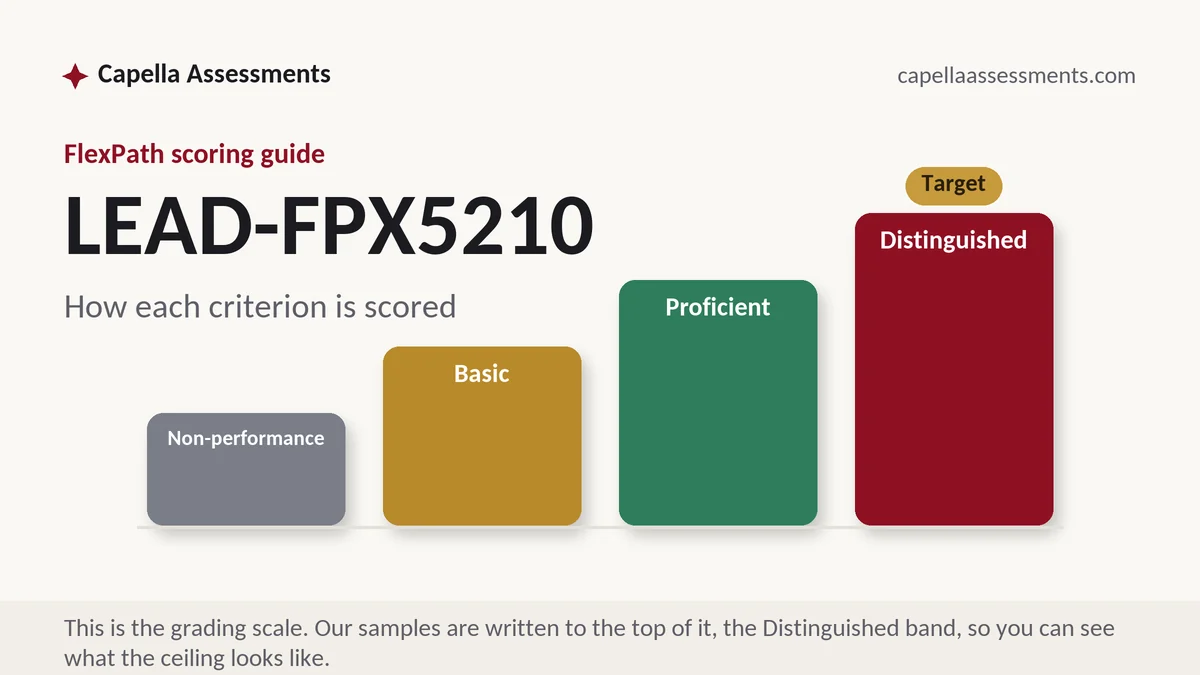
Every sample in this drawer is written the same way our custom ones are: the scoring guide decoded criterion by criterion, a subject-matched writer drafting to the Distinguished column, APA checked line by line, and the reasoning annotated so the paper teaches while it shows. Capella revises scoring guides, so a custom request is always written to the guide in YOUR courseroom, never from a stale template.
LEAD-FPX5210 questions, answered
Can LEAD-FPX5210 work be based on my own team?
Usually yes, and it is the strongest raw material, since the analysis depends on details only an insider holds: who went quiet, what the deadline slippage actually looked like, which messages misfired. Anonymize the organization and the people. Where instructions supply a case instead, mine your experience for the judgment and apply it there.
Do I have to use a cultural dimensions framework?
Use what your instructions and scoring guide name; many sections expect a recognized framework applied and properly attributed. The graded distinction is in how it is used: as a hypothesis about why a behavior made sense to the person doing it, framed at the level of tendencies. Applied as a verdict on individuals, the same framework costs marks instead of earning them.
How fast can a LEAD-FPX5210 sample arrive, and what should I send?
Within 24-48h, free the first time. Send the assessment instructions, the scoring guide, and whatever situation your section uses, the assigned case or a sketch of your own team's problem. Graduate scoring guides differ meaningfully between sections in this course, so the sample is built against yours rather than against a generic global leadership prompt.