Send the exact assignment or rubric from your classroom and a custom sample written to it lands in 24 to 48 hours, the first one free. MAT-FPX2150 is Capella’s Data and Statistics for Everyday Life course. It centers on reading the statistics embedded in daily decisions, from interest rates to health claims, and judging what they actually show. Searches like "mat fpx 2150 assessment 3 assignment example", "MATFPX2150 sample paper", and "MAT-FPX2150 assessment samples" land on this page.
What MAT-FPX2150 is really about
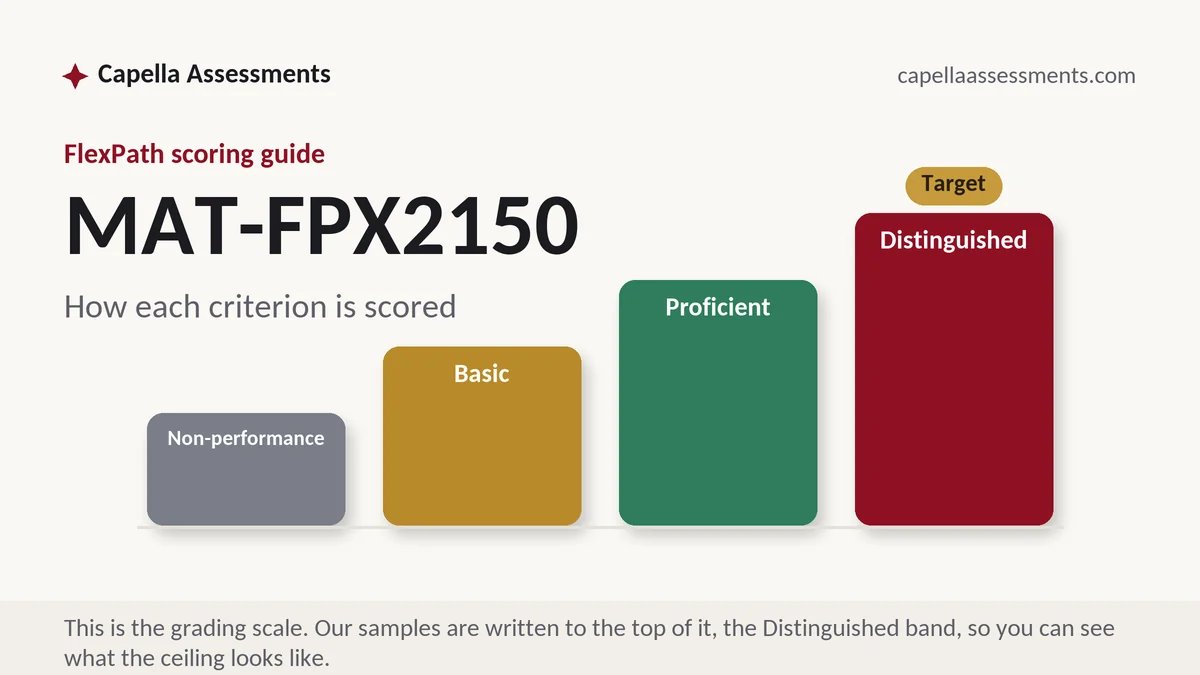
This course is statistics pointed outward. Where a formal statistics sequence builds procedures, MAT-FPX2150 builds judgment about numbers that were produced by someone else, usually someone with a purpose. The assessments hand you the kind of figure an adult meets routinely, a percentage change in a news story, an advertised rate, a risk doubling that sounds alarming, and grade whether you can reconstruct what it measures. The arithmetic involved is modest and it is still binary: a percentage taken of the wrong base is wrong, an absolute risk confused with a relative one is wrong. What the scoring guide adds is the verdict, a plain statement of whether the claim survives its own numbers.
The material typically spans personal finance, measurement, chance and data reading: compound interest and loan costs, unit conversions that decide whether a deal is a deal, probability at the scale of lotteries and screenings, and charts whose axes have been chosen to persuade. Because the contexts rotate, the durable skill is the translation step, turning a situation into a calculation and the calculation back into advice. Writing carries real weight for that reason. A correct table of loan payments earns part of a criterion; the sentence saying what the borrower should therefore do earns the rest. Sources behave differently here too, since the object under analysis is often itself a source, and describing where its number came from is part of the assessment.
What MAT-FPX2150’s assessments ask for
Assessments in current courserooms generally pose scenario problems: compare two loan offers with the arithmetic shown, evaluate a health or consumer claim against the data behind it, work a probability question about testing or games, and read a poll or a chart critically. Expect each answer to end in a recommendation a real person could act on, priced in dollars, risk or time. Where a claim is evaluated, the criteria usually want the calculation that checks it, the assumption it leans on, and a rewritten version of the claim that the numbers would actually support. Several sections include a reflection element connecting the material to a decision in your own life, which is graded on the specificity of the numbers rather than the sincerity of the reflection.
Where students lose points in MAT-FPX2150
The classic loss is the percentage of the wrong base: a discount stacked on a discount, a raise after a pay cut, computed as though the base never moved. Second is relative risk reported bare, where a doubling from one in a million to two in a million is written up as alarming because the ratio was mistaken for the stakes. Third is the chart taken at face value, its truncated axis never mentioned. Points also go to interest treated as simple when it compounds, to units dropped mid-calculation so the final figure answers a different question, to sample size ignored when a poll is quoted, and to conclusions that end at the number when the criterion asked what a person should do about it.
The MAT-FPX2150 drawers
MAT-FPX2150 Assessment 1 consumer math solutions example
Assessment 1 typically works percentages, conversions and money problems from daily situations. On request, free, 24-48h.
MAT-FPX2150 Assessment 2 risk and probability analysis example
Assessment 2 often weighs chance, screening results and what a risk figure means. On request, free, 24-48h.
MAT-FPX2150 Assessment 3 statistical claim evaluation example
Assessment 3 usually dismantles polls, charts and published claims with the checks shown. On request, free, 24-48h.
Your classroom shows something else?
Capella University revises courses; assessment counts and deliverables shift between terms. Send what your classroom shows and the desk matches it exactly.
Using a MAT-FPX2150 sample the right way
The best way into a sample here is to pick the scenario furthest from your own life and watch the method survive the change of context. The translation move, situation to calculation to advice, is identical whether the numbers describe a mortgage or a medication, and seeing it twice makes it portable. Notice also what the sample refuses to conclude, because restraint is graded in this course. Then run the same method on a claim you encountered this month, since the assessments reward numbers you can stand behind. A sample built to the scenario set in your own courseroom is free the first time and arrives within 24-48 hours.
How these samples are written
Every sample in this drawer is written the same way our custom ones are: the scoring guide decoded criterion by criterion, a subject-matched writer drafting to the Distinguished column, APA checked line by line, and the reasoning annotated so the paper teaches while it shows. Capella revises scoring guides, so a custom request is always written to the guide in YOUR courseroom, never from a stale template.
MAT-FPX2150 questions, answered
How is MAT-FPX2150 different from Statistical Reasoning?
MAT-FPX2001 builds the statistical procedures themselves; MAT-FPX2150 turns numbers already in the world, rates, risks, poll results, loan terms, into decisions. The writing genre differs accordingly: less running of tests, more auditing of claims other people made with figures they chose. Samples for each course look quite different, which is why both shelves exist on this site.
Can I get a MAT-FPX2150 example for the loan and interest problems?
Yes. Send the actual scenario from your courseroom, because the arithmetic path depends entirely on the terms given: compounding period, fees, comparison horizon. The sample works the calculation in full, shows the comparison table, and finishes with the recommendation sentence the criteria want. First custom sample free, delivered within 24-48 hours of your materials arriving.
Do I have to use the same examples the sample uses?
No, and you should not. The sample's scenarios demonstrate a method, translate the situation into a calculation, run it honestly, turn it back into advice, and that method is what transfers. Your submission works your own section's scenarios, and where a reflection element asks for a decision from your life, your numbers will always beat borrowed ones.