Each drawer below is one MBA-FPX5910 assessment. Where a sample is live, read it in full, true APA form with the reasoning annotated. Where it is not, request it free: send your assessment number and the scoring guide from your courseroom, and a custom sample written to your exact criteria arrives in 24 to 48 hours. Searches like "MBA FPX 5910 assessment 2 example", "MBA FPX 5910 sample paper", and "MBAFPX5910 sample" all land here, because this page is the drawer they belong in.
What MBA-FPX5910 is really about
MBA-FPX5910 is one business problem examined with everything you learned, which is a different assignment from everything you learned, summarized. The capstone asks you to choose a real organization and a real strategic question, then run it through the program's disciplines, strategy, marketing, finance, operations, leadership, until the analyses constrain each other and one recommendation survives. Integration is the whole grade. The scoring guide criteria do not ask whether you remember 5006 or 5014; they ask whether the market chapter's growth assumption is the same number the financial chapter discounts. Working professionals often bring a problem from their own organization, which keeps the stakes honest and the data reachable, and makes the final document worth showing an employer.
In current courserooms the capstone typically begins with a proposal that fixes the problem, the organization, and the architecture of the study, then builds the integrated analysis discipline by discipline, and ends with the recommendation that braids the strands into one course of action. The proposal deserves more respect than it gets, because a capstone fails at the blueprint stage more often than at the writing stage; a problem scoped too wide cannot be integrated by anyone. FlexPath compounds the challenge, since the project spans enough pages that early inconsistencies calcify. The strongest capstones keep a single spine, one problem statement repeated verbatim, one set of assumptions logged and reused, so that by the final chapter the recommendation feels less like a choice and more like a verdict.
What MBA-FPX5910’s assessments ask for
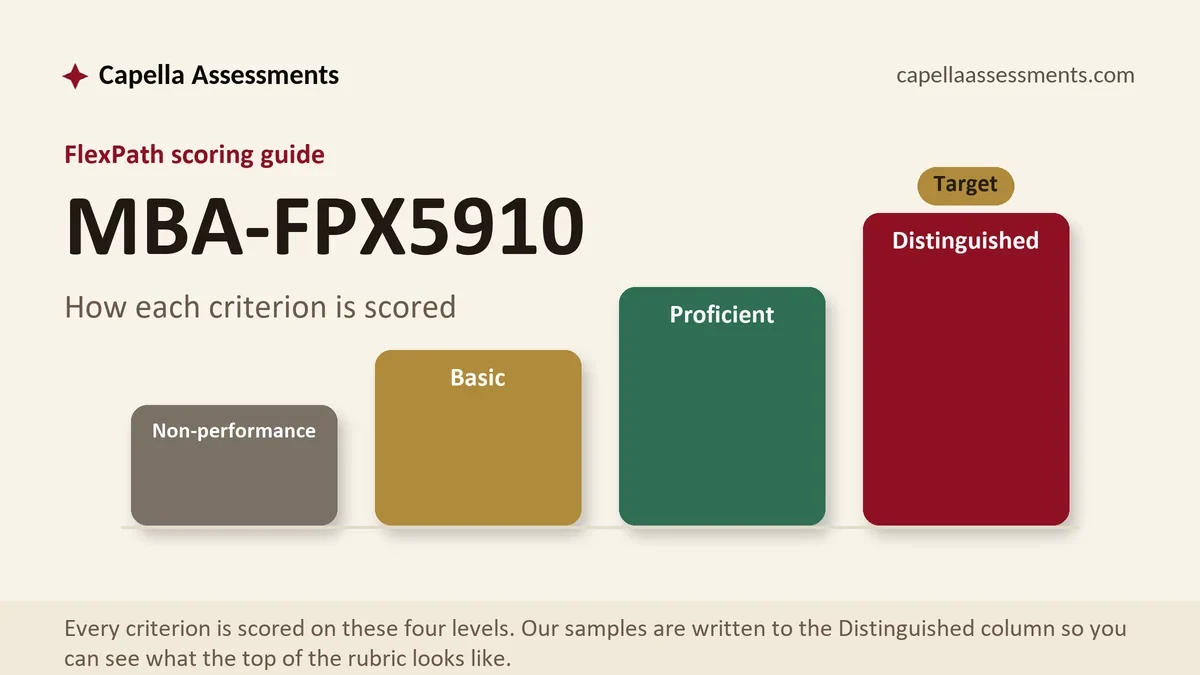
The assessments ask for a consulting engagement in academic form. The proposal wants a problem worth a capstone, bounded, researchable, consequential to the organization, plus the plan for attacking it: which analyses, in what order, on what data. The integrated chapters then ask each discipline to answer its part of the same question, the strategic position assessed, the market and customer case built, the financials modeled, the operational implications traced, with every chapter citing the ones before it. The closing assessment asks for the recommendation and its implementation logic, including risks and the conditions under which you would reverse it. Scoring guide criteria emphasize synthesis and evaluation, so the levels turn on coherence: one organization, one question, one set of numbers, every chapter pulling toward the same decision.
Where students lose points in MBA-FPX5910
The capstone that fails is the one that summarizes the MBA instead of using it. It walks through a strategy section, a marketing section, a finance section, each competent, each sealed off, a highlight reel of prior courses with the organization as a guest star, and the integration criteria grade it Basic because no chapter ever consumes another chapter's output. The telltale symptom is numbers that disagree: the market chapter projects growth the financial model never saw. A second loss is the recommendation that arrives without risks, unthinkable in a document this long, and a third is scope, a problem so large the chapters can only wave at it. The samples show the alternative, one bounded problem, assumptions carried across chapters intact, and a final chapter that audits itself.
The MBA-FPX5910 drawers
MBA-FPX5910 Assessment 1 capstone proposal example
The capstone proposal and architecture. On request, 24-48h.
MBA-FPX5910 Assessment 2 integrated analysis chapters example
The integrated analysis chapters, discipline by discipline. On request, 24-48h.
MBA-FPX5910 Assessment 3 final recommendation example
The final recommendation that braids it all. On request, 24-48h.
Your courseroom shows something else?
Capella revises courses; assessment counts and titles shift between versions. Send what your courseroom shows and the desk matches it exactly.
Using a MBA-FPX5910 sample the right way
Use an MBA-FPX5910 sample before you write your proposal, not after your chapters exist. The highest-value pages are the architecture: how the problem statement is scoped, how the analyses are ordered, and how assumptions are logged so later chapters can reuse them. Trace one number through the sample, a growth rate or a cost figure, and watch it appear in marketing, finance, and the recommendation without changing; that traceability is what you are copying. Then request a free custom sample against the scoring guide in YOUR courseroom, typically 24-48h, and build your own capstone on a problem only you can access.
How these samples are written
Samples here follow one discipline: the scoring guide is the outline, every criterion gets its section, the Distinguished description decides the depth, and the APA layer ships exact. Because Capella updates courses over time, your free custom sample is drafted against the scoring guide you send, not against an archive.
MBA-FPX5910 questions, answered
Should my MBA-FPX5910 capstone be about my own employer?
It is often the strongest choice: you get real data, a problem you understand, and a finished analysis you can actually present at work. The cautions are access and candor, confirm what you may share, and be ready to write critically about your own organization. If either is a problem, a well-documented public company works. Your courseroom instructions and scoring guide frame the choice.
Can I request an MBA-FPX5910 sample for just one part, like the proposal?
Yes. Capstone requests are usually sharpest when scoped: the proposal and architecture, an integrated chapter, or the final recommendation. Send the scoring guide for the assessment you are on and say where you are in the project, and the sample is written to that stage, first one free, typically 24-48h. Many learners request the proposal stage early, because scoping errors are the expensive ones.
How is using an MBA-FPX5910 sample different from rereading my old course papers?
Your old papers show the disciplines separately; the capstone grades what happens between them. A sample demonstrates the connective work, one problem statement governing every chapter, assumptions reused instead of reinvented, a recommendation that cites the analyses it survived. That is a genre none of the earlier courses fully taught. Study the sample for those joints, then write your own project with your own organization's evidence.