Each drawer below is one MHA-FPX5014 assessment. Where a sample is live, read it in full, true APA form with the reasoning annotated. Where it is not, request it free: send your assessment number and the scoring guide from your courseroom, and a custom sample written to your exact criteria arrives in 24 to 48 hours. Searches like "MHA FPX 5014 assessment 2 example", "MHA FPX 5014 sample paper", and "MHAFPX5014 sample" all land here, because this page is the drawer they belong in.
What MHA-FPX5014 is really about
MHA-FPX5014 gathers the three disciplines an administrator cannot delegate away: quality measurement, risk management, and regulatory compliance. The course covers how healthcare quality is defined and measured, how organizations identify and control risk before it becomes harm or liability, and how the regulatory apparatus (CMS, state agencies, accreditors, OSHA where workplaces are concerned) converts public expectations into enforceable obligations. Where a quality framework is needed, current versions still lean on Donabedian's structure, process, and outcome triad, and papers that use it accurately read noticeably stronger. Assessments ask for administrator deliverables: a quality or risk analysis, a compliance evaluation, a program proposal, each argued to leadership rather than written as a textbook chapter.
Across current FlexPath courserooms the assessments typically build from diagnosis to design: first an analysis of quality or risk in a defined setting, then an evaluation of the regulatory and accreditation obligations that apply, then a proposal, often a compliance, risk management, or quality improvement program with responsibilities assigned. Since titles move between revisions, your scoring guide decides the exact deliverable; the drawers below hold that arc. What separates this course from a generic management class is verifiability. Every obligation you claim has an owner and a citation, every metric has a definition, and every proposed control has a named accountable role. Our samples are written to that standard because the Distinguished column, read closely, is asking for exactly it.
What MHA-FPX5014’s assessments ask for
MHA-FPX5014 criteria test whether you can move between three registers without losing precision. The measurement register: define a quality or safety problem with data, stating the metric, the period, and the comparison that makes the number meaningful. The legal register: identify which requirements govern the situation and attribute each to its source (a CMS Condition of Participation, a HIPAA rule, a state reporting statute, a Joint Commission chapter). The management register: design the response (controls, monitoring, education, accountability) and argue its feasibility. Scoring guides typically weight application over recall, so Distinguished work spends its words connecting the registers: this metric breaches that obligation, so the organization takes this action, monitored by this role at this frequency.
Where students lose points in MHA-FPX5014
Compliance vagueness is the signature failure in MHA-FPX5014. Papers assert that a practice "violates regulations" or that a hospital "must comply with federal law" and never name the regulation, the agency, or the standard, and the criterion collapses because the claim cannot be checked. The correction is mechanical once you see it modeled: HIPAA's Privacy Rule for disclosure questions, CMS for participation and reporting requirements, the Joint Commission for accreditation standards, each cited where it actually applies and nowhere it does not. The second recurring loss is the untethered metric, an infection rate or fall count presented with no benchmark and no management response, which fails both the analysis and the application criteria at once. Samples here exist largely to demonstrate those two habits done right.
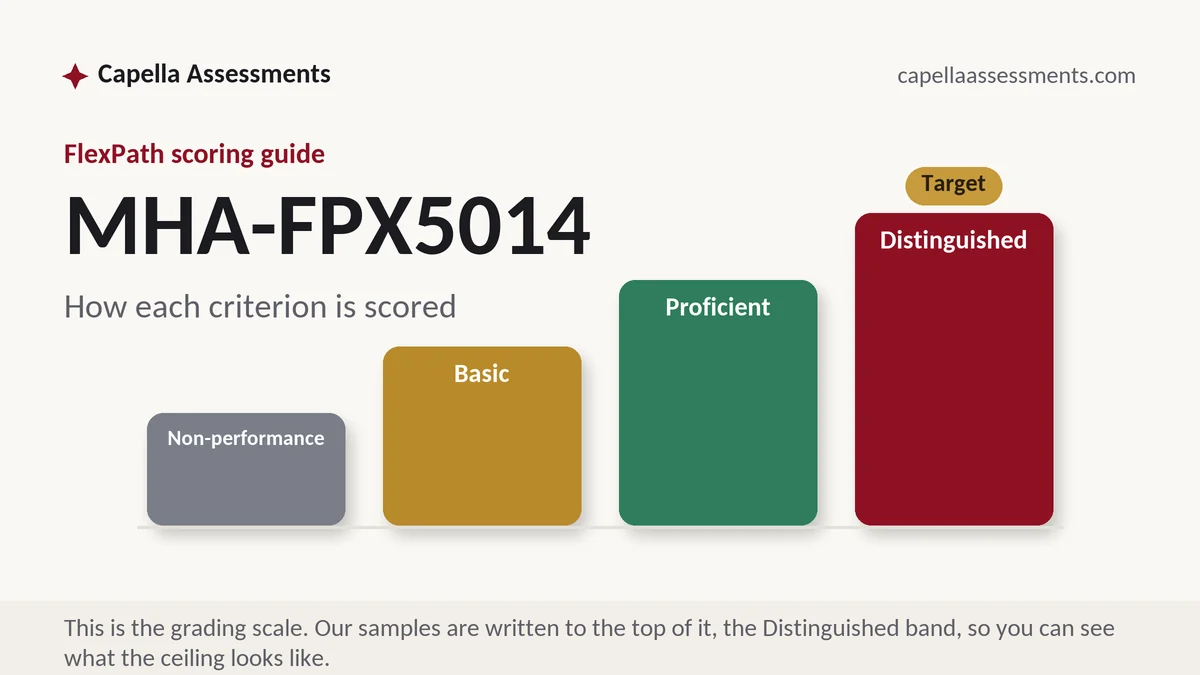
The MHA-FPX5014 drawers
MHA-FPX5014 Assessment 1 quality or risk diagnosis example
Most versions open on diagnosis: a quality or risk problem defined with metrics and benchmarks. On request, free, 24-48h.
MHA-FPX5014 Assessment 2 regulatory obligation review example
Typically second is the regulatory evaluation: governing obligations attributed to their actual sources. On request, free, 24-48h.
MHA-FPX5014 Assessment 3 compliance program proposal example
Usually last comes the program proposal: a compliance or quality initiative designed with controls and accountable roles. On request, free, 24-48h.
Your courseroom shows something else?
Capella revises courses; assessment counts and titles shift between versions. Send what your courseroom shows and the desk matches it exactly.
Using a MHA-FPX5014 sample the right way
Read a MHA-FPX5014 sample with a highlighter for authorities: mark every place a regulation, agency, or standard is named and cited, and notice how the paper never claims more than the citation supports. That calibration (strong claims, checkable sources) is the transferable skill. Then rebuild the analysis for your own scenario, because compliance conclusions depend entirely on the facts, and your courseroom's case will differ from the sample's. Keep your scoring guide open while you draft; quality, risk, and compliance criteria are usually scored separately, and a paper can be strong on one and Basic on another. A free custom sample against your exact guide takes 24-48 hours.
How these samples are written
Samples here follow one discipline: the scoring guide is the outline, every criterion gets its section, the Distinguished description decides the depth, and the APA layer ships exact. Because Capella updates courses over time, your free custom sample is drafted against the scoring guide you send, not against an archive.
MHA-FPX5014 questions, answered
Is there a MHA-FPX5014 Assessment 2 example I can read?
There is a sample at that position, written to a current scoring guide at Distinguished level. Because Capella revises this course, check that the drawer's description matches what your courseroom asks; if it does not, send your scoring guide and a matching sample is written free within 24-48 hours.
How do the samples handle citing regulations I have never worked with?
They model the pattern: obligation named, source cited, application argued. You do not need a law degree for MHA-FPX5014; you need the discipline of attributing each requirement to CMS, HIPAA, a state agency, or an accreditor and then writing about what management does with it. Seeing that done a dozen times in one paper makes it reproducible in yours.
My risk management assessment includes quality data. Will the sample show how to use it?
Yes. The risk and quality samples treat data as the start of an argument: each rate or count is defined, compared against a benchmark or prior period, and followed by the decision it justifies, escalate, monitor, or intervene. That figure-to-action chain is what the applied criteria score, and it is the part most drafts leave implicit.