Each drawer below is one MHA-FPX5040 assessment. Where a sample is live, read it in full, true APA form with the reasoning annotated. Where it is not, request it free: send your assessment number and the scoring guide from your courseroom, and a custom sample written to your exact criteria arrives in 24 to 48 hours. Searches like "MHA FPX 5040 assessment 2 example", "MHA FPX 5040 sample paper", and "MHAFPX5040 sample" all land here, because this page is the drawer they belong in.
What MHA-FPX5040 is really about
There is no harder administrative genre than the change plan, and MHA-FPX5040 is built entirely around it: a document that has to move an organization that does not want to move. The course centers established change frameworks, Kotter's eight-step model chief among them, but the scoring guides care less about reciting stages than about applying them to a specific healthcare organization with named conditions. You will diagnose readiness, build a case for urgency grounded in evidence, design the coalition and communication that carry the change, and plan the transition in phases with owners and dates. The writing voice is a leader's: declarative about what happens, honest about what could stall it, and specific about who does each piece.
What separates this course from a general management class is its insistence on the human middle of change. Healthcare organizations run on professionals with real authority to resist, quietly or openly, and a plan that treats adoption as automatic is fiction. Strong MHA-FPX5040 papers spend serious space on resistance: who loses something in the change, what form their pushback will take, and which responses are planned before it starts. They also plan past go-live, because the criteria in current courserooms typically reach into sustainment, how gains get measured, reinforced, and anchored so the organization does not drift back. Our samples are built with that full arc visible, from first diagnosis to the mechanisms that hold the change in place.
What MHA-FPX5040’s assessments ask for
MHA-FPX5040 scoring guides generally want four things demonstrated in writing. A diagnosis: the current state, the forces demanding change, and organizational readiness, assessed with evidence rather than assertion. A framework applied: whichever model your assessment specifies, used as the plan's skeleton with each element populated by your scenario's specifics, not defined in the abstract. A leadership layer: how you build the guiding coalition, communicate the vision, and handle the people who push back, argued at the level of named roles and concrete messages. And an evaluation and sustainment layer: measures that will show the change worked, checkpoints for course correction, and anchoring moves that make the new state permanent. Criteria on scholarly support and executive communication run underneath all four, and they are scored, not decorative.
Where students lose points in MHA-FPX5040
The classic MHA-FPX5040 failure is the frictionless plan. Eight steps appear in order, every stakeholder is 'engaged', and the change lands on schedule because the paper never imagined anyone saying no. An evaluator notices the missing resistance analysis immediately: no account of who is threatened, no planned response to pushback, no contingency for a stalled pilot. That gap usually caps the leadership criteria at Proficient. The second common loss is the plan that ends at go-live. Implementation gets pages; sustainment gets a sentence, so the criterion asking how gains are measured, reinforced, and anchored scores Basic by default. Kotter made anchoring the final step for a reason. A change plan that survives contact with real people, and then outlives its own launch, is the paper this course is actually asking for.
The MHA-FPX5040 drawers
MHA-FPX5040 Assessment 1 change diagnosis in a clinical setting example
First assessments here typically diagnose: the organization, the pressure for change, and a readiness assessment argued from evidence. On request, free, 24-48h.
MHA-FPX5040 Assessment 2 change plan with framework applied example
The second slot usually asks for the change plan proper, a framework applied step by step with coalition, communication, and resistance handled. On request, free, 24-48h.
MHA-FPX5040 Assessment 3 evaluation and sustainment plan example
Course arcs like this one tend to close on evaluation and sustainment, the measures and anchoring moves that keep the change from unwinding. On request, free, 24-48h.
Your courseroom shows something else?
Capella revises courses; assessment counts and titles shift between versions. Send what your courseroom shows and the desk matches it exactly.
Using a MHA-FPX5040 sample the right way
Treat a MHA-FPX5040 sample as a working model of proportion. Notice how much of the page count goes to diagnosis before any solution appears, where the resistance analysis sits, and how the plan keeps returning to owners and dates. Then rebuild that proportion around your own scenario and scoring guide; your organization, your change, your criteria. Copying a sample's plan defeats the point of the assessment, because the grading lives in application, not in the framework itself. If you send the scoring guide from your courseroom, the first custom sample is free and arrives in 24-48h, modeled on the exact criteria you will be scored against.
How these samples are written
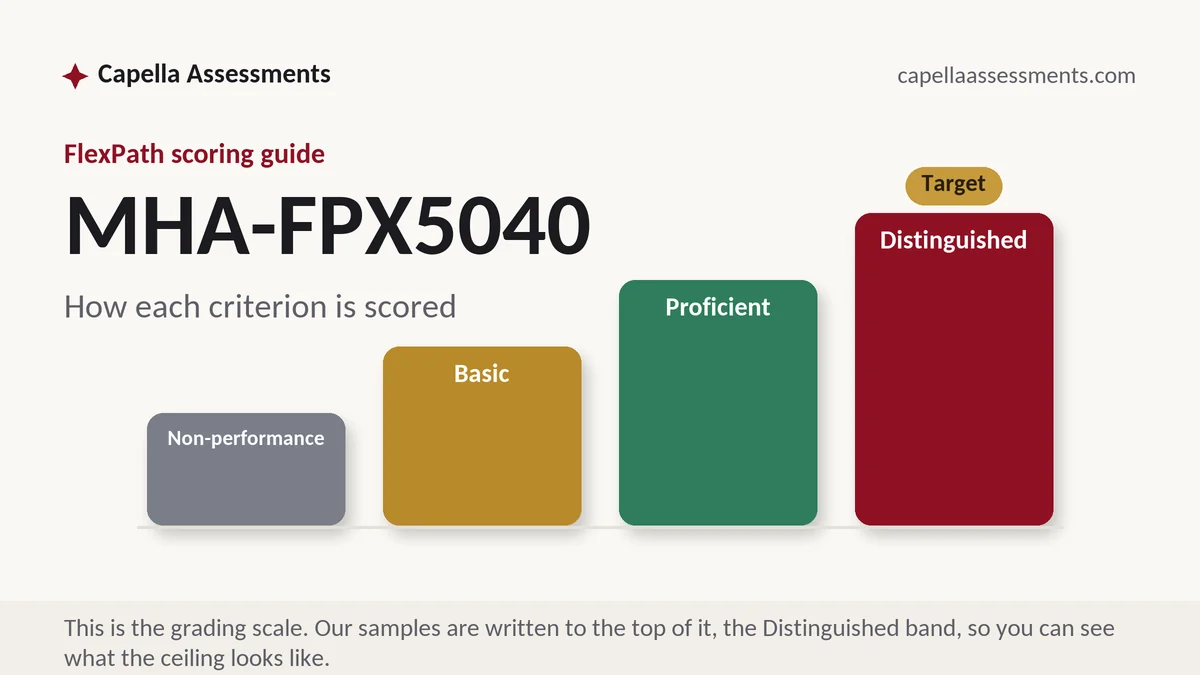
Every sample in this drawer is written the same way our custom ones are: the scoring guide decoded criterion by criterion, a subject-matched writer drafting to the Distinguished column, APA checked line by line, and the reasoning annotated so the paper teaches while it shows. Capella revises scoring guides, so a custom request is always written to the guide in YOUR courseroom, never from a stale template.
MHA-FPX5040 questions, answered
Do MHA-FPX5040 samples use Kotter, or can I see a different change model applied?
Both. Kotter's eight steps are the course's most common skeleton, and several of our samples run it end to end on a healthcare scenario. But if your assessment names Lewin or another model, say so when you request your free custom sample and we will build to that instead. The scoring guide in your courseroom decides the framework; we write to it.
How much of a MHA-FPX5040 paper should cover resistance to change?
More than feels comfortable. If your scoring guide carries a criterion on stakeholder engagement or managing resistance, treat it as a full section, not a paragraph: name who is affected, what they stand to lose, and the specific responses you have planned. Papers that skip it read as naive on exactly the criteria that separate Proficient from Distinguished. Our samples model that depth in full.
Is there a MHA-FPX5040 Assessment 3 example I can read before I start mine?
Assessment numbering shifts between courserooms, so instead of guessing at yours, send the actual instructions and scoring guide and we will write a sample to that exact assessment, free the first time, in 24-48h. That gets you a model of the deliverable you are facing, whether it lands on the diagnosis, the full change plan, or the evaluation and sustainment piece.