Each drawer below is one MHA-FPX5042 assessment. Where a sample is live, read it in full, true APA form with the reasoning annotated. Where it is not, request it free: send your assessment number and the scoring guide from your courseroom, and a custom sample written to your exact criteria arrives in 24 to 48 hours. Searches like "MHA FPX 5042 assessment 2 example", "MHA FPX 5042 sample paper", and "MHAFPX5042 sample" all land here, because this page is the drawer they belong in.
What MHA-FPX5042 is really about
MHA-FPX5042 is the MHA's mirror course. Instead of analyzing an organization, you analyze yourself as a leader and the teams you run, usually starting from a formal self-assessment instrument and building outward into a personal leadership development plan and a team development strategy. That makes the writing genre unusual: part evidence-based analysis, part honest self-appraisal, and the scoring guides want both at once. Claiming strengths without instrument results behind them reads as vanity; listing weaknesses without a development response reads as confession. The papers that score Distinguished treat the writer as a case: data collected, gaps identified, interventions chosen, progress defined, exactly the arc an administrator would apply to any other performance problem.
The team half of the course runs on the same discipline. Healthcare teams cross professions, shifts, and reporting lines, and the assessments typically hand you a team scenario, conflict, low trust, a stalled project, and ask for a development strategy grounded in team effectiveness research rather than folk wisdom. Expect to write about stages of team formation, psychological safety, role clarity, and conflict styles, but always pointed at a specific team with specific problems. The connective tissue between the two halves is the point of the course: your own leadership profile shapes what your teams need from you, and papers that draw that line explicitly are the ones evaluators remember. Our samples keep both halves concrete and joined.
What MHA-FPX5042’s assessments ask for
Scoring guides in MHA-FPX5042 reward specificity about people, starting with you. Expect criteria asking you to analyze your own leadership style against established theory, transformational, servant, situational are the usual reference points, using actual self-assessment results as evidence. Expect a development plan criterion that wants goals stated in measurable terms, activities that build the named skills, and a timeline with checkpoints, the same structure any performance plan carries. On the team side, criteria typically ask for strategies matched to a scenario: how you build trust, structure communication, and resolve conflict in a defined healthcare team, with scholarly support for each choice. And because this is a leadership course, the communication criterion is doing double duty; the paper itself is a leadership artifact, and evaluators read it that way.
Where students lose points in MHA-FPX5042
MHA-FPX5042 papers lose points when the plan stops being a plan. A development section lists admirable goals, become a better communicator, build trust, and attaches no timeline, no checkpoints, and no way to know whether anything improved by a given date. The criterion asks for a development plan; a wish list scores Basic. Team strategies fail the same way from the other side: recommendations float with no owner, 'the team should adopt structured huddles', with nobody named to run them, no starting point, and no accountability when they lapse. Both are the identical mistake, action with no accountable name attached, and both are cheap to fix. Every goal gets a date and a measure; every team recommendation gets a person responsible for making it happen. Samples written that way show how little extra space the fix costs.
The MHA-FPX5042 drawers
MHA-FPX5042 Assessment 1 leadership style analysis example
This course tends to start with the leader in the mirror: a style analysis built on self-assessment results and grounded in leadership theory. On request, free, 24-48h.
MHA-FPX5042 Assessment 2 team development plan example
Middle assessments in this course usually turn to the team, a development strategy for a defined healthcare group with trust, communication, and conflict addressed. On request, free, 24-48h.
MHA-FPX5042 Assessment 3 integrated leadership plan example
The closing position generally integrates both threads into a personal leadership development plan with measurable goals on a timeline. On request, free, 24-48h.
Your courseroom shows something else?
Capella revises courses; assessment counts and titles shift between versions. Send what your courseroom shows and the desk matches it exactly.
Using a MHA-FPX5042 sample the right way
A MHA-FPX5042 sample earns its keep as a template for honesty with structure. Study how it converts instrument results into claims, how each development goal carries a date and a measure, and how team recommendations name who acts. Then close it, take your own self-assessment, and write from your results; borrowed reflection is obvious and defeats a course whose whole subject is you. Your scenario details and scoring guide language will differ from any sample's, which is why the free first sample is custom: send the scoring guide from your courseroom and we deliver a model written to it in 24-48h.
How these samples are written
Samples here follow one discipline: the scoring guide is the outline, every criterion gets its section, the Distinguished description decides the depth, and the APA layer ships exact. Because Capella updates courses over time, your free custom sample is drafted against the scoring guide you send, not against an archive.
MHA-FPX5042 questions, answered
How does a MHA-FPX5042 sample handle the self-assessment part when it is not about me?
The sample models the method, not your results. It shows a leadership profile built from a named instrument, the honest gap analysis that follows, and a development plan with dated goals, so you can see the structure evaluators score. You then run the same arc on your own results. That is the part no sample can do for you, and the part that earns the criteria.
What makes a team development strategy score Distinguished in MHA-FPX5042?
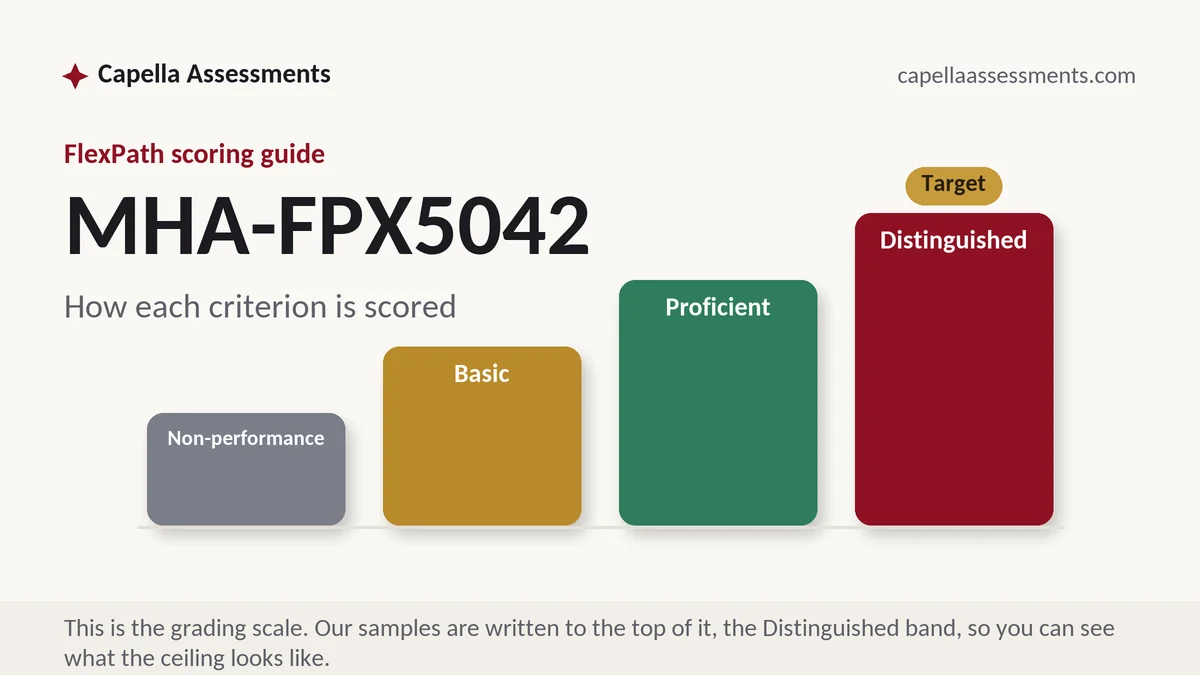
Ownership and sequence. A Distinguished strategy ties every intervention to the specific team problem it treats, names who leads it, and lays the work on a timeline with checkpoints, all supported by team effectiveness literature. Generic team-building advice with no owner and no dates is the pattern that stalls at Proficient. Your scoring guide decides the exact criteria; read it before you outline.
What should I send with a MHA-FPX5042 sample request?
The assessment instructions and scoring guide from your courseroom, plus a note on which piece you are facing, the self-assessment analysis, the team strategy, or a combined development plan. Mention the leadership instrument your courseroom uses so the sample mirrors the evidence type your evaluator expects. The first custom sample is free and arrives in 24-48h.