Each drawer below is one MHA-FPX5068 assessment. Where a sample is live, read it in full, true APA form with the reasoning annotated. Where it is not, request it free: send your assessment number and the scoring guide from your courseroom, and a custom sample written to your exact criteria arrives in 24 to 48 hours. Searches like "MHA FPX 5068 assessment 2 example", "MHA FPX 5068 sample paper", and "MHAFPX5068 sample" all land here, because this page is the drawer they belong in.
What MHA-FPX5068 is really about
Technology decisions stop being technical at a certain altitude, and MHA-FPX5068 lives exactly there. The course takes the phrase in its title seriously: meaningful use began as federal policy language for electronic health records that demonstrably improve care, and the course widens it into a leadership question, how does an administrator make any technology investment mean something? Assessments have you evaluate technologies against organizational goals, weigh governance and policy constraints, and lead adoption across people who did not choose the system they are being handed. It is a leadership and management course wearing a technology vocabulary, and the writing it rewards reads that way: strategic, evidence-backed, and centered on what the organization gets, not on what the software does.
The distinctive demand of this course is the pairing of vision with mechanics. A technology strategy paper has to claim a direction, this platform, this capability, this clinical or operational gain, and then immediately pay for the claim with specifics: which stakeholders are affected and how they were mapped, what the adoption timeline looks like phase by phase, how success will be measured against a named baseline. Papers that soar at the vision level and thin out at the mechanics read as advocacy, and the management criteria catch it. In current courserooms the assessments typically move from evaluating a technology, to planning its use, to the leadership dimensions of making it stick, so our samples are written to show all three registers under one strategy.
What MHA-FPX5068’s assessments ask for
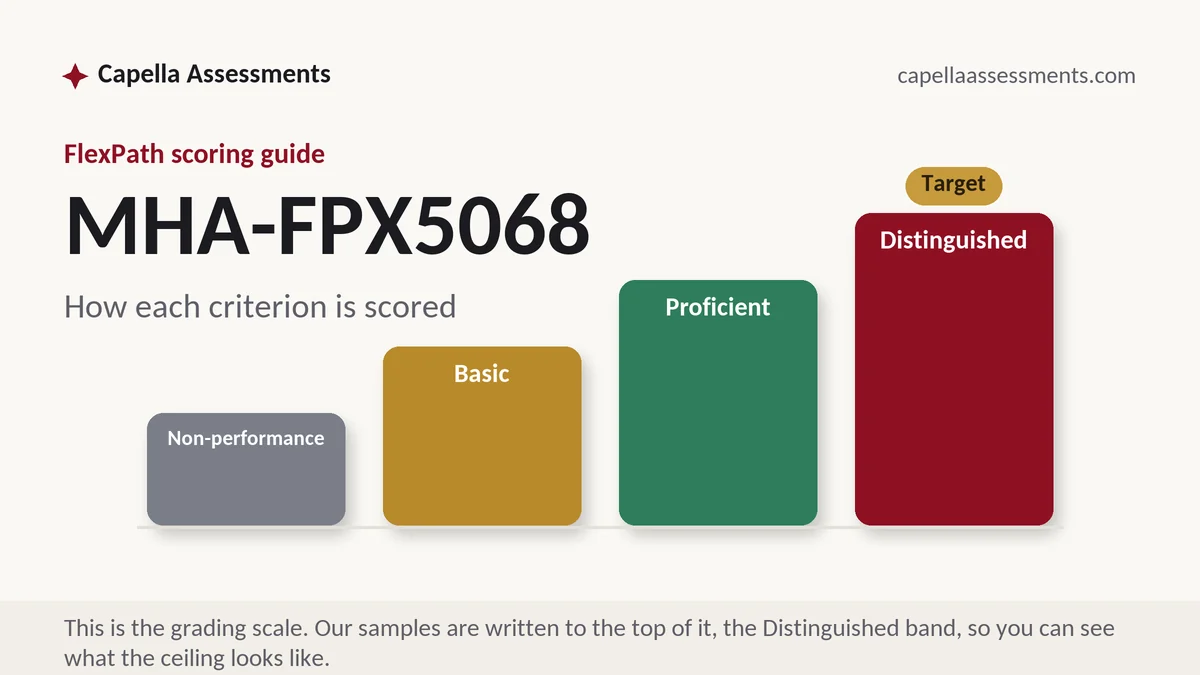
Three connected abilities get graded in MHA-FPX5068 scoring guides. Evaluation: assess a healthcare technology, an EHR capability, telehealth, analytics, remote monitoring, against organizational goals and published evidence, stating benefits and limits honestly. Planning: turn the evaluation into a management plan, scope, stakeholders, resources, timeline, and the metrics that will define meaningful use of the tool in your setting. Leadership: address the human system around the technology, governance, training, communication, and accountability for results. Criteria also expect the policy layer handled at the right altitude: enough regulatory context to show you know why meaningful use mattered, without letting the paper become a policy summary. Graduate-level sourcing and an executive-ready structure sit under everything, and the scoring guide in your courseroom sets the exact weightings.
Where students lose points in MHA-FPX5068
The losing MHA-FPX5068 paper is the technology pitch with no plan under it. It argues persuasively that the organization needs telehealth or a new analytics layer, then presents a strategy with no stakeholder map, no phased timeline, and no measure that would show the investment meant anything, which leaves the planning and management criteria scoring against thin air. A second, quieter leak: adoption claims benchmarked against nothing, 'most systems have moved to this', with no named source, no figure, no year, and the evidence criterion drops to Basic on the spot. Evaluators in this course are reading for the moment vision converts into accountable detail, who is affected, when each phase lands, what number defines success. Write that conversion explicitly and the same argument that was a pitch becomes a strategy.
The MHA-FPX5068 drawers
MHA-FPX5068 Assessment 1 technology evaluated against goals example
Courses in this position typically open by evaluating a technology against organizational goals, benefits and limits argued from published evidence. On request, free, 24-48h.
MHA-FPX5068 Assessment 2 adoption management plan example
Second assessments here usually build the management plan, stakeholders mapped, phases dated, and success metrics defined for the chosen technology. On request, free, 24-48h.
MHA-FPX5068 Assessment 3 governance training and accountability example
The arc typically closes on leadership, governance, training, and accountability structures that make a technology investment hold its value. On request, free, 24-48h.
Your courseroom shows something else?
Capella revises courses; assessment counts and titles shift between versions. Send what your courseroom shows and the desk matches it exactly.
Using a MHA-FPX5068 sample the right way
Read a MHA-FPX5068 sample twice at two speeds. Fast, for the strategic through-line: how the paper keeps technology subordinate to organizational goals from the opening paragraph on. Slow, for the accountability apparatus: stakeholder mapping, phase dates, named metrics, sourced benchmarks. Your draft needs both layers built from your own scenario and scoring guide, and the second layer is the one students underestimate. Do not lift the sample's technology choice or its evidence; both age quickly and neither fits your criteria. Send the scoring guide from your courseroom instead, and your first custom sample is free, delivered in 24-48h.
How these samples are written
Every sample in this drawer is written the same way our custom ones are: the scoring guide decoded criterion by criterion, a subject-matched writer drafting to the Distinguished column, APA checked line by line, and the reasoning annotated so the paper teaches while it shows. Capella revises scoring guides, so a custom request is always written to the guide in YOUR courseroom, never from a stale template.
MHA-FPX5068 questions, answered
Does 'meaningful use' in MHA-FPX5068 mean the old EHR incentive program?
It starts there. The term comes from the HITECH-era incentive programs that pushed hospitals onto electronic records, and a strong paper shows it knows that history. But the course treats it as a standing question for any technology: what measurable good does this tool produce, and how would leadership prove it? Samples model both the policy context and the wider strategic reading.
What belongs in the stakeholder section of a MHA-FPX5068 technology plan?
A real map, not a list. Group stakeholders by how the technology changes their work, decision makers, daily users, support functions, and state what each group needs to hear, do, and receive on the timeline. Plans that name stakeholders without mapping impact are the ones that stall on the management criteria. Our samples show the map format that keeps this compact.
How do I get a MHA-FPX5068 sample that matches my courseroom's scoring guide?
Export or copy the scoring guide and assessment instructions from your courseroom and send them over. The first custom sample is free and lands in 24-48h, written criterion by criterion to what you sent, including the technology focus your prompt specifies. If your courseroom pairs the paper with a presentation deliverable, tell us, and the sample will model that structure too.