Each drawer below is one NHS-FPX6004 assessment. Where a sample is live, read it in full, true APA form with the reasoning annotated. Where it is not, request it free: send your assessment number and the scoring guide from your courseroom, and a custom sample written to your exact criteria arrives in 24 to 48 hours. Searches like "NHS FPX 6004 assessment 2 example", "NHS FPX 6004 sample paper", and "NHSFPX6004 sample" all land here, because this page is the drawer they belong in.
What NHS-FPX6004 is really about
NHS-FPX6004 turns the master's learner toward the regulatory spine of care delivery. The course reads health care law and policy not as memorized statutes but as constraints that shape what a unit can do about an underperforming metric, an equity gap, or a compliance exposure. The writing asks you to hold three registers at once: analytic prose that quantifies a problem, policy prose that states what an organization shall do, and persuasive prose that brings clinicians along. Learners used to purely clinical papers often find the middle register hardest, because policy language rewards precision and scope discipline over narrative. Evaluators look for local specificity, meaning the state, the setting, and the population are named, not generic.
In current courserooms the sequence tends to run from diagnosis to adoption: first an analysis of where performance falls short of a benchmark or requirement, then a proposed policy and practice guidelines that would close the gap, then a piece aimed at the people who must live with the policy. That last move is what makes NHS-FPX6004 distinctive in the MSN core. It is not enough to be right about the law; the scoring guides ask whether your proposal would be adoptable, resourced, and defensible to a skeptical interprofessional audience. Population health thinking runs underneath all of it, since benchmarks exist because some group of patients is measurably underserved when they slip.
What NHS-FPX6004’s assessments ask for
The assessments ask for consequence-aware argument. An analysis piece wants the shortfall stated in numbers, the affected population identified, and the legal or regulatory driver cited by name, whether that is a federal requirement, a state provision, or an accreditor's standard. A proposal piece wants actual policy language: scope, guidelines, responsible roles, and the evidence base for each guideline, with ethical principles applied rather than listed. A communication piece wants the proposal translated for a specific audience, anticipating objections about workload and cost. Every criterion carries a quality bar in its Distinguished cell, and in this course the bar is usually specificity: which stakeholders, which environmental factors, which unintended consequences. Vague policies read as Basic no matter how polished the prose.
Where students lose points in NHS-FPX6004
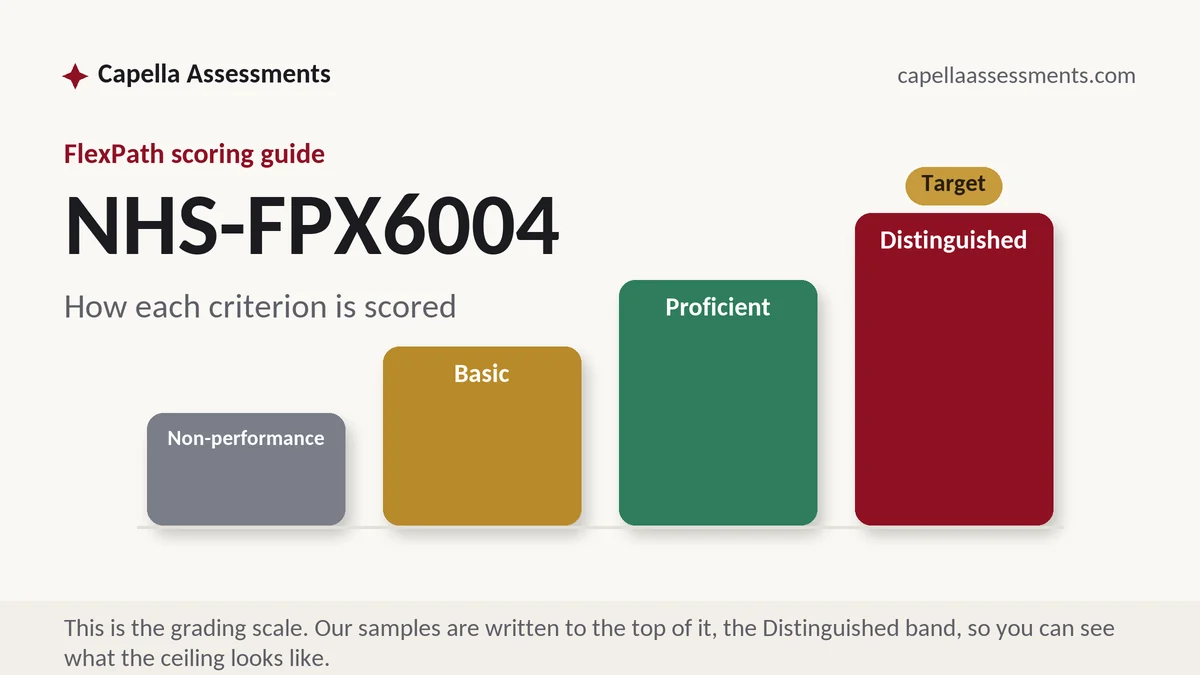
Points vanish in NHS-FPX6004 when a criterion row simply never gets a section. The scoring guides here often stack half a dozen criteria per assessment, and one of them is always quieter than the rest: the environmental factors row, the ethical considerations row, the one about involving stakeholders in policy development. Learners outline from the assessment instructions, the instructions foreground the dramatic parts, and the quiet row never makes it into the outline. Skipped is scored as Non-performance, which on a six-criterion guide can drag an otherwise Distinguished paper below Proficient overall. The fix is mechanical: outline from the scoring guide itself, one heading per criterion, before reading anything else, and check the finished draft row by row against it.
The NHS-FPX6004 drawers
NHS-FPX6004 Assessment 1 dashboard metrics read against benchmarks example
In current courserooms this assessment typically appears as "Dashboard Metrics, Benchmarks, and Policy Decisions". In current courserooms, Assessment 1 samples usually sit at the diagnosis end of the arc, quantifying a performance or compliance shortfall and naming the regulation behind it. On request, free, 24-48h.
NHS-FPX6004 Assessment 2 example
In current courserooms this assessment typically appears as "Policy Proposal". Assessment 2 samples typically carry the proposal stage, where analysis becomes drafted policy and practice guidelines with evidence and ethics attached to each choice. On request, free, 24-48h.
NHS-FPX6004 Assessment 3 training session built for policy implementation example
In current courserooms this assessment typically appears as "Training Session for Policy Implementation". Assessment 3 samples tend to occupy the adoption position, translating the policy for the stakeholders who must implement it and answering their likely objections. On request, free, 24-48h.
Your courseroom shows something else?
Capella revises courses; assessment counts and titles shift between versions. Send what your courseroom shows and the desk matches it exactly.
Using a NHS-FPX6004 sample the right way
A law and policy sample earns its keep as a register model. Study how the analysis section keeps numbers and citations tight, where the proposal shifts into policy voice, and how the stakeholder piece changes tone without losing precision. Note the mapping between headings and criteria, then build your own outline the same way from the guide in your courseroom before you write a word. Send that guide over and the desk will write a sample to it, first one free, in 24-48h, so the structure you study matches the criteria you are actually graded on.
How these samples are written
Every sample in this drawer is written the same way our custom ones are: the scoring guide decoded criterion by criterion, a subject-matched writer drafting to the Distinguished column, APA checked line by line, and the reasoning annotated so the paper teaches while it shows. Capella revises scoring guides, so a custom request is always written to the guide in YOUR courseroom, never from a stale template.
NHS-FPX6004 questions, answered
Where can I find an NHS-FPX6004 policy proposal example?
Request one here and it arrives in 24-48h, written to the scoring guide you send from your courseroom, free the first time. That routing matters in this course because proposal criteria differ between courseroom revisions, and a sample keyed to an old guide will teach you an outline that no longer matches your rows.
My draft covers the topic well, so why did a whole criterion score Non-performance?
Almost always because the row never got a section. NHS-FPX6004 guides carry quiet criteria, ethics, environmental factors, stakeholder involvement, that the assessment narrative barely mentions. If no paragraph performs that row's verb, the evaluator cannot award it anything. Rebuild your outline directly from the scoring guide, one heading per criterion, and the problem disappears.
Do NHS-FPX6004 samples cite real laws or made-up ones?
Real ones, current at the time of writing, matched to the jurisdiction the scenario names. Policy writing loses all credibility the moment a citation is invented, and evaluators check. When you request a sample, mention your state or setting if the assessment lets you choose, and the legal layer is built around what actually applies there.