Each drawer below is one NURS-FPX4000 assessment. Where a sample is live, read it in full, true APA form with the reasoning annotated. Where it is not, request it free: send your assessment number and the scoring guide from your courseroom, and a custom sample written to your exact criteria arrives in 24 to 48 hours. Searches like "NURS FPX 4000 assessment 2 example", "NURS FPX 4000 sample paper", and "NURSFPX4000 sample" all land here, because this page is the drawer they belong in.
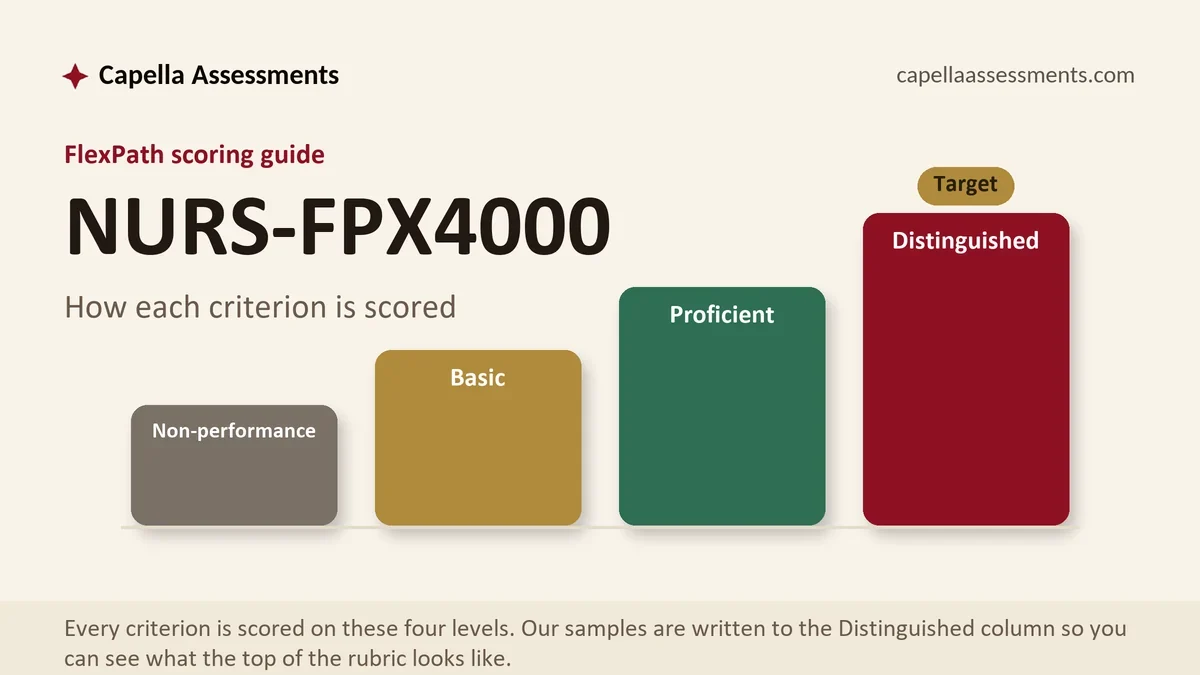
What NURS-FPX4000 is really about
NURS-FPX4000 is Capella's on-ramp, and it grades the one skill the bedside never asked of you: arguing a professional position on paper. Most RNs arrive with years of sound clinical judgment and no recent practice at thesis-driven writing. The course exists to close that gap. Each assessment takes something you already hold, a view of what nursing is, a stance on a practice question, and requires it stated as a claim, supported with published sources, and organized so a reader can follow the reasoning without you in the room. The scoring guide in your courseroom lists the criteria plainly; the work is learning to write toward them instead of around them.
Treat it as an anatomy lesson rather than a hurdle. The parts you assemble here, an introduction that commits to a claim, body paragraphs that each carry one idea and one piece of evidence, a reference list in APA 7, repeat in every course that follows, from leadership through the capstone. FlexPath adds its own pressure: no fixed deadlines means the writing habits you set in this course are the ones you keep. Students who slow down here, learning what Distinguished actually looks like on a scoring guide, tend to move faster later, because they stop guessing. The samples on this shelf exist to make that anatomy visible before you commit your own draft.
What NURS-FPX4000’s assessments ask for
The arc runs from stance to synthesis. Early work asks you to frame a professional perspective and defend it, which means a real thesis, not a survey of opinions. The middle assessments turn to evidence: locating credible sources, separating peer-reviewed research from trade commentary, and putting what you find to work inside an argument. Later writing applies that evidence to a nursing practice question in full APA form, title page to references, and the closing piece synthesizes the course into one coherent statement of where you stand and why. Across all of it, criteria reward the same behaviors: a claim stated early, evidence attached to every assertion that needs one, counterpoints acknowledged, and formatting clean enough that nothing distracts from the reasoning. Your scoring guide decides the weighting; read it first.
Where students lose points in NURS-FPX4000
Two failure patterns dominate this course, and both belong to returning RNs specifically. The first is substituting a story for a source. You have watched short staffing hurt patients, so you write what you saw; the criterion, though, asks for cited evidence, and an uncited anecdote scores as unsupported opinion no matter how true it is. Keep the story if it illustrates, but attach a published study that carries the claim. The second is APA 7 mechanics treated as decoration: a title page missing required elements, references without hanging indents, DOIs pasted as long URLs instead of the https://doi.org form. Faculty see those in the first ten seconds, and a paper that looks careless gets read as careless. Both problems are cheap to fix and expensive to ignore.
The NURS-FPX4000 drawers
NURS-FPX4000 Assessment 1 example
The orientation deliverable: professional perspective framed and defended. On request, 24-48h.
NURS-FPX4000 Assessment 2 example
In current courserooms this assessment typically appears as "Applying Research Skills". Evidence and source work: credible research located and put to use. On request, 24-48h.
NURS-FPX4000 Assessment 3 example
In current courserooms this assessment typically appears as "Applying Ethical Principles". Applied analysis: a nursing practice question argued in full APA form. On request, 24-48h.
NURS-FPX4000 Assessment 4 example
The synthesis piece that closes the course. On request, 24-48h.
Your courseroom shows something else?
Capella revises courses; assessment counts and titles shift between versions. Send what your courseroom shows and the desk matches it exactly.
Using a NURS-FPX4000 sample the right way
A NURS-FPX4000 sample is a dissection specimen, not a donor organ. Read it once for shape: where the thesis sits, how each paragraph pairs claim with citation, how the reference list is built. Then open your own scoring guide and check how the sample earns each criterion at the Distinguished level. After that, close it and draft from your own stance and your own sources; the argument only works in your voice. If the generic version does not match what your courseroom is asking, send your scoring guide and the desk writes a custom sample to it, free the first time, delivered in 24-48h.
How these samples are written
Every sample in this drawer is written the same way our custom ones are: the scoring guide decoded criterion by criterion, a subject-matched writer drafting to the Distinguished column, APA checked line by line, and the reasoning annotated so the paper teaches while it shows. Capella revises scoring guides, so a custom request is always written to the guide in YOUR courseroom, never from a stale template.
NURS-FPX4000 questions, answered
Is there a NURS-FPX4000 Assessment 1 example I can look at before I start?
Yes. Every drawer on this shelf, including the Assessment 1 perspective paper, is available on request. Tell us which assessment you are on and, ideally, attach the scoring guide from your courseroom; the sample comes back written to those exact criteria, free the first time, within 24-48h. Reading one before you draft usually saves a full revision cycle.
I have not written in APA since nursing school. Will NURS-FPX4000 samples show the current format?
They are built in current APA 7, which changed in ways that matter: the student title page, no running head on student papers, DOIs presented as https://doi.org links, hanging indents on every reference. If your last formal paper predates 2020, assume your defaults are stale. Use the sample as a formatting reference alongside its argument; the mechanics are graded in this course, not assumed.
Can I just submit a sample as my own NURS-FPX4000 paper?
No, and you would be underpaying yourself if you did. The samples are study models: they show structure, sourcing, and criterion coverage so you can build your own paper faster and better. Your perspective piece has to carry your stance and your practice history to make sense. Read the sample, map its moves, then write yours. That line keeps you safe and keeps the work worth doing.