Each drawer below is one NURS-FPX4035 assessment. Where a sample is live, read it in full, true APA form with the reasoning annotated. Where it is not, request it free: send your assessment number and the scoring guide from your courseroom, and a custom sample written to your exact criteria arrives in 24 to 48 hours. Searches like "NURS FPX 4035 assessment 2 example", "NURS FPX 4035 sample paper", and "NURSFPX4035 sample" all land here, because this page is the drawer they belong in.
What NURS-FPX4035 is really about
Safety writing has a grammar, and NURS-FPX4035 grades it. The course takes incidents nurses usually process as stories, the near-miss, the fall, the med error, and requires them rewritten as systems analysis: contributing factors instead of culprits, processes instead of personalities, measures instead of vows to be more careful. That shift is the entire point. Returning RNs bring the raw material, years of firsthand safety knowledge, and the course teaches the form that makes it usable: root-cause logic, improvement plans with numbers attached, and language a quality department would recognize as its own. The criteria are explicit about it: analyze at the system level, or the paper is only retelling an incident.
Donabedian's structure-process-outcome triad sits under most of this writing, whether or not an assessment names it: where in the system the failure lives, what process change would close it, what outcome will prove it closed. Expect your papers to carry all three, because improvement plans without measurable outcomes are the most common shape of weak work in this course. There is also an audience layer: at some point you present the improvement to the people who would have to run it, which is persuasion, not reporting. The samples on this shelf model both registers, the analytic and the persuasive, so you can hear the difference before your own draft has to switch between them.
What NURS-FPX4035’s assessments ask for
The deliverables mirror how quality work actually moves. An analysis of a safety problem examined at the system level: prevalence, contributing factors, what the literature says drives and prevents it. A root-cause analysis with an improvement plan attached, where the criteria want the causal chain explicit and every intervention paired with a measure, because a plan you cannot audit is a wish. A presentation of that improvement work to the staff and leaders who must carry it out, scored on clarity and persuasion as much as content. And the synthesis that closes the course. Throughout, scoring guides reward evidence-based interventions over invented ones; the strongest papers cite what worked elsewhere, then adapt it honestly to their setting, limitations included. Your scoring guide decides emphasis per assessment, so read the criteria before choosing your incident.
Where students lose points in NURS-FPX4035
Watch for two traps this course sets for experienced nurses. The first: letting the incident stay a story. You describe the fall vividly, everyone can picture it, and the criterion still scores low, because it asked for cited evidence on fall rates, contributing factors, and effective interventions, and the narrative never handed off to the literature. Vivid is fine; unsourced is not. The second trap is the presentation assessment. Its stated audience is the staff who would implement the change, yet drafts arrive written upward, at the instructor, full of course vocabulary and empty of the answer a floor nurse wants first: what changes on my next shift. Match the stated audience and the same content scores differently. Both traps are audience-and-evidence problems, which is to say both are fixable in revision.
The NURS-FPX4035 drawers
NURS-FPX4035 Assessment 1 example
In current courserooms this assessment typically appears as "Enhancing Quality and Safety". The safety-problem analysis: a failure examined at system level. On request, 24-48h.
NURS-FPX4035 Assessment 2 example
Root-cause analysis and an improvement plan with measures attached. On request, 24-48h.
NURS-FPX4035 Assessment 3 example
In current courserooms this assessment typically appears as "Improvement Plan In-Service Presentation". Presenting the improvement work to the people who must run it. On request, 24-48h.
NURS-FPX4035 Assessment 4 example
The safety-and-quality synthesis that closes the course. On request, 24-48h.
Your courseroom shows something else?
Capella revises courses; assessment counts and titles shift between versions. Send what your courseroom shows and the desk matches it exactly.
Using a NURS-FPX4035 sample the right way
Use a NURS-FPX4035 sample to calibrate depth. Notice how far past the incident the analysis goes, how each cause claims a source, how the improvement plan attaches a number to every intervention. Then pick a safety problem you have actually lived with, the writing is easier and more convincing when the system is one you know, and run your own analysis to the sample's depth. Keep its structure, replace its substance entirely. If the assessment in your courseroom is shaped differently, send the scoring guide over; a custom sample written to those criteria comes back free the first time, in 24-48h.
How these samples are written
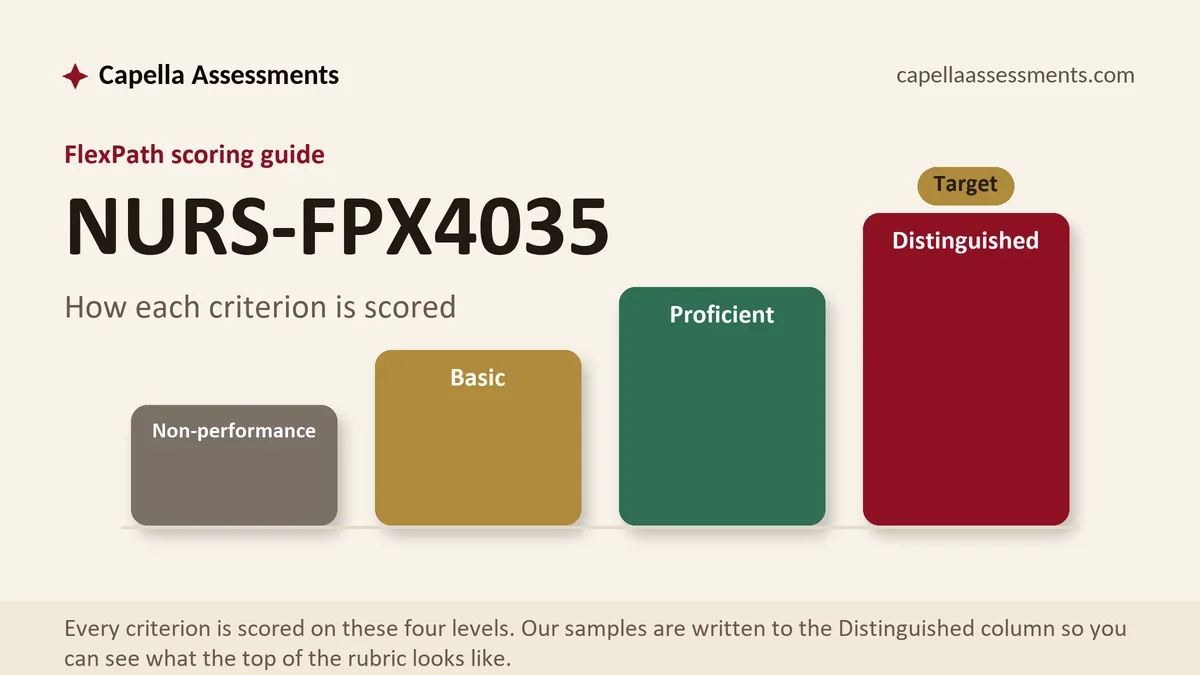
Samples here follow one discipline: the scoring guide is the outline, every criterion gets its section, the Distinguished description decides the depth, and the APA layer ships exact. Because Capella updates courses over time, your free custom sample is drafted against the scoring guide you send, not against an archive.
NURS-FPX4035 questions, answered
Can I see a NURS-FPX4035 root-cause analysis example before I write mine?
Yes, request the RCA drawer. The sample shows the causal chain built factor by factor, the improvement plan that answers it, and the measures that make the plan auditable, all cited to safety literature. Attach your scoring guide when you ask and it is written to your courseroom's criteria. First request is free; delivery runs 24-48h.
I was there for the incident I want to write about. Why do I still need citations?
Because the criterion is testing whether you can generalize. Your incident proves a failure happened once; the literature establishes how often it happens, why, and which interventions actually reduce it. Faculty score the connection between your case and that evidence base. Being there gives you the best possible starting material, and it counts for nothing on the scoring guide until sources carry it.
The NURS-FPX4035 presentation assessment worries me more than the papers. Do samples cover it?
They do. The presentation drawer's sample handles the part students actually struggle with: organizing the argument for a staff audience and writing speaker notes that persuade rather than recite. It is still writing, just aimed at listeners. Request it with your scoring guide, note any slide or time limits your courseroom sets, and the sample reflects them. Free first, 24-48h.