Each drawer below is one NURS-FPX6011 assessment. Where a sample is live, read it in full, true APA form with the reasoning annotated. Where it is not, request it free: send your assessment number and the scoring guide from your courseroom, and a custom sample written to your exact criteria arrives in 24 to 48 hours. Searches like "NURS FPX 6011 assessment 2 example", "NURS FPX 6011 sample paper", and "NURSFPX6011 sample" all land here, because this page is the drawer they belong in.
What NURS-FPX6011 is really about
NURS-FPX6011 is the MSN core's evidence course, and it tests a specific skill: turning literature into decisions for a defined population. Not summarizing studies, appraising them, weighing design and sample and applicability, then letting the strongest evidence dictate what a needs assessment finds and what an improvement plan does. Patient-centered care and population health share the page here, which trips up learners who write well about one patient or one community but not both at once. The course wants the individual perspective, health literacy, culture, technology access, held inside the population frame, so a plan reads as something real patients could actually receive rather than an abstract program description.
The deliverables trace one continuous project. The evidence-based needs assessment establishes a population and proves, from data and literature, what it lacks. The population health improvement plan converts that proof into interventions with measurable outcomes and an evaluation method. Putting the practice change into place then argues implementation: stakeholders, barriers, resources, and the leverage that gets a plan adopted on a real unit. Each step inherits the previous one's evidence, so a weak appraisal in the first assessment quietly poisons the next two. Learners who treat the sequence as separate essays redo work; those who treat it as one project in three registers move faster and score higher on the synthesis criteria.
What NURS-FPX6011’s assessments ask for
The needs assessment asks you to define a population precisely, gather demographic and epidemiological data, appraise the guiding literature, and state needs as findings rather than impressions, with technology and care coordination considered as part of the need. The improvement plan asks for interventions matched to those findings, each justified by appraised evidence, with outcomes that can be measured and a plan for measuring them. The implementation piece asks who must act, what will resist, and how the change survives contact with staffing realities. Across the sequence, criteria repeatedly use appraisal language: evaluate the evidence, synthesize the literature, justify with sources. Summary verbs do not satisfy appraisal criteria, and the difference between Proficient and Distinguished usually lives exactly there.
Where students lose points in NURS-FPX6011
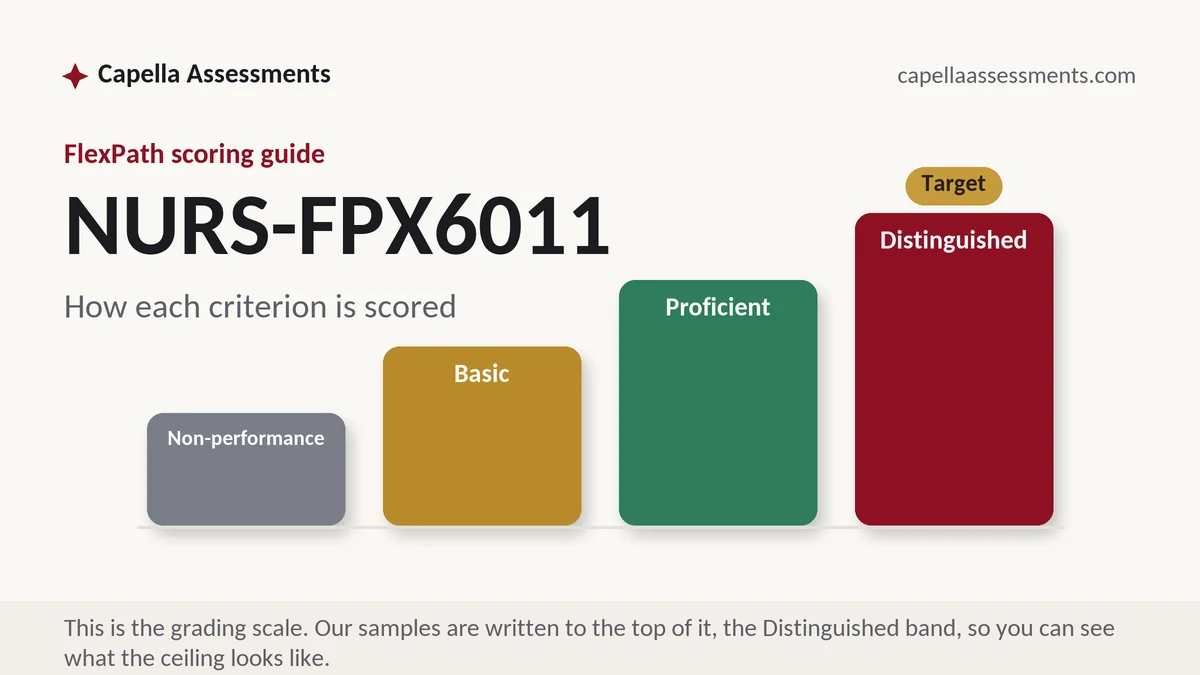
NURS-FPX6011 punishes learners who read only the criterion statement and never the Distinguished cell beside it. The row says describe the evidence; the Distinguished column adds evaluates the strength and applicability of that evidence. A paper that describes beautifully has done Proficient work by the guide's own definition, and the learner staring at the score cannot see why, because the assignment felt complete. The extra verb is the whole game in an appraisal course. Evaluate means judge design, sample size, recency, and fit to your population, in writing. Before drafting each section, read across the row to the Distinguished cell, underline the verb that appears only there, and make sure a sentence in that section visibly performs it.
The NURS-FPX6011 drawers
NURS-FPX6011 Assessment 1 evidence-based needs assessment for a population example
The evidence-based needs assessment drawer models a population defined, data gathered, and literature appraised until the needs read as findings, not impressions. On request, free, 24-48h.
NURS-FPX6011 Assessment 2 example
In current courserooms this assessment typically appears as "Evidence-Based Population Health Improvement Plan". The population health improvement plan drawer shows appraised evidence converted into interventions with measurable outcomes and an evaluation method already built in. On request, free, 24-48h.
NURS-FPX6011 Assessment 3 example
In current courserooms this assessment typically appears as "Implementing Evidence-Based Practice". Putting the practice change into place gets a drawer arguing implementation itself: stakeholders enlisted, barriers priced, and the plan defended against unit realities. On request, free, 24-48h.
Your courseroom shows something else?
Capella revises courses; assessment counts and titles shift between versions. Send what your courseroom shows and the desk matches it exactly.
Using a NURS-FPX6011 sample the right way
Treat the sample as an appraisal demonstration. Watch where it stops summarizing a study and starts judging it, that pivot sentence is the skill the course exists to teach, and it recurs in every assessment. Compare the sample's sections against the Distinguished column of your own scoring guide and mark where the higher verb gets performed. Then run the same pivot on your own literature for your own population. Samples here are written to the guide you send from your courseroom, first request free, back in 24-48h, so the appraisal moves you study line up with the rows you are graded on.
How these samples are written
The method behind every paper on this shelf: criteria first, structure from the criteria, evidence current, APA exact, and annotations that show which paragraph answers which criterion. Send your courseroom's scoring guide with a request and the custom sample matches it exactly, revisions included.
NURS-FPX6011 questions, answered
Is there a NURS-FPX6011 Assessment 2 example of the population health improvement plan?
On request, yes. Send the scoring guide from your courseroom and name the population you assessed in Assessment 1, and the plan sample is written to both, free the first time, in 24-48h. Continuity matters in this course, so a sample plan disconnected from your needs assessment teaches the wrong habit.
What does Distinguished actually require in NURS-FPX6011 that Proficient does not?
Usually one more verb per row. Where Proficient describes or identifies, Distinguished evaluates, synthesizes, or justifies with specific reference to evidence quality and applicability. Read each row all the way across before writing its section and perform the rightmost verb on the page. The samples here mark those moves so you can see what the extra verb looks like in prose.
How current do sources need to be in these papers?
Appraisal criteria in evidence courses read recency as part of evidence strength, and most courserooms expect the core sources within roughly five years unless a foundational work earns its place. Samples are built from literature current at the time of writing, with each source's date and design visible, so you can see recency being weighed rather than assumed.