Each drawer below is one NURS-FPX6016 assessment. Where a sample is live, read it in full, true APA form with the reasoning annotated. Where it is not, request it free: send your assessment number and the scoring guide from your courseroom, and a custom sample written to your exact criteria arrives in 24 to 48 hours. Searches like "NURS FPX 6016 assessment 2 example", "NURS FPX 6016 sample paper", and "NURSFPX6016 sample" all land here, because this page is the drawer they belong in.
What NURS-FPX6016 is really about
NURS-FPX6016 teaches quality improvement the way hospitals actually practice it: something goes wrong, someone must explain why without scapegoating, and the system has to change in a measurable way. The writing genre is systems analysis. An adverse event or near miss becomes a chain of contributing factors, interprofessional handoffs, missed safeguards, data that nobody was watching, and the paper's job is to hold the whole chain in view. Root-cause thinking matters more than clinical detail here. Evaluators reward papers that treat the event as evidence about a process, quantify what the process costs in harm or risk, and keep every discipline involved visible, because the course's title is a thesis: quality lives between professions, not within one.
The verified sequence covers the three postures a QI-literate nurse needs. The adverse event or near-miss analysis looks backward at one incident. Judging an existing improvement initiative turns critical: was a real program well designed, honestly measured, worth its cost. Reading the data, then proposing the initiative looks forward, starting from a dashboard and ending in a proposal a committee could adopt. Together they force the full Donabedian span, structure, process, outcome, though the scoring guides mostly test whether you can move between narrative and numbers without losing either. Learners comfortable with incident narratives often stall at the critique assessment, because judging a colleague-built program feels impolite; the guide rewards doing it anyway, with evidence.
What NURS-FPX6016’s assessments ask for
The incident analysis asks for a factual reconstruction, the missed steps and communication failures named, the relevant quality and safety metrics identified, and implications drawn for the interprofessional team rather than for one nurse. The critique asks you to weigh a real initiative's purpose against its results: what it measured, what it ignored, whether its data supports the success it claims, and what you would change. The proposal asks you to read dashboard metrics honestly, pick the signal that matters, and design an initiative with interprofessional roles, a measurement plan, and realistic resource needs. All three carry criteria on communication strategies and evidence support, and the Distinguished cells consistently want consequences considered, not just problems described.
Where students lose points in NURS-FPX6016
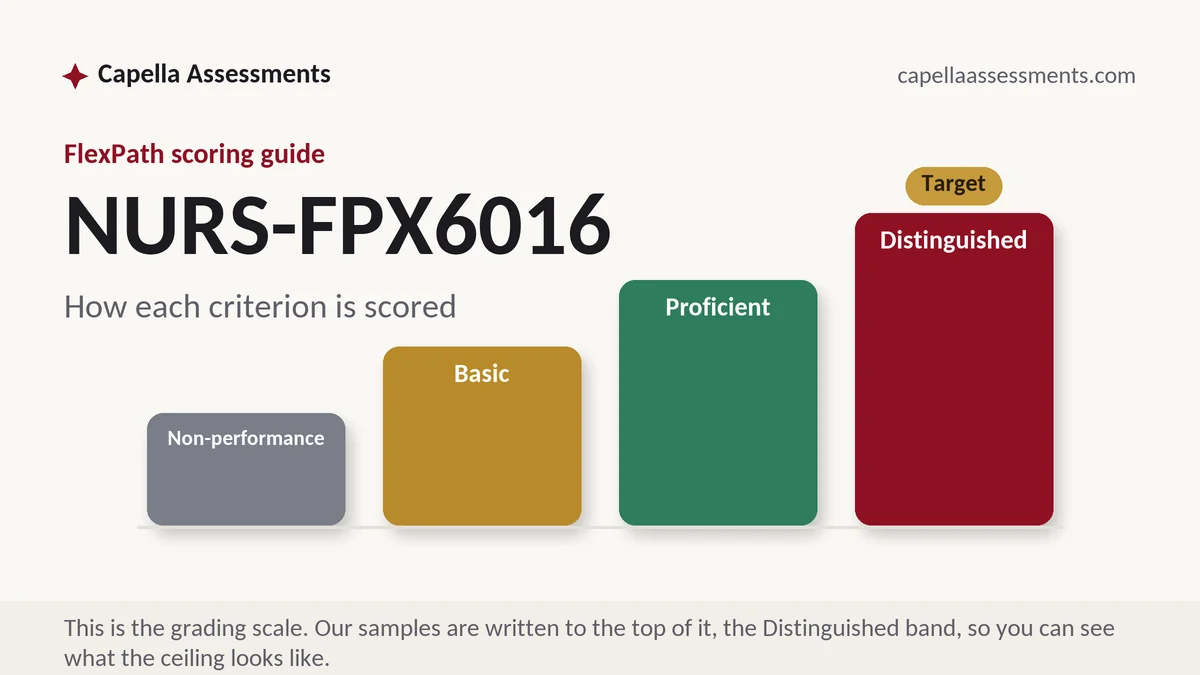
Ask a NURS-FPX6016 learner who scored Basic what the third criterion said and most cannot answer, because the paper was drafted and submitted with the scoring guide closed. The incident is vivid, the writing flows, and the guide stays a download that never got opened past day one. Working from memory of the instructions produces exactly the gaps this course punishes: the quality metrics criterion satisfied with one vague sentence, the interprofessional criterion treated as implied, the evidence criterion met with citations that support nothing specific. The habit that fixes it costs nothing. Write with the guide open in a second window, check each section against its row before moving on, and reread every row once more between finishing and submitting.
The NURS-FPX6016 drawers
NURS-FPX6016 Assessment 1 example
The adverse event or near-miss analysis drawer holds an incident reconstructed as a system failure, contributing factors chained and quality metrics attached. On request, free, 24-48h.
NURS-FPX6016 Assessment 2 example
In current courserooms this assessment typically appears as "Quality Improvement Initiative Evaluation". Judging an existing improvement initiative fills the second drawer: a real program weighed against its own measures, with the verdict argued from data. On request, free, 24-48h.
NURS-FPX6016 Assessment 3 example
In current courserooms this assessment typically appears as "Data Analysis and Quality Improvement Initiative Proposal". Reading the data, then proposing the initiative closes the set, modeling dashboard interpretation that ends in a fundable interprofessional proposal. On request, free, 24-48h.
Your courseroom shows something else?
Capella revises courses; assessment counts and titles shift between versions. Send what your courseroom shows and the desk matches it exactly.
Using a NURS-FPX6016 sample the right way
Open the sample and your scoring guide side by side and read them as a pair; the sample is deliberately structured so each guide row has an obvious home. Study how the incident analysis stays factual without going flat, and how the critique assigns judgment to evidence instead of opinion. Then close the sample and draft from your own incident, your own dashboard. What transfers is the structure and the discipline, never the content. Request a sample keyed to the guide in your courseroom, first one free, delivered in 24-48h, and keep that guide open while you compare.
How these samples are written
Every sample in this drawer is written the same way our custom ones are: the scoring guide decoded criterion by criterion, a subject-matched writer drafting to the Distinguished column, APA checked line by line, and the reasoning annotated so the paper teaches while it shows. Capella revises scoring guides, so a custom request is always written to the guide in YOUR courseroom, never from a stale template.
NURS-FPX6016 questions, answered
Can I see a NURS-FPX6016 adverse event analysis sample before I pick my incident?
Yes, and that order is smart. Request the sample with your scoring guide attached, read how it frames contributing factors and metrics, then choose an incident from your own experience with enough system detail to sustain that structure. First sample free, delivered in 24-48h, written to the exact guide you send.
Do I really need the scoring guide open while I write?
For this course especially, yes. NURS-FPX6016 criteria include quiet rows on metrics, interprofessional implications, and communication strategy that memory reliably drops. Learners who keep the guide beside the draft and verify each section against its row stop losing points they already earned in research. It is the cheapest habit in FlexPath.
Is it okay to base my paper on the sample's incident instead of one of mine?
Use your own. The analysis criteria ask for implications tied to a setting you can describe credibly, and evaluators notice borrowed incidents that lack texture. The sample exists to show you the analytic frame, how factors chain, how metrics attach, how judgment stays blameless. Swap in your own event and the frame still holds; that is the point of it.