Each drawer below is one NURS-FPX6026 assessment. Where a sample is live, read it in full, true APA form with the reasoning annotated. Where it is not, request it free: send your assessment number and the scoring guide from your courseroom, and a custom sample written to your exact criteria arrives in 24 to 48 hours. Searches like "NURS FPX 6026 assessment 2 example", "NURS FPX 6026 sample paper", and "NURSFPX6026 sample" all land here, because this page is the drawer they belong in.
What NURS-FPX6026 is really about
NURS-FPX6026 takes the whole-person lens of its predecessor and points it at a vulnerable population: people experiencing homelessness, rural elders, veterans with comorbid conditions, whichever group the learner selects and stays with. The intellectual work is harder than it looks, because the course opens by demanding fairness. Before you may advocate, you must weigh the genuine disagreements about how to serve your population, competing evidence, competing values, competing budgets, and represent the positions you reject accurately. That sets the register for everything after: argued, sourced, and calm. Papers that read as advocacy from the first page tend to score worse than papers that earn their position through visible weighing.
The verified set runs weighing the positions on a vulnerable population, then the population health policy proposal, then advocating the policy to people who can adopt it, then development goals and the equity commitment. Read as one arc, it is a professional formation exercise: you end the course having argued a policy into existence and having stated what kind of advanced practice nurse you intend to become, with equity named as a commitment rather than a sentiment. The interprofessional layer never leaves. Proposals must assign roles across disciplines, advocacy must speak to administrators and legislators in their own decision language, and the final piece ties personal development to measurable contribution toward the population you chose.
What NURS-FPX6026’s assessments ask for
The weighing piece asks for a balanced analysis: the population characterized with data, the live disagreements about serving them laid out, and each position assessed on its evidence before you take a side. The proposal asks for policy structure, the problem, the proposed change, the evidence base, expected outcomes, and the interprofessional roles that make it work. The advocacy piece asks you to persuade named decision makers, choosing arguments, format, and tone for that audience while keeping every claim sourced. The closing piece asks for professional development goals connected to health equity, specific enough to evaluate later. Scoring guides across the set grade the quality of support hardest, and their Distinguished cells routinely add impartiality language: alternatives acknowledged, conflicting evidence addressed rather than hidden.
Where students lose points in NURS-FPX6026
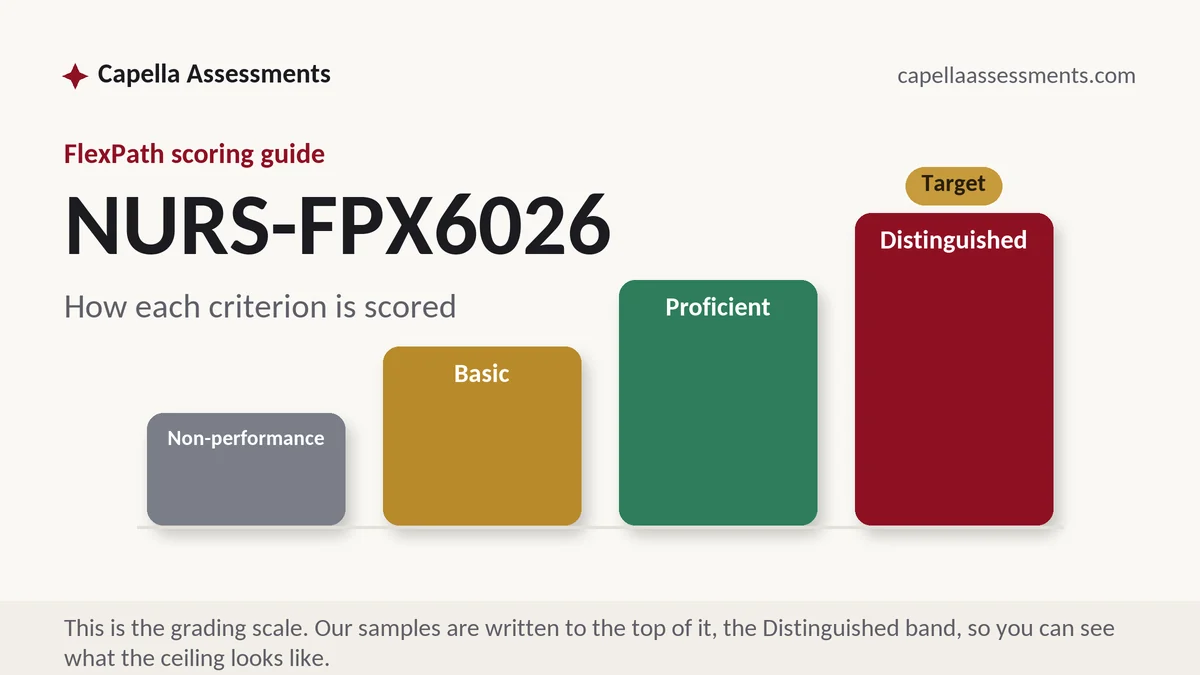
NURS-FPX6026 learners lose most points to rows they decided were soft. The equity commitment criterion, the professional development criterion, the row about acknowledging opposing positions: these read like reflection, so they get a closing paragraph instead of a section, or vanish from the outline entirely. The scoring guide does not share the learner's hierarchy. A skipped row scores Non-performance whether it asked for a meta-analysis or a development goal, and an underwritten one caps at Basic, which is how a paper with a genuinely strong policy core lands at a grade that feels unrelated to its quality. Give the soft rows the same treatment as the analytic ones: a heading, evidence or specifics, and a sentence performing the exact verb the criterion uses.
The NURS-FPX6026 drawers
NURS-FPX6026 Assessment 1 position papers weighed for a vulnerable population example
In current courserooms this assessment typically appears as "Analysis of Position Papers for Vulnerable Populations". Weighing the positions on a vulnerable population opens the shelf: one group characterized with data and the live disagreements about serving them assessed fairly. On request, free, 24-48h.
NURS-FPX6026 Assessment 2 population health policy proposal example
In current courserooms this assessment typically appears as "Biopsychosocial Population Health Policy Proposal". The population health policy proposal drawer models problem, change, evidence base, and interprofessional roles assembled into policy an organization could adopt. On request, free, 24-48h.
NURS-FPX6026 Assessment 3 policy advocated to people who can enact it example
In current courserooms this assessment typically appears as "Population Health Policy Advocacy". Advocating the policy to people who can adopt it fills the third drawer, persuasion aimed at named decision makers without a single unsourced claim. On request, free, 24-48h.
NURS-FPX6026 Assessment 4 development goals with an equity commitment example
In current courserooms this assessment typically appears as "Personal Goals and DEI Reflection". Development goals and the equity commitment closes the course, connecting the learner's professional growth plan to measurable service of the chosen population. On request, free, 24-48h.
Your courseroom shows something else?
Capella revises courses; assessment counts and titles shift between versions. Send what your courseroom shows and the desk matches it exactly.
Using a NURS-FPX6026 sample the right way
Use the sample to calibrate register. Notice how the weighing piece treats positions it will ultimately reject, that evenhandedness is a graded behavior, and how the advocacy piece changes voice without loosening its sourcing. Map each sample section to a row of your own scoring guide, including the development and equity rows you might be tempted to skim. Then choose your own population and write from your own convictions inside the same structure. Send the guide from your courseroom with your request; the first sample is free and arrives in 24-48h, written to those exact rows.
How these samples are written
The method behind every paper on this shelf: criteria first, structure from the criteria, evidence current, APA exact, and annotations that show which paragraph answers which criterion. Send your courseroom's scoring guide with a request and the custom sample matches it exactly, revisions included.
NURS-FPX6026 questions, answered
Is there a NURS-FPX6026 sample about a specific vulnerable population, like veterans or rural patients?
Request it with your population named and the sample is built around that group, using current data and literature, free on the first request, delivered in 24-48h. Because the whole course chains off one population choice, a sample keyed to yours is far more useful than a generic one, so say who you are writing about.
The policy part of my paper is strong. Why is my NURS-FPX6026 grade stuck below Proficient?
Print your scoring guide and check for rows without sections. In this course the development, equity, and opposing-positions criteria are the usual casualties; learners fold them into a conclusion, and folded rows score as missing. Every criterion needs its own labeled performance, however reflective it sounds. Restore the missing sections and the grade usually moves immediately.
Should the advocacy assessment sample be a paper or a presentation-style piece?
Whichever your courseroom specifies, which is why requests here start with your scoring guide. Advocacy deliverables in current courserooms vary in format, but the graded core is constant: a named audience with adoption power, arguments chosen for that audience, and sourcing that survives a hostile read. The sample models the format your guide describes, not a guessed one.