Each drawer below is one NURS-FPX6108 assessment. Where a sample is live, read it in full, true APA form with the reasoning annotated. Where it is not, request it free: send your assessment number and the scoring guide from your courseroom, and a custom sample written to your exact criteria arrives in 24 to 48 hours. Searches like "NURS FPX 6108 assessment 2 example", "NURS FPX 6108 sample paper", and "NURSFPX6108 sample" all land here, because this page is the drawer they belong in.
What NURS-FPX6108 is really about
NURS-FPX6108 treats curriculum as an engineered product with a lifecycle: identify the need, design to outcomes, develop the pieces, evaluate whether it worked. Papers in this course are design documents. You will propose a course or curriculum change for a real or realistic program, defend the need with data, align outcomes to professional standards, and specify how the design will be evaluated after launch. The writing is closer to an architect's submission than an essay, because every element must trace to something: a gap, a standard, an accreditation expectation, a learner characteristic. Committees approve curricula, so the genre assumes a skeptical faculty reader who wants the reasoning shown, not just the finished table of courses.
The course also tests whether you can hold the whole system in view. A single new course touches program outcomes, sequencing, faculty workload, clinical placements, and the evaluation data a program reports upward, and strong papers acknowledge those connections instead of designing in a vacuum. In current courserooms the sequence typically moves from appraising an existing curriculum to designing a change to planning its evaluation, which means your early scenario choice follows you through the whole course. Choose a program you can describe concretely. Our NURS-FPX6108 samples are built on that principle: one coherent scenario carried across assessments, each design decision weighed against an alternative before it is made, every criterion of the scoring guide answered where a grader can find it.
What NURS-FPX6108’s assessments ask for
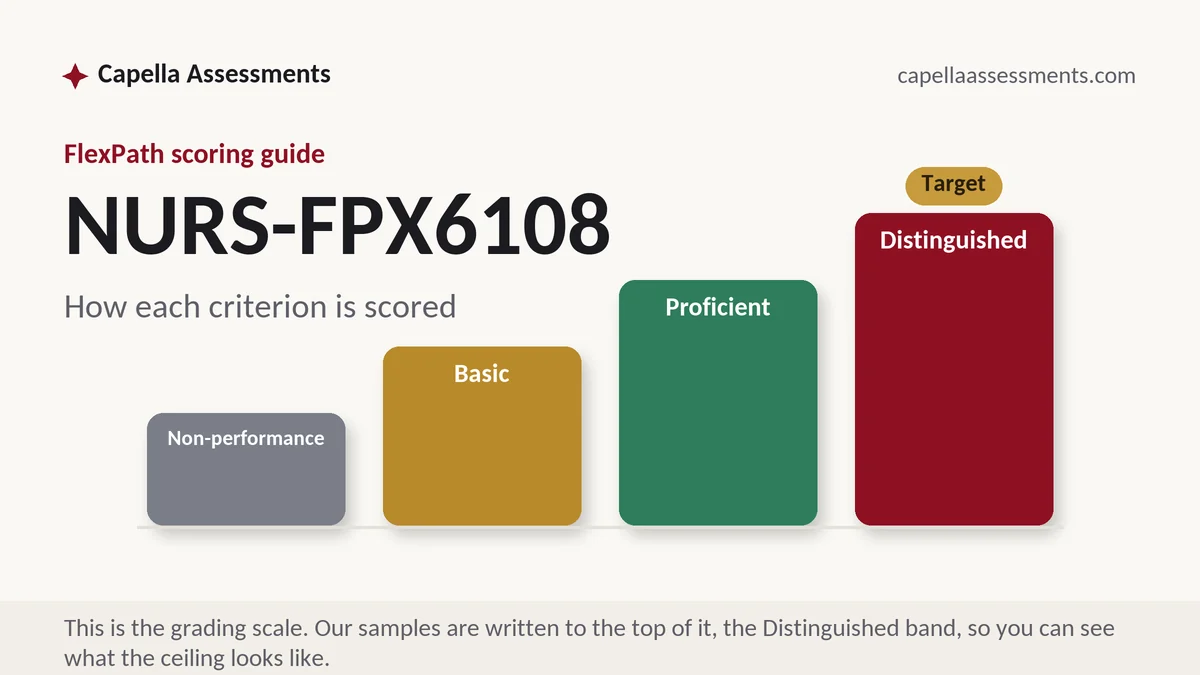
Expect design deliverables with parts that must agree with each other. Assessments in this course typically ask for a curriculum overview or appraisal, a needs-based proposal for a new course or revision, an outcomes and sequencing plan, and an evaluation design that says how success will be measured and by whom. The scoring guide criteria reward alignment above all: outcomes that map to professional standards, content that maps to outcomes, evaluation methods that could actually detect what the design promises. Distinguished-level criteria push further and ask you to justify choices against alternatives, so the paper has to show the option you rejected and why. Whatever your courseroom's exact lineup, send us the scoring guide and the sample will follow its criteria in order, not a generic template.
Where students lose points in NURS-FPX6108
Curriculum papers fail on depth more than accuracy. The most common miss: a student presents a curriculum design model faithfully, complete with citations, then never runs their own proposed course through it, so the model sits in the paper as decoration while the design decisions happen unexplained. Second: needs assessments that stack statistics, enrollment trends, employer surveys, licensure pass data, without weighing which piece of evidence actually drives the proposal, leaving the grader to do the synthesis the criterion assigned to you. Third: analysis sections that end without the so-what paragraph, the one that says what the appraisal means for the redesign. Each of these reads as Proficient work wearing a Distinguished reference list, and the scoring guide can tell the difference.
The NURS-FPX6108 drawers
NURS-FPX6108 Assessment 1 an existing curriculum appraised example
The opening drawer in current courserooms typically holds the appraisal piece, an existing curriculum examined for how it was designed and where it strains. On request, free, 24-48h.
NURS-FPX6108 Assessment 2 the needs case for a course to exist example
The second drawer usually carries the needs argument, the evidence-backed case that a course or revision should exist at all. On request, free, 24-48h.
NURS-FPX6108 Assessment 3 curriculum theory chosen and applied example
In current courserooms this assessment typically appears as "Curriculum Theory, Frameworks, and Models". Midway sits the design itself in most sequences, outcomes and content aligned to standards a committee would check. On request, free, 24-48h.
NURS-FPX6108 Assessment 4 course developed with influencing factors named example
In current courserooms this assessment typically appears as "Course Development and Influencing Factors". The development piece usually lands fourth, the approved design worked into teachable form with methods justified rather than listed. On request, free, 24-48h.
NURS-FPX6108 Assessment 5 curriculum evaluation designed example
In current courserooms this assessment typically appears as "Curriculum Evaluation". The closing drawer typically holds the evaluation plan, the document that decides in advance how the curriculum will prove itself. On request, free, 24-48h.
Your courseroom shows something else?
Capella revises courses; assessment counts and titles shift between versions. Send what your courseroom shows and the desk matches it exactly.
Using a NURS-FPX6108 sample the right way
Treat the sample as a worked example of alignment. Trace one outcome through it: where the need justified it, where content delivers it, where the evaluation plan measures it. That thread is the skill NURS-FPX6108 is grading, and seeing it once makes it much easier to build. Then set up your own scenario, a program you know, and rebuild the thread with your own data and standards. Send the scoring guide from your courseroom and we will write the sample to those criteria, free, within 24-48h, so the model you study matches the document you owe.
How these samples are written
Every sample in this drawer is written the same way our custom ones are: the scoring guide decoded criterion by criterion, a subject-matched writer drafting to the Distinguished column, APA checked line by line, and the reasoning annotated so the paper teaches while it shows. Capella revises scoring guides, so a custom request is always written to the guide in YOUR courseroom, never from a stale template.
NURS-FPX6108 questions, answered
Can I get a NURS-FPX6108 curriculum design sample for my specific assessment?
Yes. Tell us which assessment you are on and attach the scoring guide from your courseroom, and we write the NURS-FPX6108 sample to those criteria, free, in 24-48h. Curriculum assessments vary by scenario, so a sample built to your exact criteria and program type beats any pre-written paper sitting in a library.
My NURS-FPX6108 paper cited a design model but still lost points. What happened?
Citing a model earns Basic to Proficient; applying it earns more. Graders look for the model doing work: your proposed course run through its stages, with the output of each stage visible in the design. If the model appears in one paragraph and the design in another with no traffic between them, the criterion asking for application goes unmet. Our samples keep the model and the design in the same sentences.
How much detail does a 6108 evaluation plan need to reach Distinguished?
Enough that someone else could run it. Distinguished-level criteria in evaluation-focused assessments generally want named measures, a timeline, responsible parties, and a decision rule: what the program will do if the data comes back poor. A plan that says outcomes will be assessed annually describes intent, not evaluation. Weigh your methods, state their limits, and end by deciding what evidence would trigger revision.