Each drawer below is one NURS-FPX6112 assessment. Where a sample is live, read it in full, true APA form with the reasoning annotated. Where it is not, request it free: send your assessment number and the scoring guide from your courseroom, and a custom sample written to your exact criteria arrives in 24 to 48 hours. Searches like "NURS FPX 6112 assessment 2 example", "NURS FPX 6112 sample paper", and "NURSFPX6112 sample" all land here, because this page is the drawer they belong in.
What NURS-FPX6112 is really about
NURS-FPX6112 asks a question most educator courses skip: does the technology actually help anyone learn? The course covers simulation, learning management platforms, virtual clinical tools, and classroom technologies, but the papers it grades are evaluations, not catalogs. You will assess tools against learning outcomes, weigh cost and faculty readiness, and argue an integration approach for a specific educational setting. The strongest work borrows its logic from evidence-based practice: define the learning problem first, then measure candidate technologies against it, then commit. A paper that opens with the tool and works backward to a justification tends to read as advocacy, and scoring guide criteria at the upper levels are built to catch exactly that.
Learning science carries this course, and it deserves primary-source treatment. When a paper argues that a simulation design overloads novices, Sweller's cognitive load theory is the citation doing the work, and it should be applied to the actual design, screen by screen or scenario by scenario, not summarized in an obligatory paragraph. In current courserooms the sequence typically moves from assessing a setting's technology needs toward a defended integration or implementation plan, so decisions accumulate: the tool you evaluate early becomes the tool you plan around later. Our NURS-FPX6112 samples hold that continuity and show what theory-in-use looks like on the page, at the Distinguished level of each criterion, in the order your scoring guide lists them.
What NURS-FPX6112’s assessments ask for
The deliverables here are decision documents. Typical assessments ask you to profile a learning environment and its technology gaps, evaluate specific tools against outcomes and constraints, design how a chosen technology enters actual teaching, and defend the plan to the people who would approve or fund it. Criteria repeatedly ask for comparison: this tool against that one, benefit against cost, innovation against faculty workload. That means tables and criteria matrices often belong in the paper, but the scoring guide still grades the prose around them, the paragraphs that interpret the comparison and commit to a choice. Distinguished-level language in this course usually turns on evaluation verbs, so a submission that stops at describing features has left the top level unclaimed regardless of how current the tools are.
Where students lose points in NURS-FPX6112
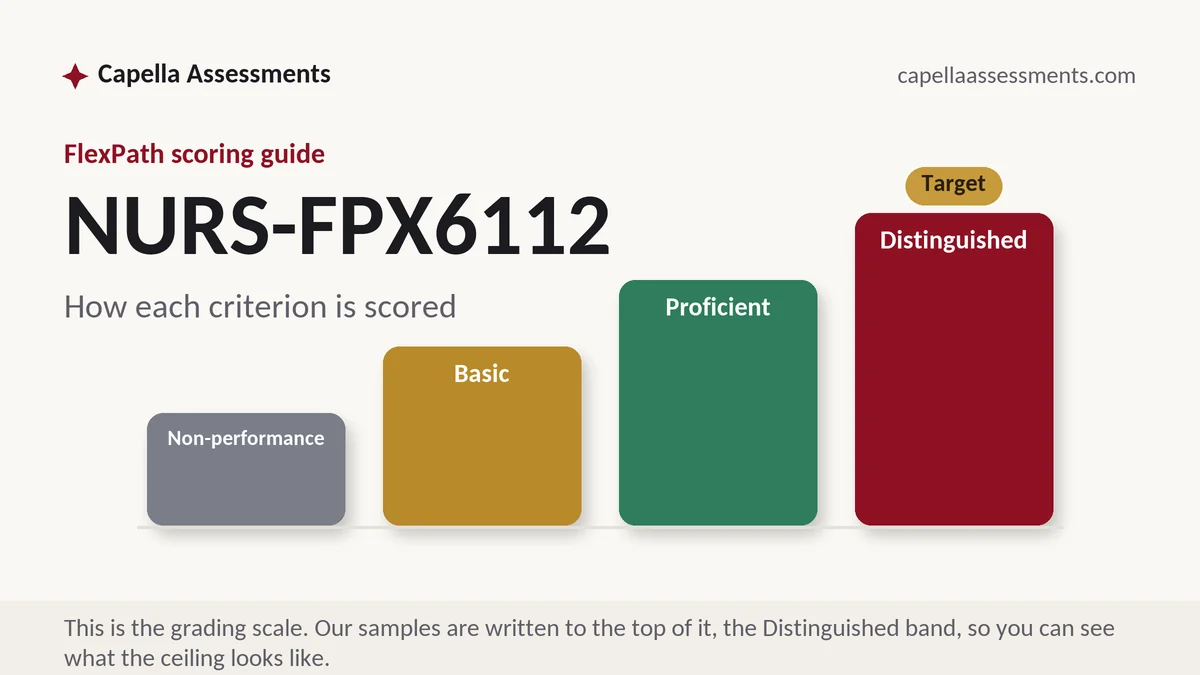
Watch where 6112 drafts go flat. A comparison matrix gets built, six tools scored across eight factors, and then the paper moves on without the paragraph that weighs the results and picks, which is the paragraph the criterion was actually about. Cognitive load theory gets a textbook-accurate summary but never touches the simulation the student is proposing, so application criteria score as description. Needs analyses close without a so-what: the environment is profiled, gaps are named, and the reader is left to infer what should happen next. In each case the student did the research and skipped the judgment, and the gap between Proficient and Distinguished in this course is almost entirely judgment rendered in writing.
The NURS-FPX6112 drawers
NURS-FPX6112 Assessment 1 practicum plan against the site's simulation resources example
In current courserooms this assessment typically appears as "Conference Call Scheduling and Notes". First position typically surveys the educational setting and its readiness, the diagnostic work that precedes any tool choice. On request, free, 24-48h.
NURS-FPX6112 Assessment 2 one virtual simulation scenario evaluated example
In current courserooms this assessment typically appears as "Evaluation of a Virtual Simulation Scenario". Position two tends to hold the evaluation piece, candidate technologies measured against learning outcomes with the trade-offs argued. On request, free, 24-48h.
NURS-FPX6112 Assessment 3 simulation technologies compared example
In current courserooms this assessment typically appears as "Comparison of Types of Simulation Technology". The third drawer tends toward application, an integration or course design where the chosen technology meets actual instruction. On request, free, 24-48h.
NURS-FPX6112 Assessment 4 implementation plan for a new simulation product example
In current courserooms this assessment typically appears as "Implementation Plan for a New Simulation Product". The closing assessment in most sequences defends the plan, implementation and evaluation reasoned for the stakeholders who would approve it. On request, free, 24-48h.
Your courseroom shows something else?
Capella revises courses; assessment counts and titles shift between versions. Send what your courseroom shows and the desk matches it exactly.
Using a NURS-FPX6112 sample the right way
Read the sample twice. First pass, follow the argument: where the learning problem is defined, where each technology is weighed, where the commitment lands. Second pass, follow the scoring guide: match each criterion to the passage that answers it and notice the evaluative sentence that lifts it past description. Then build your own version around your own setting, your own learners, the platforms your program actually runs. If you send the scoring guide from your courseroom, the free custom sample arrives in 24-48h already shaped to those criteria, which makes the second pass much shorter.
How these samples are written
Samples here follow one discipline: the scoring guide is the outline, every criterion gets its section, the Distinguished description decides the depth, and the APA layer ships exact. Because Capella updates courses over time, your free custom sample is drafted against the scoring guide you send, not against an archive.
NURS-FPX6112 questions, answered
How fast can I get a NURS-FPX6112 sample written to my scoring guide?
Within 24-48h of sending it, and the first custom sample is free. Attach the scoring guide for the assessment you are on and mention your setting if the instructions name one, academic program or staff development, since the technology argument changes with the audience. The sample comes back written to those criteria in order, at the Distinguished level, ready to study against your own draft.
I compared several technologies in my 6112 paper. Why was the criterion still marked Proficient?
Comparison alone is evidence presented, not evidence weighed. Proficient shows you gathered the factors; Distinguished shows you ranked them, traded them off, and decided, with the losing option acknowledged. Add the paragraph after your matrix that says which factor mattered most for your learners and why the runner-up lost. That single evaluative move is usually the whole distance between the two levels.
Do NURS-FPX6112 samples cover simulation-focused assessments?
Yes, when your scoring guide points there. Simulation, virtual clinical environments, LMS builds, and classroom tools all appear in current courserooms, and the sample follows whatever scenario your criteria define. Because tools change faster than courses, we write to the criteria and the learning argument rather than to one product's feature list, which is also how your grader reads it.