Each drawer below is one NURS-FPX6400 assessment. Where a sample is live, read it in full, true APA form with the reasoning annotated. Where it is not, request it free: send your assessment number and the scoring guide from your courseroom, and a custom sample written to your exact criteria arrives in 24 to 48 hours. Searches like "NURS FPX 6400 assessment 2 example", "NURS FPX 6400 sample paper", and "NURSFPX6400 sample" all land here, because this page is the drawer they belong in.
What NURS-FPX6400 is really about
NURS-FPX6400 is the MSN entry into nursing informatics, and its papers live or die on specificity. The course asks you to define what informatics actually is in a working unit: how a medication pass, a triage note, or a shift handoff becomes structured data, where that data travels, and who governs it once it lands. Strong submissions read like a nurse explaining a system to another nurse, with the workflow named before any technology is praised. Weak ones read like vendor copy. The scoring guide rewards writers who can hold both identities at once, clinician and analyst, and who treat the electronic health record as a clinical instrument rather than an IT purchase.
Because this is a FlexPath course, the pacing is yours but the evidence bar is not. Expect criteria that ask for current peer-reviewed sources on data standards, nursing terminologies, and the informatics nurse specialist role, plus at least one deliverable aimed at a non-academic audience such as leadership or an interdisciplinary committee. That audience shift trips up experienced clinicians: the writing must stay evidence-based while dropping classroom scaffolding. Sample papers help most here by showing register, how a governance argument sounds when it is written for a CNO rather than a professor, and how APA citation keeps working quietly underneath. Your scoring guide decides the exact deliverables, so read it before you outline anything.
What NURS-FPX6400’s assessments ask for
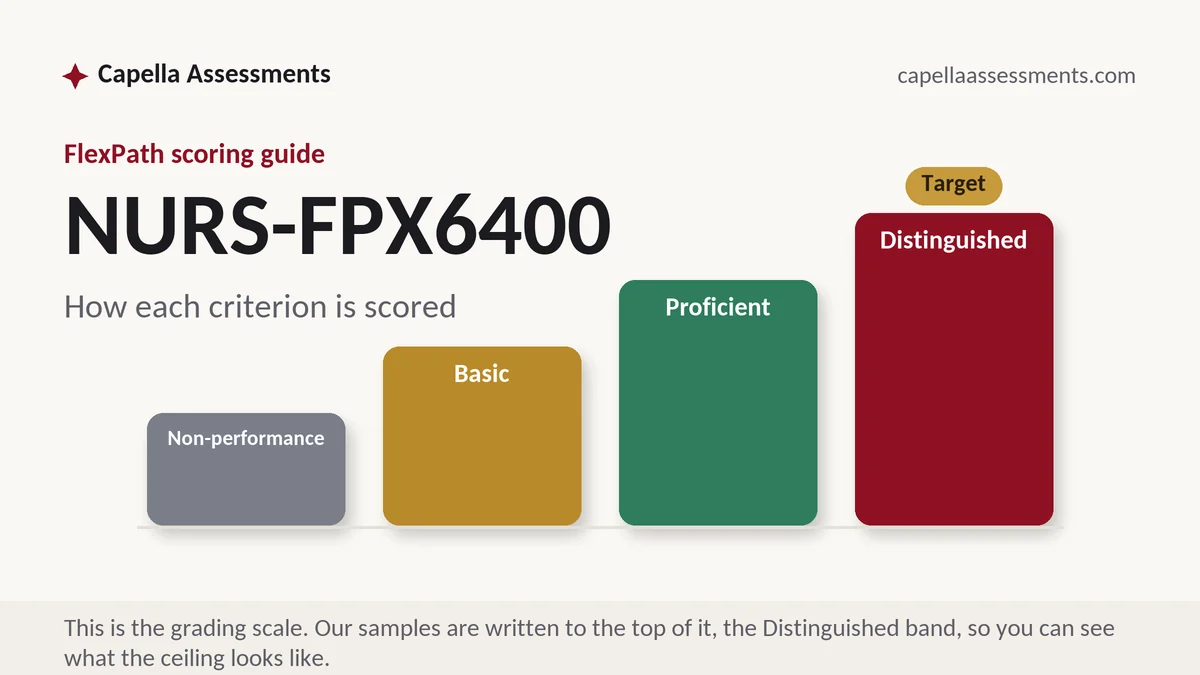
Across current courserooms, NURS-FPX6400 assessments ask for analysis first and advocacy second. A typical sequence moves from defining informatics concepts and the specialist's scope, through examining how a specific clinical workflow generates and consumes data, toward a proposal or presentation that argues for better governance, training, or system use. Criteria usually want three things visible at once: a named clinical process, the data elements it touches, and the standard or policy that disciplines them. Distinguished work adds consequence, saying what changes for patients when the data is clean or dirty. Most deliverables are APA papers; some become slide decks or briefs for a stated audience. Whatever the format, the scoring guide in your courseroom is the contract, and every criterion in it expects evidence, not enthusiasm.
Where students lose points in NURS-FPX6400
The classic NURS-FPX6400 point-loss is the sentence that says technology improves patient care and then stops. Graders see it constantly: three paragraphs praising the EHR with no named workflow anywhere, no medication reconciliation, no barcode scan at the bedside, no discharge summary moving to a primary care inbox. A criterion that asks you to analyze how informatics supports practice cannot score Distinguished on abstractions; it needs one process, walked step by step, with the data trail visible. The same failure hides in governance sections that mention standards without naming one, and in role descriptions that could apply to any committee anywhere. These sections land at Basic because nothing in them can be verified or acted on. Specific beats sweeping in this course, every single time.
The NURS-FPX6400 drawers
NURS-FPX6400 Assessment 1 informatics defined with the specialist role scoped example
Openers here typically define nursing informatics and the specialist role, so this drawer's samples model concept-and-scope writing with the evidence layer already in place. On request, free, 24-48h.
NURS-FPX6400 Assessment 2 one clinical workflow traced into its data example
Second assessments in this course tend to sit in analysis territory, and these samples show a named clinical workflow traced into its data before any recommendation appears. On request, free, 24-48h.
NURS-FPX6400 Assessment 3 executive summary to administration example
In current courserooms this assessment typically appears as "Executive Summary to Administration". By the third assessment the arc usually turns applied, so the models here argue governance, training, or system improvement for a stated professional audience. On request, free, 24-48h.
NURS-FPX6400 Assessment 4 regulations explored for practice implications example
In current courserooms this assessment typically appears as "Exploration of Regulations and Implications for Practice". Closing work typically synthesizes the quarter into a proposal or presentation, and this drawer models that shift from analysis to persuasion without losing citations. On request, free, 24-48h.
Your courseroom shows something else?
Capella revises courses; assessment counts and titles shift between versions. Send what your courseroom shows and the desk matches it exactly.
Using a NURS-FPX6400 sample the right way
Use a NURS-FPX6400 sample the way you would use a well-charted patient record: as a model of structure, not a source of content. Read it once against the scoring guide, criterion by criterion, and mark where the writer names a workflow, defines a data element, or cites a standard. Then close it and outline your own paper around a process you actually know from practice. Your submission should carry your unit, your system, your sources. If the drawer sample does not match the scoring guide in your courseroom, send yours through the free request and we will write to that exact document instead.
How these samples are written
Samples here follow one discipline: the scoring guide is the outline, every criterion gets its section, the Distinguished description decides the depth, and the APA layer ships exact. Because Capella updates courses over time, your free custom sample is drafted against the scoring guide you send, not against an archive.
NURS-FPX6400 questions, answered
Is there a NURS-FPX6400 Assessment 2 sample I can actually read?
Yes, through the drawer request. Assessment order shifts between courserooms, so instead of posting a fixed set we write your sample to the scoring guide you send, matched to the exact assessment you are on. The first custom sample is free and arrives in 24-48h, written as a readable model, not a fill-in template.
How specific does my workflow example need to be for Distinguished in NURS-FPX6400?
Specific enough that a colleague could observe it. Name the process, the unit type, the data captured at each step, and the standard that governs it. A criterion asking you to analyze informatics in practice is really asking whether you can trace one workflow end to end. Our samples model that depth so you can calibrate your own.
Can I submit a sample paper as my own NURS-FPX6400 work?
No, and you would not want to. Samples here are study models: they show how a scoring guide converts into structure, evidence, and register. Submitting one defeats the point and violates Capella's academic honesty policy. Read it, learn the moves, then write your own paper from your own practice. That version is the one worth grading.