Each drawer below is one NURS-FPX6620 assessment. Where a sample is live, read it in full, true APA form with the reasoning annotated. Where it is not, request it free: send your assessment number and the scoring guide from your courseroom, and a custom sample written to your exact criteria arrives in 24 to 48 hours. Searches like "NURS FPX 6620 assessment 2 example", "NURS FPX 6620 sample paper", and "NURSFPX6620 sample" all land here, because this page is the drawer they belong in.
What NURS-FPX6620 is really about
NURS-FPX6620 opens the MSN care coordination track by asking what a model actually does. Accountable care organizations, patient-centered medical homes, transitional care programs, and chronic care frameworks all claim better outcomes at lower cost; the course wants you to open the hood on those claims. Strong papers pick a population, heart failure patients leaving a community hospital, diabetics in a rural clinic, and trace how a given model reorganizes who follows them, who is paid, and what happens at the first missed appointment. The writing is comparative and mechanical in the best sense: not whether coordination is good, but how this model produces it, for whom, and at whose expense.
Payment is the quiet second subject of this course. Models exist because reimbursement shaped them, so criteria often expect fluency with value-based purchasing, bundled payments, readmission penalties, and the IHI Triple Aim as the standing scorecard. MSN students sometimes treat that material as background; graders treat it as the point. Expect at least one deliverable aimed at stakeholders, leadership, a community board, an interprofessional team, where you translate model mechanics into consequences an audience cares about. The samples in these drawers model that translation, showing how a paper stays scholarly while explaining who pays, who benefits, and where the nurse coordinator sits inside the machinery. FlexPath pacing gives you room to learn the payment material properly before it is graded.
What NURS-FPX6620’s assessments ask for
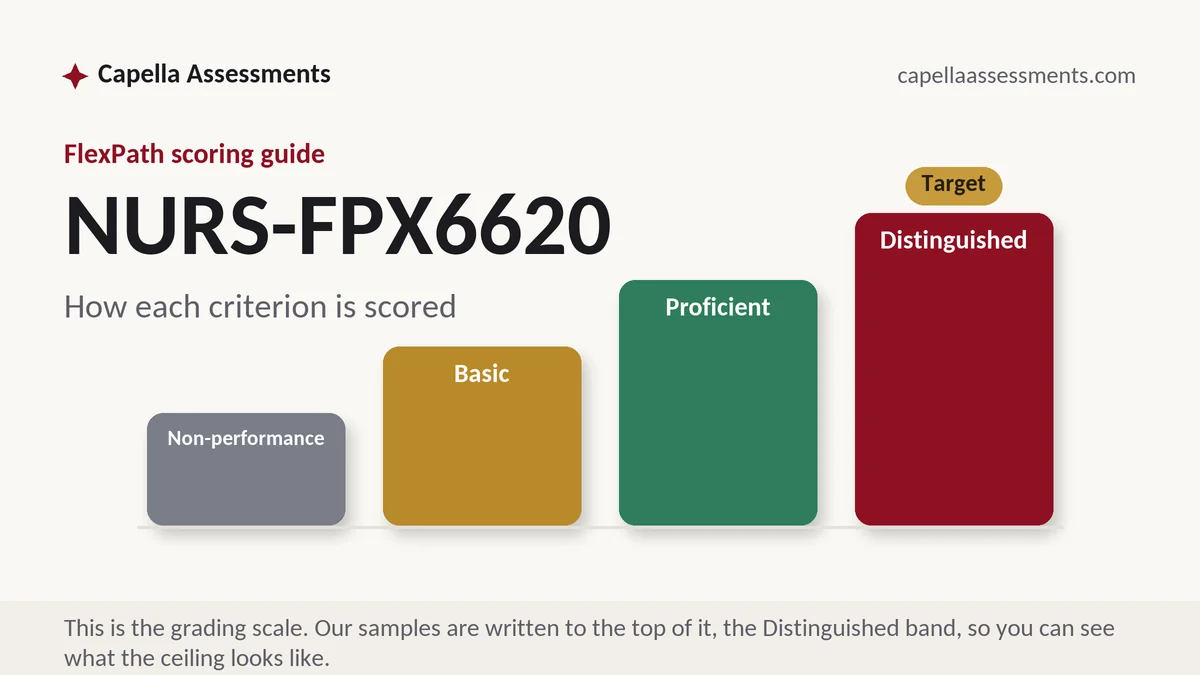
The NURS-FPX6620 sequence in current courserooms typically runs from analysis to application. Openers usually ask you to examine established care coordination models and the evidence behind them; middle work tends to apply a model to a defined population or setting, often with an eye on transitions between levels of care; the close generally argues a recommendation, which model, adapted how, for this community, with financial and quality implications stated. Criteria reward three habits: naming the population precisely, citing outcome evidence rather than asserting it, and connecting every model feature to a payer or policy reason it exists. Deliverables are mostly APA analyses with an occasional presentation, and your scoring guide decides which model families are in bounds, so read it before committing to a favorite.
Where students lose points in NURS-FPX6620
Where NURS-FPX6620 papers fall to Proficient or below is almost always the unnamed particular. A model application that says patients will be connected to community resources, and never names one, no Area Agency on Aging, no medication assistance program, no county transport service, gives the criterion nothing to credit. The same hollowness appears when a paper repeats that the model improves outcomes without saying which outcome, for which population, in which study. Graders read those sentences as borrowed confidence. The repair is cheap and mechanical: every time your draft gestures at resources, services, or outcomes, replace the gesture with one named instance and its citation. Three real nouns will lift a section further than three polished paragraphs of general praise.
The NURS-FPX6620 drawers
NURS-FPX6620 Assessment 1 coordination models compared against evidence example
Opening assessments in this course typically survey the major coordination models against their evidence, and these samples model that comparative analysis without acronym recital. On request, free, 24-48h.
NURS-FPX6620 Assessment 2 one model applied to a named population example
The middle slot usually applies a chosen model to a named population and setting, so the drawer's samples show mechanism, payer logic, and community services made concrete. On request, free, 24-48h.
NURS-FPX6620 Assessment 3 recommendation argued to stakeholders example
Closing work tends to argue a recommendation to stakeholders, and these models make the case with outcomes, costs, and the coordinator role all specified. On request, free, 24-48h.
Your courseroom shows something else?
Capella revises courses; assessment counts and titles shift between versions. Send what your courseroom shows and the desk matches it exactly.
Using a NURS-FPX6620 sample the right way
Open a NURS-FPX6620 sample next to your scoring guide and read for anchoring. Note where the model paper commits, the population it names, the payment mechanism it explains, the community services it lists by name, and use those commitments as a checklist for your own draft rather than a source to echo. Your community has different resources and your courseroom may weight different models, so the transferable part is the habit of specificity, not the specifics. Write your paper from your own setting and evidence, then compare structure. If your scoring guide does not match what this drawer describes, send yours in; the first custom sample is free and arrives in 24-48h.
How these samples are written
The method behind every paper on this shelf: criteria first, structure from the criteria, evidence current, APA exact, and annotations that show which paragraph answers which criterion. Send your courseroom's scoring guide with a request and the custom sample matches it exactly, revisions included.
NURS-FPX6620 questions, answered
Which care coordination model should I pick for my NURS-FPX6620 paper?
Pick the one your population makes interesting. Transitional care suits writers working discharge-heavy settings; medical home models suit primary care; accountable care structures suit anyone who can write about shared savings honestly. The criteria score depth of application, not the fashionableness of the model, so choose where you can name real services, payers, and handoffs.
Is there a NURS-FPX6620 Assessment 1 sample available before I commit to a direction?
Yes, through the free request. Send the Assessment 1 scoring guide from your courseroom and you will have a matched sample in 24-48h, written to those criteria rather than to a guess about them. Reading it before you outline is exactly the right sequence, because the opener usually sets the model and population the later assessments inherit.
How much health policy and payment detail does NURS-FPX6620 really expect from a nurse?
Working fluency, not economist depth. You should be able to explain why a readmission penalty changes discharge behavior or why capitation rewards prevention, in two or three cited sentences. Criteria fall when papers skip payment entirely, treating coordination as pure goodwill. A sample shows the proportion: clinical reasoning in front, financing explained wherever the model depends on it.