Each drawer below is one NURS-FPX6622 assessment. Where a sample is live, read it in full, true APA form with the reasoning annotated. Where it is not, request it free: send your assessment number and the scoring guide from your courseroom, and a custom sample written to your exact criteria arrives in 24 to 48 hours. Searches like "NURS FPX 6622 assessment 2 example", "NURS FPX 6622 sample paper", and "NURSFPX6622 sample" all land here, because this page is the drawer they belong in.
What NURS-FPX6622 is really about
Coordination gets physical in NURS-FPX6622: staffing structures, communication channels, care plans, and the processes that move a patient from unit to unit or hospital to home. Donabedian's structure-process-outcome logic sits underneath most of the course, whether or not a criterion names it, because the papers keep asking the same paired questions. What arrangement makes good coordination possible, and what sequence of actions actually delivers it? Submissions that score Distinguished read like operations writing with a clinical conscience: they can describe a discharge as a chain of specific steps, each with an owner and a deadline, and still keep the patient's experience at the center of the chain.
The course also insists that coordination crosses organizational walls. Expect to write about handoffs to skilled nursing, home health, behavioral health, and community agencies, and about the interprofessional team sharing the plan: pharmacist, social worker, case manager, primary care. That breadth is where drafts go thin, because most nurses know one segment of the route intimately and only wave at the rest. The drawer samples are built to counter that, modeling papers where every transition has a named receiver and every team member a stated contribution. FlexPath gives you time to research the segments you have not worked; the scoring guide will notice whether you spent it.
What NURS-FPX6622’s assessments ask for
Typical NURS-FPX6622 sequences in current courserooms move from mapping to building. Early assessments generally analyze existing coordination structures and processes, sometimes through a case or a setting you select; later assessments usually construct something, a care coordination plan, a process redesign, or a presentation that walks a team through a safer transition. Criteria concentrate on completeness of the chain: preparation before the move, communication during it, follow-up after it, with the patient and family treated as participants rather than cargo. Evidence expectations stay high, current sources on transitions of care, discharge planning, and team communication, and APA remains the frame. Because deliverable formats shift between courserooms, confirm in your scoring guide whether you owe a paper, a plan document, or slides before you start building.
Where students lose points in NURS-FPX6622
The fastest way to lose points in NURS-FPX6622 is the ownerless handoff. Drafts write that the patient will be transitioned to home health with follow-up arranged, and no person anywhere holds the action: nobody named to send the medication list, nobody named to receive it, no timeframe for the first home visit, no backup when the referral bounces. A coordination plan without owners is a hope, and criteria built around process cannot score hope above Basic. The weakness compounds when community follow-up is written as an address rather than a relationship, an agency mentioned once and never contacted in the plan's own logic. Give every step a role, a deadline, and a failure path, and the same plan starts reading like something a unit could run tomorrow.
The NURS-FPX6622 drawers
NURS-FPX6622 Assessment 1 how a real setting currently moves patients example
This first drawer typically covers the mapping stage, samples that analyze how a real setting's structures and processes currently move patients, gaps included. On request, free, 24-48h.
NURS-FPX6622 Assessment 2 transitions written with owners and receiving agencies example
Middle assessments usually build the plan itself, and the samples here model transitions written with owners, timeframes, and named receiving agencies. On request, free, 24-48h.
NURS-FPX6622 Assessment 3 process work packaged for a team audience example
The final slot tends to package the work for a team or stakeholder audience, so these models show process writing translated into presentation-ready argument. On request, free, 24-48h.
Your courseroom shows something else?
Capella revises courses; assessment counts and titles shift between versions. Send what your courseroom shows and the desk matches it exactly.
Using a NURS-FPX6622 sample the right way
Work a NURS-FPX6622 sample like a process map you intend to argue with. Trace one transition through the model paper and list every owner, timestamp, and contingency it names; that list is the standard your own plan needs to meet in your own setting. Then draft yours from the unit you know, with your agencies, your team roles, your scoring guide open beside you. Copying the sample's structure of accountability is the point; copying its content would just import someone else's hospital into your paper. Where drawer and courseroom diverge, the free custom sample closes the gap, written to the exact scoring guide you send within 24-48h.
How these samples are written
Every sample in this drawer is written the same way our custom ones are: the scoring guide decoded criterion by criterion, a subject-matched writer drafting to the Distinguished column, APA checked line by line, and the reasoning annotated so the paper teaches while it shows. Capella revises scoring guides, so a custom request is always written to the guide in YOUR courseroom, never from a stale template.
NURS-FPX6622 questions, answered
What does a Distinguished care coordination plan look like in NURS-FPX6622?
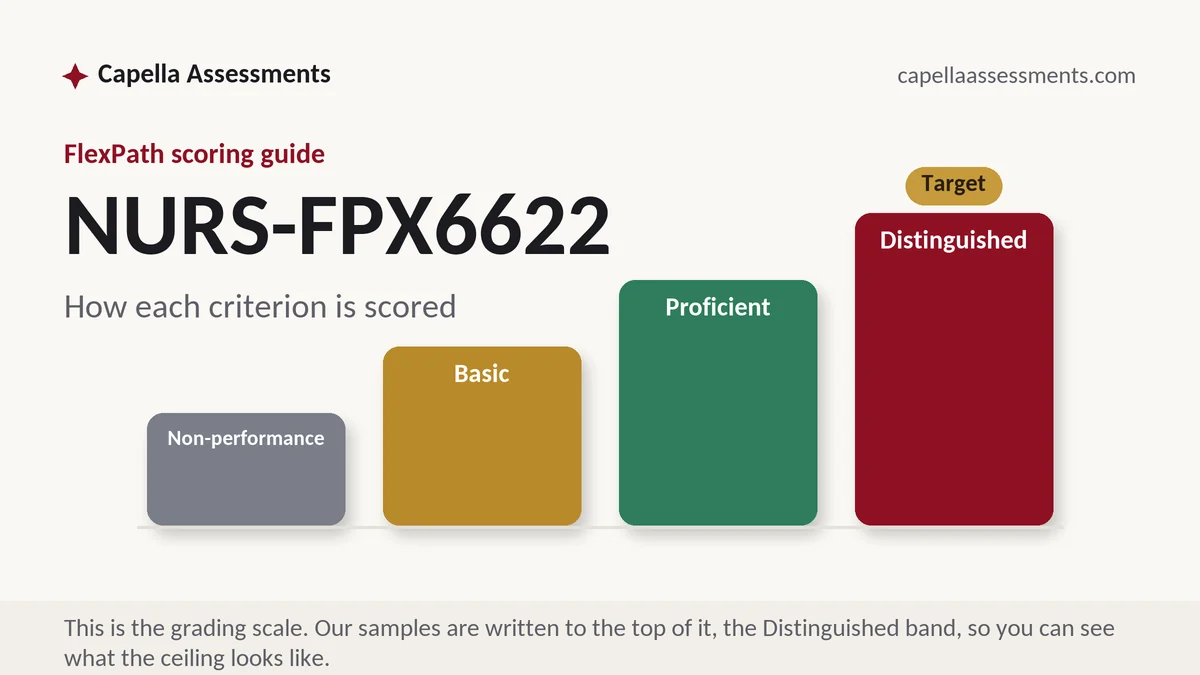
It is runnable. Each transition step has a named role responsible, a timeframe, and a plan B; each community referral is a specific agency with a stated service, not a category; the patient's goals appear in the plan's own decisions. Proficient plans describe coordination. Distinguished plans could be handed to a charge nurse and executed, which is the difference criteria are written to detect.
Can you send a NURS-FPX6622 sample for the exact assessment my courseroom shows?
Yes. Assessment structure in this course varies enough between courserooms that we stopped pretending one posted paper fits all. Send your scoring guide, note the assessment number, and a matched sample arrives within 24-48h, free the first time. It will follow your criteria in order, which also makes it a working outline for your own draft.
I have never worked discharge planning. How do I write transitions I have not personally run?
Research them the way the course intends. Published transitional care studies describe step sequences in detail, and agency websites state their services and referral requirements plainly. Build your plan from those documented specifics, cite them, and be honest about assumptions. Criteria score the quality and sourcing of the process you design, not your job title, and a sample shows how cited detail substitutes for firsthand routine.