Each drawer below is one NURS-FPX8008 assessment. Where a sample is live, read it in full, true APA form with the reasoning annotated. Where it is not, request it free: send your assessment number and the scoring guide from your courseroom, and a custom sample written to your exact criteria arrives in 24 to 48 hours. Searches like "NURS FPX 8008 assessment 2 example", "NURS FPX 8008 sample paper", and "NURSFPX8008 sample" all land here, because this page is the drawer they belong in.
What NURS-FPX8008 is really about
Every nurse believes in person-centered care; NURS-FPX8008 asks what a doctorate does about it. The course reframes a bedside value as a design problem: how intake workflows, care plans, education materials, and policies either honor or override what patients actually want. Writing here means working from evidence about preferences, culture, language, and health equity, then arguing for structures that make person-centeredness the default rather than a heroic individual effort. The altitude is the tell. A strong paper spends little time on how one nurse should speak to one patient and most of its length on how a service line, a policy, or a population-level program would change, with the patient's voice built into the mechanism.
The evidence base for this course is broader than most learners expect. Patient experience measures, shared decision-making research, cultural safety work, and equity data all count, and the assessments expect you to synthesize across those literatures rather than review any one of them. That synthesis has to stay honest: experience scores move with many variables at once, so claims about what improved them need associational language unless the design earns more. Expect the criteria to reward specificity about populations, respect in terminology, and recommendations tied to measurable outcomes. NURS-FPX8008 also tends to be where DNP learners first argue policy, and the samples here model how to do that without abandoning the clinical evidence underneath.
What NURS-FPX8008’s assessments ask for
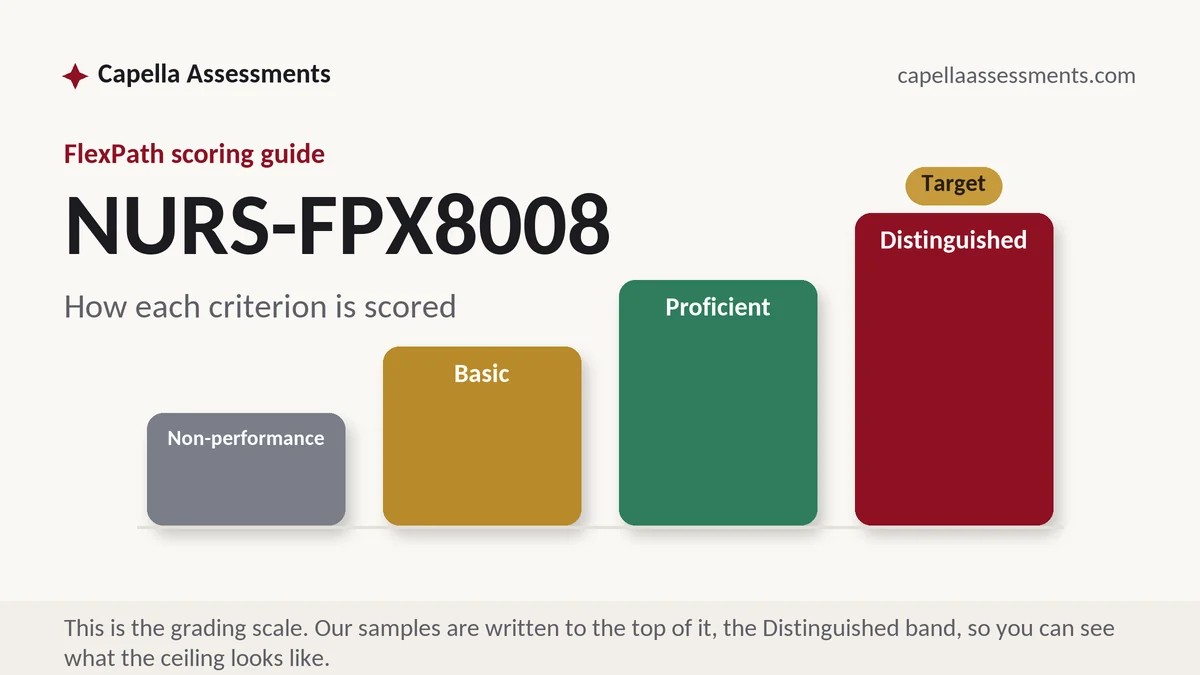
Assessment titles shift between courserooms, but NURS-FPX8008 criteria circle a consistent set of demands. You will be asked to define person-centered care with sources rather than sentiment, to analyze how a real or given setting falls short for a specific population, and to propose changes that operate at the level of process and policy. Scoring guides in this course lean hard on synthesis language: integrate evidence about preferences, culture, and equity into one coherent argument, not into parallel summaries. Many criteria also ask for an evaluation component, how you would know care became more person-centered, which pulls in measurement without turning the paper into a study. Read your own scoring guide closely; the Distinguished wording usually names the exact synthesis it wants.
Where students lose points in NURS-FPX8008
NURS-FPX8008 papers most often stall at the synthesis criterion. The learner assembles a respectable literature review, one paragraph per study on patient experience, another sequence on culture, and never merges them into a position about what this population needs; the scoring guide wanted practice evidence synthesized, and parallel summaries cap at Proficient or below. The second recurring loss is causal: satisfaction rose after a communication program, so the paper announces the program worked, when the data are associational and a doctoral reader expects that stated. Currency errors sting here too, since preference and equity evidence shifts quickly; citations past five years old for present-tense claims draw direct feedback. Each is avoidable with one disciplined revision pass.
The NURS-FPX8008 drawers
NURS-FPX8008 Assessment 1 breakdown analyzed for one population example
The first assessment typically analyzes where person-centeredness breaks down for a defined population, grounded in current experience and equity evidence. On request, free, 24-48h.
NURS-FPX8008 Assessment 2 process redesigned around preference example
Mid-sequence work usually turns analysis into design, a plan that rebuilds a process or policy around patient preference and culture. On request, free, 24-48h.
NURS-FPX8008 Assessment 3 policy argument with honest measurement example
The last assessment tends to synthesize the argument at policy and evaluation level, including how improvement would be measured honestly. On request, free, 24-48h.
Your courseroom shows something else?
Capella revises courses; assessment counts and titles shift between versions. Send what your courseroom shows and the desk matches it exactly.
Using a NURS-FPX8008 sample the right way
Use a NURS-FPX8008 sample to calibrate altitude before you outline. Notice how quickly it leaves the individual encounter for the system, and mark every sentence where separate evidence streams are argued together; those are the synthesis moves your criteria are grading. Check the verbs around outcomes, associated with, accompanied, linked, and borrow that discipline for your own claims. Then request a free custom sample written to the scoring guide in YOUR courseroom, with your population and setting in mind, delivered in 24-48h. It is a model to write beside, not from; the analysis you submit should carry your practice and your voice.
How these samples are written
Every sample in this drawer is written the same way our custom ones are: the scoring guide decoded criterion by criterion, a subject-matched writer drafting to the Distinguished column, APA checked line by line, and the reasoning annotated so the paper teaches while it shows. Capella revises scoring guides, so a custom request is always written to the guide in YOUR courseroom, never from a stale template.
NURS-FPX8008 questions, answered
Can I see a NURS-FPX8008 sample focused on a population like the one I serve?
The shelf samples deliberately vary their populations, so start with the drawer closest to your assessment. If none matches, that is what the free custom request is for: name your population, setting, and the scoring guide in your courseroom, and the sample is written around them in 24-48h, with the equity and preference evidence chosen for that group.
Patient satisfaction went up after our initiative. Can my NURS-FPX8008 paper say the initiative caused it?
Say it carefully or not at all. Satisfaction scores respond to staffing, season, case mix, and survey timing, so an uncontrolled before-and-after comparison supports association, not causation. Doctoral criteria reward the honest version: scores improved alongside the initiative, alternative explanations acknowledged, stronger evaluation proposed. Our samples model that exact phrasing, which reads as rigor to faculty rather than as hedging.
What exactly arrives when I request a free NURS-FPX8008 sample?
A complete sample paper written to the scoring guide you send: every criterion visibly addressed, current preference and equity evidence cited in APA 7, and the systems-level argument the course expects. First custom sample is free and typically lands in 24-48h. It is a study model, so plan to write your own assessment beside it rather than from it.