Each drawer below is one NURS-FPX9000 assessment. Where a sample is live, read it in full, true APA form with the reasoning annotated. Where it is not, request it free: send your assessment number and the scoring guide from your courseroom, and a custom sample written to your exact criteria arrives in 24 to 48 hours. Searches like "NURS FPX 9000 assessment 2 example", "NURS FPX 9000 sample paper", and "NURSFPX9000 sample" all land here, because this page is the drawer they belong in.
What NURS-FPX9000 is really about
NURS-FPX9000 opens Capella's five-course DNP project sequence, and everything you write in the next four courses inherits what you decide here. The course is about identification in the strict sense: finding a practice problem at your project site that is real, measurable, and small enough to change on a FlexPath doctoral timeline. That means gap analysis, not complaint. Strong papers show the distance between current practice and the evidence standard with data the site actually produces, then state the problem in one disciplined sentence a committee could approve. The temptation is to pick something worthy and enormous; the courseroom rewards something worthy and finishable. Faculty read these first documents as a forecast of the entire project.
Because this is a practicum-anchored course, one boundary matters and we hold it: samples cover the written layer only. Problem statements, gap analyses, evidence summaries, early charter language, those are documents, and documents can be modeled. Your practicum hours, logs, site conversations, and preceptor attestations are your own record, and no sample will draft, reconstruct, or estimate them. What the written layer can teach is considerable. A well-built NURS-FPX9000 paper shows how to cite site data without breaching confidentiality, how to connect a local gap to national evidence, and how to write a problem statement that will not need rescuing in NURS-FPX9010. Students who see that shape once tend to stop over-writing and start specifying.
What NURS-FPX9000’s assessments ask for
Deliverables vary by courseroom, so your scoring guide decides, but the arc is consistent in current courserooms. Early work typically orients: the practice problem named, the site context described within confidentiality limits, and the significance argued from data rather than passion. Middle work usually deepens the evidence case, an appraisal of the literature that supports both the existence of the gap and the plausibility of closing it. Later work tends to formalize: problem statement refined to committee standard, project direction sketched, and the groundwork laid for the proposal you will build in the next course. The criteria reward precision about scope, honest use of site data, and doctoral APA. What they quietly punish is any sentence that promises more project than five courses can hold.
Where students lose points in NURS-FPX9000
Two failures set students up to lose points for five straight courses, and both start in NURS-FPX9000. The first is a problem sized for a career instead of a project: reduce readmissions hospital-wide, fix burnout across a health system. Every criterion downstream, feasibility, measures, timeline, strains against that width until something tears. The second is writing the course as a standalone paper, polished in itself but pointing nowhere, so NURS-FPX9010 has to reinvent the problem instead of proposing against it. A third, quieter loss: a problem statement with no measurable term in it, which leaves nothing for an evaluation plan to count later. Distinguished work here reads like the first chapter of one project, not the only chapter of a small one.
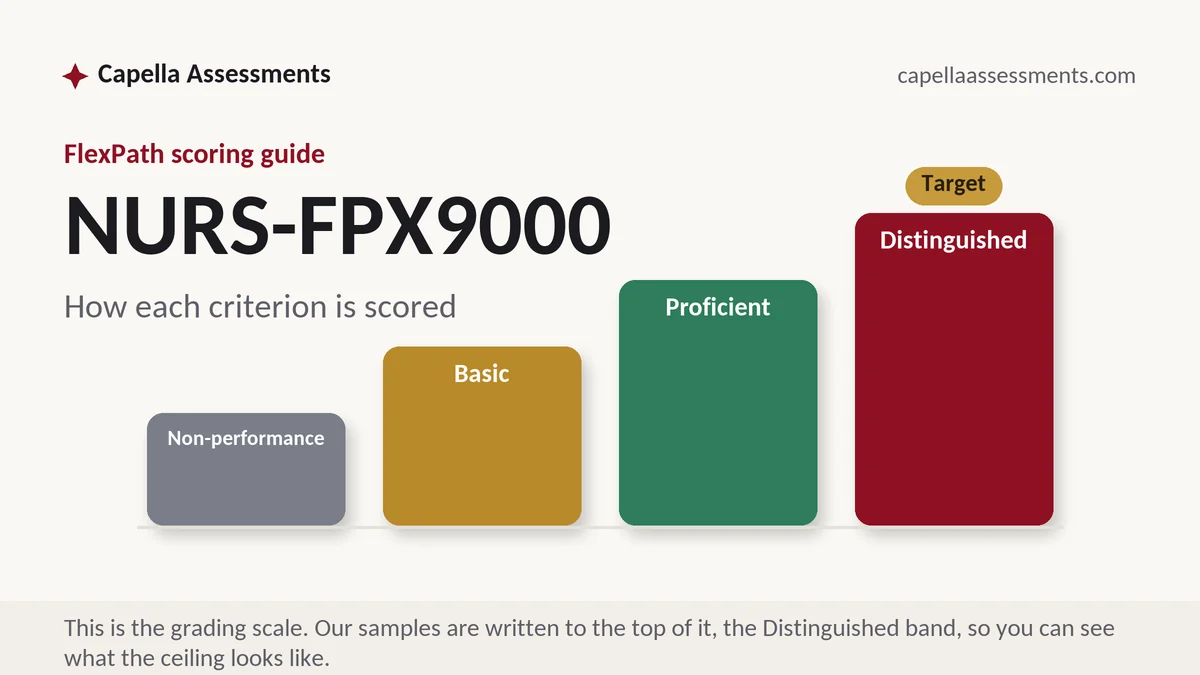
The NURS-FPX9000 drawers
NURS-FPX9000 Assessment 1 project and practicum interest form completed example
In current courserooms this assessment typically appears as "Project, Preceptor, and Practicum Interest Form (PPPIF)". A typical opening assessment introduces the project: one practice gap, its setting, and the case that it matters, grounded in numbers. On request, free, 24-48h.
NURS-FPX9000 Assessment 2 literature appraisal summary example
In current courserooms this assessment typically appears as "VCI Summary". Middle work in current courserooms usually appraises the literature, proving the gap is real and the fix is supported. On request, free, 24-48h.
NURS-FPX9000 Assessment 3 topic report with training evidenced example
In current courserooms this assessment typically appears as "Topic Report With CITI Training". The closing assessment typically locks direction: a problem statement at committee standard and the groundwork NURS-FPX9010 will build on. On request, free, 24-48h.
Your courseroom shows something else?
Capella revises courses; assessment counts and titles shift between versions. Send what your courseroom shows and the desk matches it exactly.
Using a NURS-FPX9000 sample the right way
Treat a NURS-FPX9000 sample as a sizing tool. The most useful thing it shows is proportion: how narrow a fundable, finishable DNP problem actually is on the page, and how much of the paper is data versus description. Map its structure against your scoring guide, notice how each criterion is answered where a reviewer can find it, then write your own problem from your own site's numbers. Nothing in a sample should migrate into your draft except the discipline. If your courseroom's guide reads differently, send it over; the first custom sample is free and written to the scoring guide in YOUR courseroom.
How these samples are written
Samples here follow one discipline: the scoring guide is the outline, every criterion gets its section, the Distinguished description decides the depth, and the APA layer ships exact. Because Capella updates courses over time, your free custom sample is drafted against the scoring guide you send, not against an archive.
NURS-FPX9000 questions, answered
Can I see a NURS-FPX9000 problem statement example before I commit my project direction?
Yes. Ask for a sample built around a problem type near yours, falls, readmissions, screening compliance, staff education, and read how it is bounded before you lock your own. The first custom sample is free, arrives in 24-48h, and is written to the scoring guide you send from your courseroom. Committing after seeing one usually saves a resubmission.
Do NURS-FPX9000 papers need to set up the later DNP courses, or is each course graded on its own?
Each course grades its own scoring guide, but the project is one continuous build. A problem identified loosely here forces rework in every later phase, because the proposal, implementation, and evaluation all reference this document. Write NURS-FPX9000 as the foundation it is: graded alone, load-bearing for four more courses. Samples in this drawer are written with that continuity visible.
Should my NURS-FPX9000 problem statement already mention numbers, or do measures come later in the sequence?
Put a measurable term in now. The evaluation you will design two courses from here can only compare against what gets counted from the start, and problem statements without a number are the most common source of missing baselines later. Samples in this drawer show the measure named inside the problem statement itself. If yours resists measurement, that is worth solving before you propose anything.