Each drawer below is one NURS-FPX9020 assessment. Where a sample is live, read it in full, true APA form with the reasoning annotated. Where it is not, request it free: send your assessment number and the scoring guide from your courseroom, and a custom sample written to your exact criteria arrives in 24 to 48 hours. Searches like "NURS FPX 9020 assessment 2 example", "NURS FPX 9020 sample paper", and "NURSFPX9020 sample" all land here, because this page is the drawer they belong in.
What NURS-FPX9020 is really about
NURS-FPX9020 changes the writer's job. Through two courses you argued what should happen; now the FlexPath courseroom wants an accurate account of what is happening. The genre becomes the implementation report: intervention launched as proposed, participation and fidelity tracked, obstacles named while they are still being managed. Honesty is the skill being graded. A site that trains slower than planned, a champion who rotates off the unit, a data pull that arrives late, these are not failures to hide but variances to document, explain, and answer with an adjustment. Faculty know real projects wobble. What separates Distinguished work is a written record precise enough that the wobble, the response, and the effect on timeline are all traceable.
The course also tests whether your project is still one project. By the third course in the sequence, the proposal is a standing contract, and every implementation report gets read against it. Strong papers quote their own plan, then report against it: the measure defined in NURS-FPX9010 is the measure being collected, the timeline being tracked is the one that was approved, and any change is framed as a documented amendment rather than a silent rewrite. Where a change model genuinely drives the work, Kotter is the one current courserooms most often center, and citing it to the primary source costs nothing. The writing stays lean, present tense where the project is live, and anchored to dates.
What NURS-FPX9020’s assessments ask for
Assessments here typically track the live phase of the project, though your scoring guide decides the exact deliverables. Early work often documents launch: the intervention started as approved, roles active, baseline in hand from the planning phase. Middle work usually reports progress, fidelity to the protocol, participation numbers, variances with their causes and corrections, and the state of data collection. Later work tends to close the phase, summarizing what was delivered against what was proposed and readying the dataset for evaluation. One boundary runs through all of it: samples model these written reports only, while practicum hours, logs, and preceptor attestations remain your own record, never drafted by anyone else. The criteria consistently reward specificity, dates, counts, and named responsibilities over enthusiasm.
Where students lose points in NURS-FPX9020
NURS-FPX9020 has a signature failure: the report that reintroduces the project instead of reporting on it. Students spend two pages re-arguing the problem statement they already defended twice, run out of room, and give implementation itself a paragraph. Faculty grade what the criteria ask for, and the criteria here ask what happened. A second pattern is unlogged drift: the intervention quietly gains a component mid-phase, a huddle here, an extra form there, and the report never reconciles the addition with the approved proposal, which turns helpful energy into a fidelity problem. A third is reporting activity without numbers, sessions held but not counted, staff trained but not totaled, leaving the evaluation course a dataset that exists only as adjectives.
The NURS-FPX9020 drawers
NURS-FPX9020 Assessment 1 launch recorded against the approved plan example
Launch is the typical first deliverable: the intervention started as approved, roles active, baseline and timeline confirmed in writing. On request, free, 24-48h.
NURS-FPX9020 Assessment 2 status report with drift and correction example
Middle assessments in current courserooms usually carry the status reports: what ran, what drifted, what was corrected, with counts attached. On request, free, 24-48h.
NURS-FPX9020 Assessment 3 phase closed and the dataset readied example
A typical closing assessment squares the finished phase with the approved plan and readies the dataset the next course will judge. On request, free, 24-48h.
Your courseroom shows something else?
Capella revises courses; assessment counts and titles shift between versions. Send what your courseroom shows and the desk matches it exactly.
Using a NURS-FPX9020 sample the right way
Use a NURS-FPX9020 sample to calibrate proportion and tone. Notice how little space the background takes, one tight paragraph pointing back to the proposal, and how much space goes to counts, dates, variances, and corrections. Notice the tense discipline: plans in past tense, live work in present. Then draft your own report from your project's actual tracking, and check each scoring guide criterion against a specific sentence. If your courseroom's deliverable differs from the shelf copy, request a free custom sample; it arrives in 24-48h, written to the scoring guide in YOUR courseroom.
How these samples are written
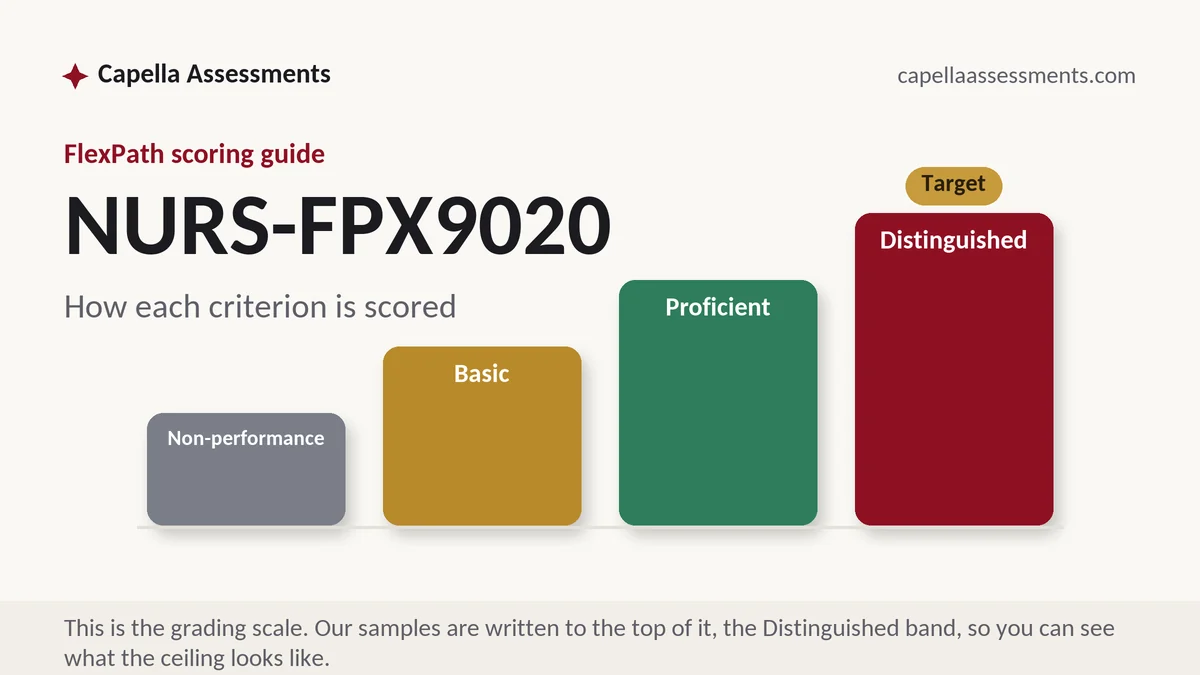
Every sample in this drawer is written the same way our custom ones are: the scoring guide decoded criterion by criterion, a subject-matched writer drafting to the Distinguished column, APA checked line by line, and the reasoning annotated so the paper teaches while it shows. Capella revises scoring guides, so a custom request is always written to the guide in YOUR courseroom, never from a stale template.
NURS-FPX9020 questions, answered
My NURS-FPX9020 report keeps repeating my problem statement. How do the samples handle background without restating everything?
They compress it to a pointer: one paragraph that names the problem, cites the approved proposal, and moves on. The sequence already contains your argument; this course wants your account. In the samples, background stays to one short section, which frees the criteria that actually score here, fidelity, variance, and progress, to get real space.
We added an extra component to the intervention mid-project. Will that hurt my NURS-FPX9020 submissions?
Not if you document it as an amendment. Report the change, the date, the reason, and its expected effect on your measures, then keep tracking both the original protocol and the addition. What costs points is silent drift, where the report describes a project the proposal never approved. A sample can show amendment language done cleanly; ask for one matched to your situation.
How fast can I get a NURS-FPX9020 implementation report sample for my scoring guide?
Within 24-48h of sending the scoring guide and instructions from your courseroom, and the first custom sample is free. Include your project type and where the phase stands, launch, mid-phase, or closeout, so the report models the right moment. Shelf samples are available immediately if you just need to see the genre before drafting.